Attribution Models for Traffic Arriving From AI Referrals
Track which AI platforms your analytics can actually see, and why that gap costs you budget.
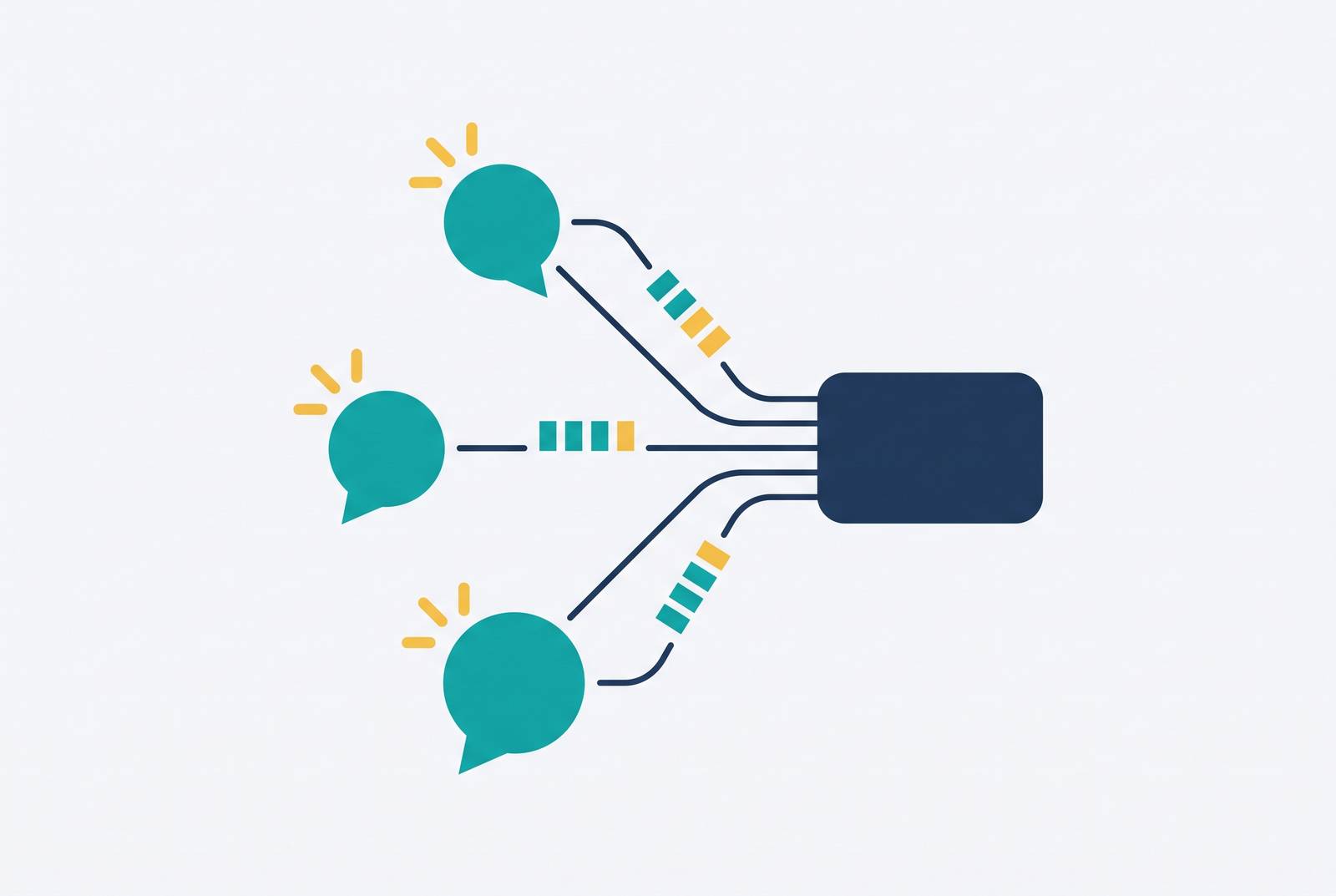
Attribution for AI-sourced traffic fails before a session even gets logged, because the HTTP referrer header that GA4 depends on is often stripped or absent by design, not by a tracking oversight. When someone clicks a link inside a ChatGPT response, a Claude answer, or a Perplexity citation, the browser frequently sends no referrer data to the destination site. GA4 has no way to make sense of that gap, so it logs the session as Direct: no source, no medium, no channel, nothing to tie the visit back to the AI platform that sent it.
The stripping isn't consistent across platforms, which makes the problem harder to patch with one fix. Ziptie's attribution framework documents that ChatGPT's paid accounts send no referrer data at all, so even the highest-intent users on that tier land in GA4 as "Direct / (none)." Perplexity behaves differently: it generally passes perplexity.ai as a referrer, reliably on desktop web, though far less reliably on mobile. Google AI Overviews sit at the far end of the spectrum, producing no distinguishable AI signal whatsoever. Clicks from an AI Overview look identical to a standard Google organic click, with nothing in the data to separate the two.
Timing adds another layer of distortion. ChatGPT started passing utm_source=chatgpt.com on citation links when ChatGPT Search launched in October 2024, and it widened that UTM tagging to cover "More sources" links on June 13, 2025. Any historical analysis run on data from before that window carries a built-in undercount of ChatGPT-sourced sessions, since the platform simply wasn't tagging most of its outbound clicks.
Device and account type compound all of this further. ChatGPT's mobile app strips referrer headers entirely, while the desktop web version passes only the origin rather than the full referrer path. Paid-tier inline links on desktop strip referrers too, via rel=noreferrer. The result: the same platform produces different attribution outcomes depending on whether someone reached it through the app, the free desktop interface, or a paid account, with no consistent signal connecting those three experiences back to a single source.
What misattributed AI traffic costs a marketing team
Letting AI-referred sessions collapse into Direct does more than make the channel report inaccurate. It misprices the content and citation work that earned those visits in the first place, and it corrupts last-click models by routing conversion credit to whatever channel happened to close the deal, usually branded search, rather than the channel that opened it.
The pattern plays out predictably in a last-click setup. A prospect asks ChatGPT for the best B2B attribution tools, reads a cited blog post, leaves the site, comes back three weeks later through a branded Google search, and converts. Last-click attribution hands all the credit to that branded search. The AI touchpoint that started the entire journey never appears anywhere in the model.
B2B SaaS companies feel this acutely because their sales cycles run long. A 90-day gap between an AI-influenced first touch and an eventual conversion is common, and a standard 30-day lookback window drops the originating session before it can ever be counted. The data is structurally incapable of seeing the touchpoint that mattered most.
The same research documenting these gaps also shows that AI-referred visitors convert at much higher rates than visitors who come from traditional organic search. That pairing is what makes the miscount expensive: the channel most consistently buried inside Direct is also the one generating the best-converting traffic a team has. If a marketing team builds next quarter's budget off a Direct channel that quietly contains a growing share of these high-converting AI sessions, it will chronically underfund the content and citation work that generates them. That's the decision failure sitting inside plenty of QBR slides right now: a line item labeled "Direct, flat quarter over quarter" that's actually masking the fastest-growing, highest-value channel in the account.
AI platforms and referrer data
Building any attribution layer starts with knowing which platforms can even be identified in the first place, because the approach for Perplexity looks nothing like the approach for ChatGPT, and the approach for Google AI Overviews looks nothing like either one.
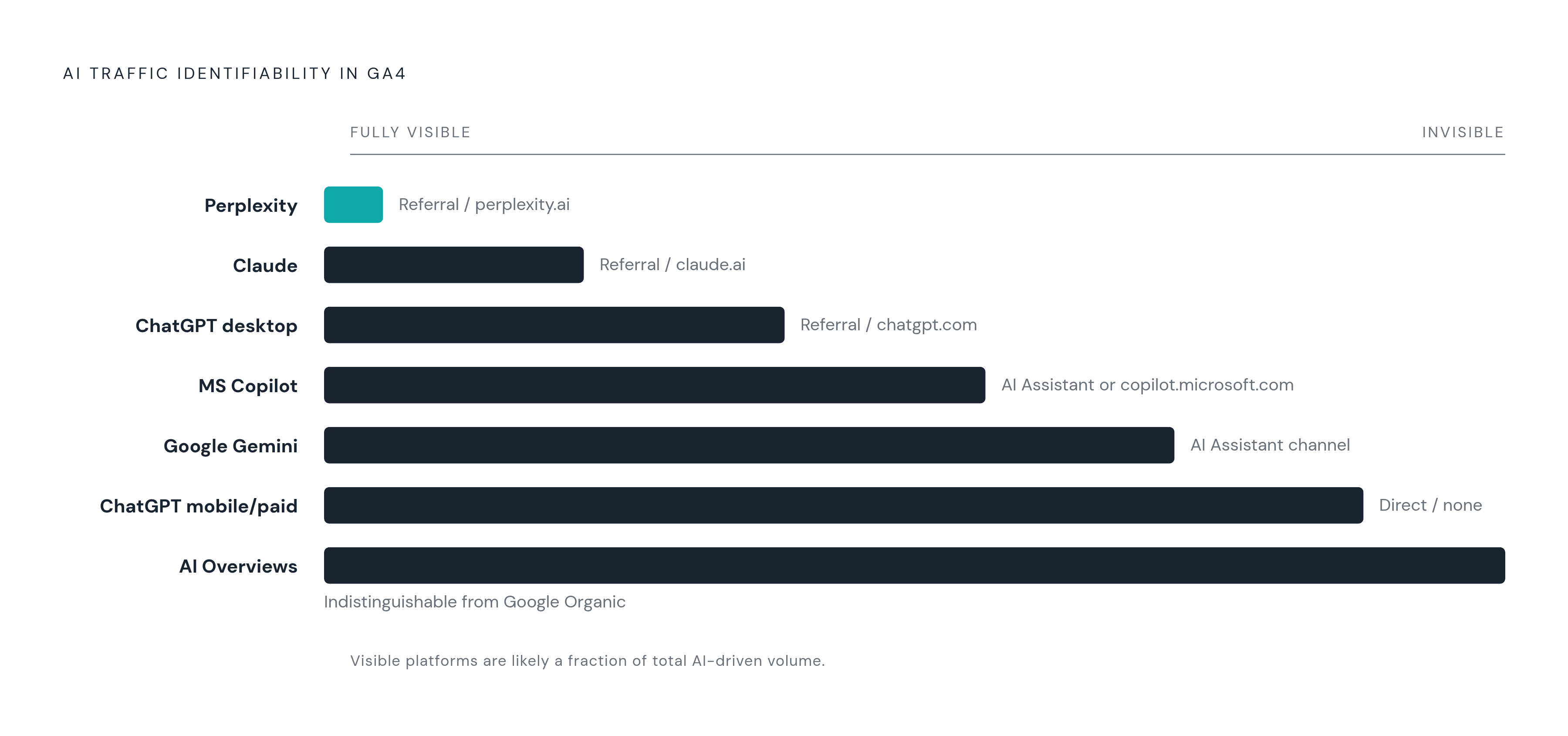
Separate 2026 guides from Ziptie and Yotpo lay out how each major platform behaves inside GA4. ChatGPT, when accessed through its mobile app or a paid account, shows up as Direct or "(not set)," since no referrer is passed. Perplexity shows up as Referral from perplexity.ai, making it the most consistently identifiable of the major AI platforms. GA4 logs clicks from Google AI Overviews as Organic, indistinguishable from a standard Google search click, so the platform yields no AI-specific signal. Google Gemini shows up in GA4's native AI Assistant channel (a category GA4 added in May 2026), and you can identify it through its referrer domain. Microsoft Copilot shows up as AI Assistant, or as Referral in older GA4 setups, through copilot.microsoft.com. Claude shows up as Referral from claude.ai when accessed through its browser-based web interface, but the Claude desktop app passes no referrer and shows up as Direct instead.
The practical upshot: even without any custom configuration, a team can already surface Perplexity traffic, desktop ChatGPT traffic from after June 2025, Copilot traffic, and Claude web traffic just by filtering GA4 for those domains. Mobile ChatGPT, paid ChatGPT accounts, Gemini, and AI Overviews stay invisible under that same filter. Yotpo's guide and Ziptie's framework both point out that the identifiable share is almost certainly a fraction of the AI traffic actually hitting a site, since the platforms that report themselves cleanly tend to make up the smaller slice of total AI-driven volume.
The list of platforms to track keeps growing, too. Trakkr's AI Search Traffic Index, tracking referrals across 5,439 anonymized GA4 properties, recorded 109.4% growth in you.com traffic over a 30-day period, and several current GA4 guides now include you.com in their recommended AI referral regex patterns alongside the platforms listed above. Whatever channel grouping you build today needs room so you can add new domains as new AI search interfaces gain traction.
Building a custom AI channel group in GA4 as the first attribution layer
A custom GA4 channel group built on a regex match against known AI domains is the fastest way to pull the identifiable share of AI traffic out of Direct, and setting one up takes minutes.
GA4 doesn't ship with a native AI channel. The default channel group has no category for chatgpt.com, perplexity.ai, claude.ai, or copilot.microsoft.com, so without intervention, all of that traffic either falls into Direct or gets scattered across Referral depending on how the session happened to arrive. Yotpo's 2026 technical guide documents the fix: build a new custom channel group rather than editing the default one, add a channel definition using a regex condition on Session Source that matches the known AI domains, and give it a name that will still make sense in a year, something like "AI Traffic (2026)." That naming convention matters because the regex itself will need regular updates as new platforms show up.
The regex should cover chatgpt.com, chat.openai.com, perplexity.ai, claude.ai, copilot.microsoft.com, and you.com at minimum, along with any other AI search interface a brand's audience actually uses. Treat that list as something to review quarterly, not something to set once and forget. In GA4, this means going into Admin, then Data display, then Channel groups, and building the custom group there rather than touching the platform's default definitions.
Once the group is live, the most useful report it unlocks is landing-page-by-source. It shows exactly which pages AI platforms are citing and which pages they're ignoring, which turns into a direct, page-level read on what content is earning AI citations and what content AI engines never surface.
This layer has clear limits worth stating plainly. It surfaces Perplexity, desktop ChatGPT traffic carrying UTM parameters, Copilot, and Claude web. It does not surface mobile ChatGPT, paid ChatGPT accounts, Gemini, or AI Overviews. Closing that second gap requires a different kind of method.
Using proxy signals to estimate the AI traffic that referrer headers cannot reveal
Google AI Overviews, mobile ChatGPT, and paid ChatGPT accounts produce no referrer signal at all, so no amount of channel-group tuning in GA4 will ever surface them directly. Estimating their contribution means turning to proxy signals instead: brand search lift, anomalous Direct traffic on commercial pages, and self-reported attribution from customers themselves.
The first proxy looks at Direct traffic landing on deep URLs. Ziptie's framework describes isolating GA4 sessions classified as Direct that land specifically on pricing pages, product pages, or other deep service pages, the kind of pages nobody reaches by typing a URL from memory or clicking a browser bookmark. A sustained rise in Direct sessions that hit those exact pages gives you the strongest available proxy for AI referrals that arrived with no referrer attached.
The second proxy tracks brand search lift. When an AI platform recommends a brand by name, a meaningful share of users open a new tab and search for that brand on Google directly instead of clicking the link the AI platform offered. That behavior is logged in GA4 as Google organic branded search, with nothing connecting it back to the AI mention that actually prompted it. If you watch branded search volume over time against known AI citation activity, you can detect AI-driven demand that never registers as a referral.
The third proxy is simpler and slower to collect: post-conversion surveys asking customers how they first heard about a company. These surveys consistently turn up mentions of AI platforms that no analytics tool had caught. The volume tends to be low, but the signal is strong enough to validate whether the other two proxies are pointed in the right direction.
AuthorityTech documents a multiplier model built from these proxies: for every AI referral session a team can actually detect, roughly 2.5 additional sessions arrive misattributed as Direct. That ratio gives teams a way to turn a measured baseline into a corrected estimate of total AI-driven traffic. None of these three methods produces an exact count, and none should be treated as one. What they produce is a directional read, which is still a meaningful improvement over a Direct channel that offers no read on AI traffic.
Attribution models need reconfiguration, not just better data collection
Correctly identifying an AI referral session doesn't automatically mean a standard attribution model will value it correctly. AI touchpoints tend to arrive at the start of long customer journeys rather than at the moment of conversion, and most attribution models are built to reward whatever touchpoint comes last.
Ziptie's framework lays out the structural mismatch directly: a prospect discovers a brand through an AI recommendation, reads a piece of content, leaves the site, and returns weeks later through a branded search before converting. A last-click model gives all the credit to that final branded search and none to the AI referral that started the journey. Fixing the data collection problem from the earlier sections doesn't fix this on its own, since the model itself still only knows how to reward the final click.
Ziptie's recommended configuration splits by how the session was identified. For AI referrals confirmed directly, GA4's data-driven attribution, built on a Shapley value model, distributes credit across the full journey. For AI sessions identified only through proxy signals, a position-based (U-shaped) model works better, since it assigns meaningful first-touch weight to the earliest interaction in the journey, the interaction most likely to be the AI referral itself.
The lookback window needs to change too. A standard 30-day window drops the AI first touch in most B2B sales cycles before it can ever register, so Ziptie's framework calls for extending that window substantially to catch conversions that arrive well after the AI-influenced first visit.
One diagnostic ties the whole argument together: watch for an "excess conversion rate" inside the Direct channel. If Direct traffic converts at a rate far higher than plain direct-navigation intent would explain, that's a sign high-converting AI sessions are hiding inside it. When you see that signal, reconfigure the model before anyone uses the Direct channel's numbers to make a budget call.
Upstream citation monitoring as the fourth layer, measuring AI visibility before clicks happen
Everything above measures traffic after a click has already happened. The fourth layer moves upstream of the click entirely, tracking whether AI platforms are citing a brand in the first place, regardless of whether the user who saw that citation ever followed it to the site.
This matters because a referrer header, by definition, can only exist after someone clicks. A citation that an AI platform shows to a user who never clicks through generates no session, no referrer, and no trace in GA4 at all, even though it may have shaped that user's perception of the brand or influenced a purchase decision weeks later through an entirely different, unconnected visit. Monitoring tools built for this purpose track citation and mention rates directly: whether ChatGPT, Claude, Gemini, and Perplexity name a brand in response to a given query, where that brand ranks relative to competitors, and how that ranking shifts over time. Microsoft's own Bing Webmaster Blog notes that citation data it surfaces represents only a sample of overall citation activity, a reminder that even upstream monitoring tools carry their own margins and should be read the same way the proxy signals in an earlier section ought to be: directionally, not as an exact count.
Letterstory is one platform built around this kind of upstream tracking, and it measures whether a brand is named and cited across AI platforms as its own signal, apart from whatever GA4 referrer data happens to arrive afterward. Treated as a fourth layer alongside a custom channel group, proxy signals, and a reconfigured attribution model, citation monitoring closes the part of the picture that clicks were never going to reveal. A brand cited prominently by Perplexity but ignored by Gemini learns something concrete about where its content strategy is working and where it isn't directly from citation monitoring, well before a GA4 report could reveal that gap, if it ever did.