Share of Voice Measurement in AI-Generated Answers
Brands now need to track visibility inside AI chatbots, not just Google rankings.

If you ask ChatGPT today which vendor fits a need, you then check the answer in Perplexity, and you never click a single blue link in Google. That pattern is now common enough to make keyword rankings an incomplete measure of where a brand actually stands. Forrester's Buyers' Journey Survey found that most B2B buyers used AI tools during a recent purchase, and more than half of them checked out vendors inside those tools before they contacted a supplier. G2's Answer Economy report found that about half of B2B software buyers now start vendor research in an AI chatbot, more often than in Google. The consequence for anyone tracking visibility is structural: a brand's organic traffic can hold steady for months while the brand is completely absent from the AI-generated answers steering those same purchase decisions, because the two signals have come apart and no longer move together.
AI share of voice measures a different surface than traditional SOV.
AI share of voice looks at a defined set of prompts and asks what percentage of the AI-generated responses mention a given brand. It is calculated as a simple ratio: responses mentioning the brand, divided by total responses analyzed, multiplied by 100. That formula looks familiar to anyone who has tracked share of voice in paid media or organic search, but it describes a different surface.
| Channel | What it measures | Data source | Volatility | |---|---|---|---| | Traditional SOV | Rank position, impression share, media mentions | SERPs, ad networks, press coverage | Relatively stable, slow-moving | | AI SOV | Mention and citation rate inside generated answers | ChatGPT, Perplexity, Gemini, Claude, AI Overviews | Probabilistic, changes run to run |
The mechanism behind each is where the real divergence sits. Most AI answer engines run on retrieval-augmented generation: the system retrieves a set of relevant documents, then synthesizes a response that draws on and cites a subset of them. A brand needs to show up credibly in that retrieved corpus, not just hold backlink authority, so a page can be ranked position one in Google and still get a near-zero AI SOV. Because large language models sample probabilistically, the same prompt run twice can return two different sets of brands. AI SOV is a directional signal built from repeated sampling over time, not a single fixed readout.
The five-metric stack that makes AI SOV actionable
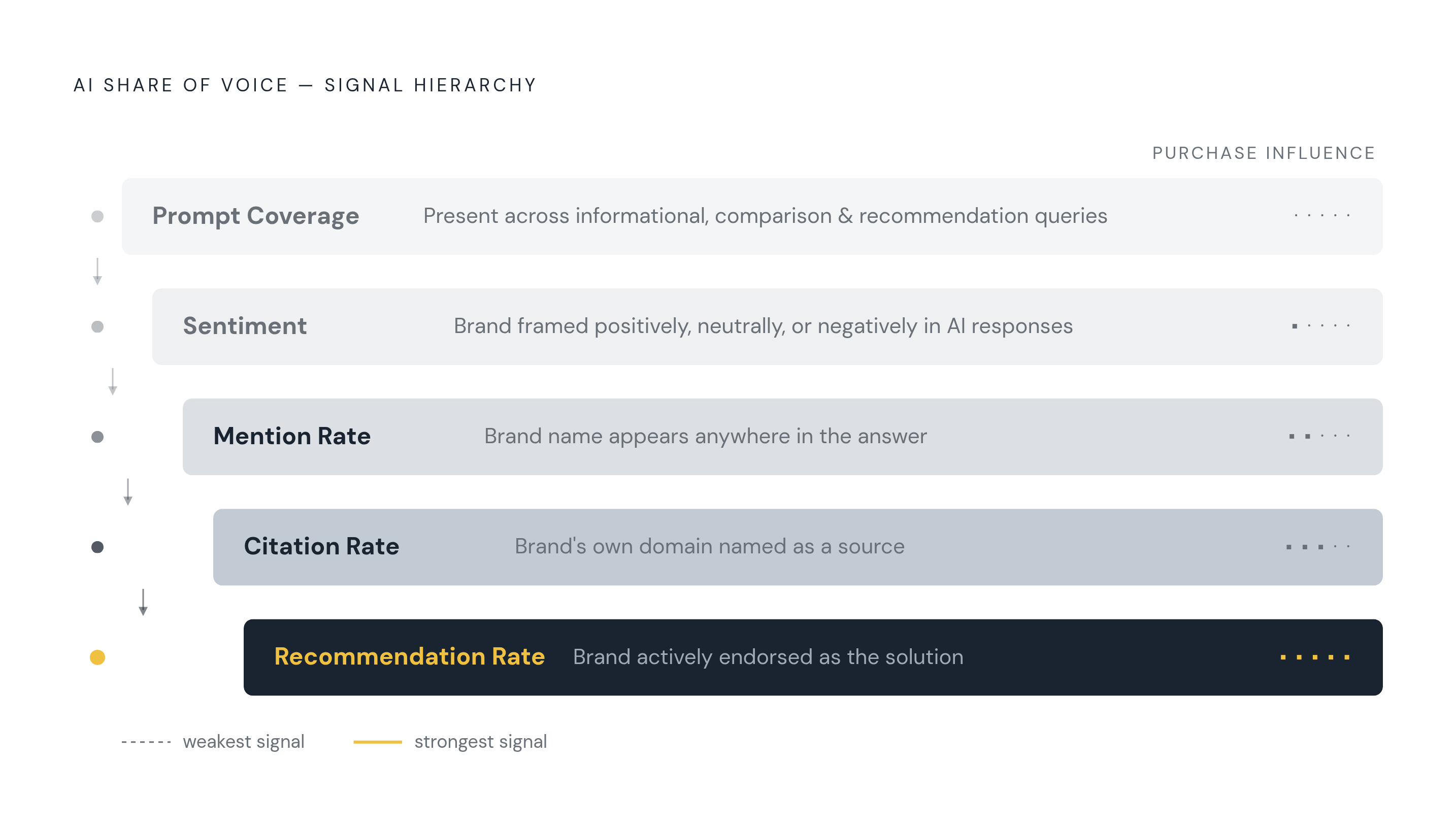
A single AI SOV percentage tells a team that it is present in some share of answers and absent from the rest, and that is nearly all it tells them. The number becomes useful only once it is broken into five component metrics: mention rate, citation rate, recommendation rate, sentiment, and prompt coverage.
Mention rate is the base layer and also the weakest signal on its own: the brand's name appears somewhere in the answer, but a brand can be named in passing inside an answer built almost entirely from a competitor's content. Citation rate is harder won: the brand's own domain or published material is the thing the model names or links as a source, which marks a genuine foothold in the corpus the model is drawing from. Recommendation rate goes a step further: it captures when a brand is actively endorsed as the solution, not just listed among options, and that puts it closest to actual purchase influence. Sentiment records whether the brand is framed well, neutrally, or poorly when it shows up, because a brand named only to be dismissed still adds to a raw mention-rate number that looks healthy on a dashboard. Prompt coverage tracks whether a brand shows up across the full range of query types buyers use, so if a brand does well on informational prompts but goes missing on comparison and recommendation prompts, it has a gap right at the conversion stage.
Branded, category, and competitor prompts measure different things, and treating them as one undifferentiated pool produces a misleading figure. A brand might score a strong SOV on prompts that already include its own name (branded prompts), but look mediocre on broader category prompts where it has to compete for attention, and then disappear almost entirely on prompts that name a competitor directly. If you blend those three realities into a single number, you get a tidy, misleading figure. Any benchmark range circulating for a "healthy" AI SOV percentage should be read as a rough orientation point, not a fixed target, since the right number varies by category, by engine, and by how crowded the competitive set is.
How to build and run the prompt set that feeds the calculation
The single most common mistake in AI SOV measurement is failing to lock the prompt library before starting to track trends. Prompts must stay fixed across runs, because if you change them mid-cycle, you restart the baseline and make week-over-week or month-over-month comparison meaningless.
Building that library starts with recognizing that prompts are not keywords. A prompt is a conversational query that reflects how a real buyer actually talks to a response engine, not a search term you optimize for a results page. A workable prompt universe spans three intent types: informational prompts ("what is the best tool for X"), comparison prompts ("X vs. Y"), and recommendation prompts ("recommend a tool for Z"). Keeping these three buckets separate in reporting, rather than folding them into one undifferentiated set, is what lets a team see where it actually stands at each stage of a buyer's research.
Running the set matters as much as building it. Because large language models sample from a probability distribution at every token, the same exact prompt can return different brand sets on back-to-back runs. The fix is repetition: run each prompt multiple times and average the results, producing a stabilized mention rate that is the right input for the SOV formula. For each execution, record whether the brand appeared, where it appeared in the answer, how it was framed (recommended, mentioned, compared, or dismissed), and which sources the model cited to back up the mention. Competitor tracking rides along for free: run the identical prompt set and log citation counts for each named competitor alongside the brand's own, so every number has a comparison point built in from the start.
AI SOV Is Not One Number Across Engines
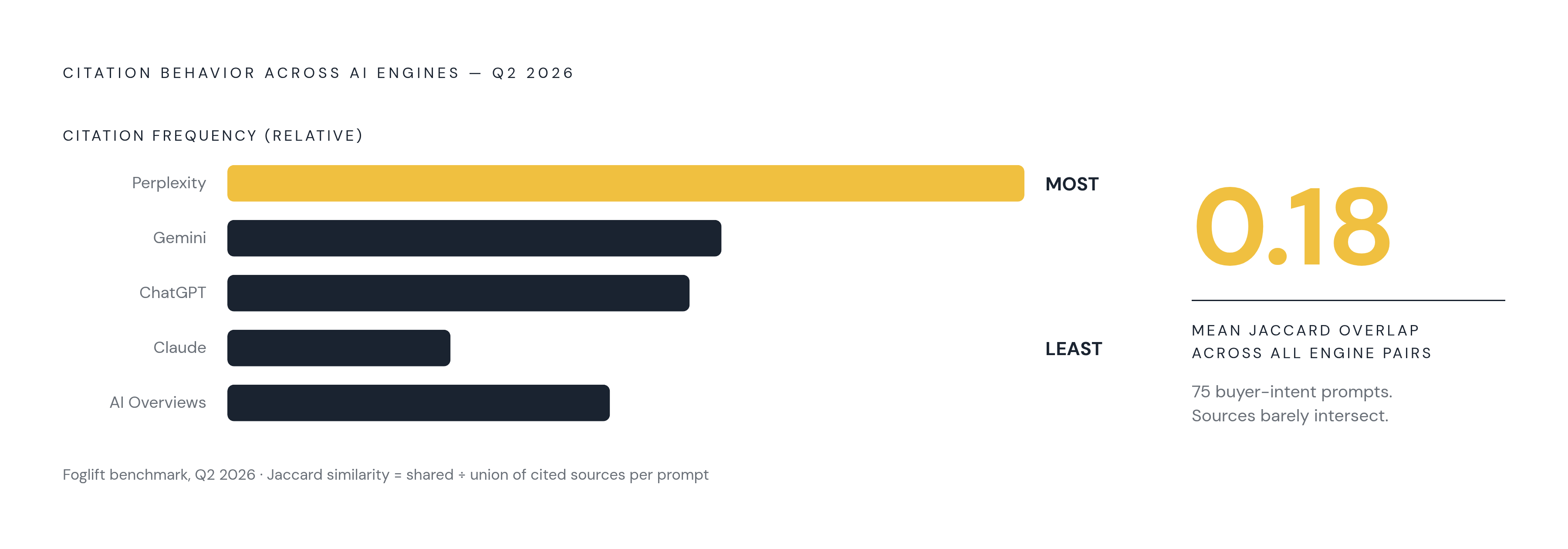
Averaging AI SOV across ChatGPT, Perplexity, Gemini, Claude, and AI Overviews into a single figure produces a number that is accurate on average and wrong wherever a team needs to act on it. The engines do not draw from the same sources, do not weigh them the same way, and do not cite at comparable rates.
The scale of that divergence is larger than most teams expect. Foglift's Q2 2026 benchmark, run across 75 buyer-intent prompts, found a mean cross-engine citation overlap of just 0.18 by Jaccard similarity, so the sources different engines cite for the same questions barely intersect. Citation behavior also differs by platform in a consistent, structural way: Claude cites noticeably less often than Perplexity across matched brand and query sets, while still citing more often than ChatGPT and Gemini. Layered on top of that is a traffic attribution problem. A high citation rate on one engine does not translate proportionally into referral traffic, because most AI citations carry no clickable link at all, so a brand can be cited constantly on a given engine and still show up as nearly invisible in GA4.
The practical response to all of this is to report each engine separately, ChatGPT, Perplexity, Gemini, Claude, and AI Overviews, before producing any blended rollup number. A rollup is a summary of where things stand overall, but it is not a diagnosis of where the problem sits. Knowing that a brand's SOV lags specifically on Gemini, or that it is cited well on Perplexity but barely named on ChatGPT, tells a team where to spend optimization effort.
What the measurement infrastructure needs to look like
The analytics stack built for traditional search cannot answer the questions AI SOV requires, because the signals that matter here, mention rate, citation rate, sentiment, AI Overview presence, are largely invisible to tools built around clicks. The real test for any measurement setup is whether it can answer four plain questions: is the brand being cited, on which engines, by how much relative to named competitors, and is that trend moving up or down.
GA4 can only capture AI referral traffic under a narrow condition: an engine has to include a clickable source link, and a user has to actually follow it. Most AI-influenced research behavior appears in GA4 as plain Direct traffic rather than as a clean, attributable referral source, so a standard analytics report misses a large share of AI-driven visibility. Traditional rank trackers have the same blind spot from a different angle: they are built to measure position on a search engine results page, and they do not parse a generated answer for brand mentions, citation frequency, or how the brand is framed.
Purpose-built GEO monitoring tools close that gap by design. They define a query set, run it across multiple engines, parse the resulting answers for brand mentions and source citations, track frequency and sentiment over time, and benchmark the results against named competitors answering the same queries. When evaluating a tool, the criteria that matter are multi-engine coverage across ChatGPT, Gemini, Perplexity, Claude, and AI Overviews, a genuine competitive benchmarking capability, a per-prompt and per-engine breakdown rather than one blended score, and API access for teams that need the data flowing into their own dashboards. A manual spot-check across a handful of prompts can give you a rough one-time baseline, but it cannot sustain the prompt volume or repeated sampling that reliable trend data demands, so some form of automated, recurring measurement is the only workable approach for ongoing reporting.
Producing Content That Drives Citation Rate at Scale
Raising AI SOV depends on content built for citation from the first draft, not content retrofitted for it after the fact. Producing that content at the volume a real prompt library demands, without letting quality slide, is a pipeline design question rather than a question of how much a team can crank out.
A few concrete signals raise citation rates in practice. Leading AEO practitioners in 2026 have converged on authoring standards that put a direct answer in the opening sentence of a page, use question-based headers that mirror how buyers actually phrase prompts, and write paragraphs as standalone units a model can extract cleanly without needing the surrounding context. Citing authoritative sources inside the content itself also helps: the Princeton GEO-bench study found that adding citations produced a meaningful lift in visibility, though a 2026 replication found no positive pooled gain from citation edits once content volume was controlled for, a reminder that the effect is real but not unconditional. Placement on the page matters too: a large share of all AI citations draw from the opening portion of a page, and material buried near the very end is rarely cited at all, though the closing third of a page still captures a meaningful share of citations overall, so the middle of a long page is where attention tends to drop off hardest.
The brand's own website remains the single largest citation surface available, the number-one source an AI engine cites when it can read the site directly, but owning that surface alone will not get you there. The production model that holds up at scale pairs AI drafting with mandatory human review: AI contributes structure, coverage, and raw output volume, and human editors supply the accuracy, the brand voice, and the original thinking that gives a piece of content something worth citing. If you push out bulk AI output without that editorial layer, you get a liability, not a shortcut, because inaccurate or generic material will not earn citations and can drag down sentiment scores once a model does notice the brand. The 2026 approach to planning that content inverts the traditional keyword-first workflow: research what AI platforms currently answer for the queries that matter to the brand, find the gaps or outright inaccuracies in those answers, and build content that fills those specific gaps, rather than starting from a keyword-volume report and working backward.
How to read AI SOV data and turn it into a prioritized action list
A completed round of measurement produces a stack of numbers: mention rate, citation rate, recommendation rate, sentiment, and prompt coverage, broken out by engine and by prompt type. Reading that data well means treating each layer as a diagnostic, because each one points to a different cause.
Start with prompt coverage, because it shows you where in the buyer's research journey a brand is going missing. A brand strong on informational prompts but absent from comparison and recommendation prompts has a gap sitting right before the purchase decision gets made, which argues for content that directly answers "X vs. Y" and "recommend a tool for Z" style queries before anything else. Next, look at the gap between mention rate and citation rate. If a brand is mentioned often but rarely cited, it is showing up in answers built on someone else's content, so the brand's own site is not yet serving as a usable source for the model, which points back to the authoring standards and citation-worthy content discussed above. Sentiment data flags where a presence is working against the brand: a dismissive or neutral framing inside an otherwise healthy mention rate needs better-substantiated content, a different fix than low visibility requires.
The per-engine breakdown then decides where to spend effort first. A brand cited well on Perplexity but nearly invisible on Gemini faces two separate problems, shaped by how each engine retrieves and weighs sources, and the fix for each should be scoped and tracked separately. Competitive context sets the final priority order: a mention rate that looks alarming next to a dominant category leader may be a modest, closeable gap if that leader is only a few points ahead, while a smaller-looking gap against a less entrenched competitor can represent the faster win. Run the same locked prompt set on a fixed schedule, track the five metrics by engine over time, and let the movement in those numbers, not the single headline percentage, decide what the team builds next.