Thought Leadership Content Formats That AI Engines Cite
Listicles and data-driven formats dramatically boost your odds of being cited by AI engines.
Thought Leadership Content Formats That AI Engines Cite.
Why AI citations have become the new shortlist moment for B2B buyers
Forrester's Buyers' Journey Survey, which polled roughly 18,000 business buyers, found that 94% used AI at some point during their most recent purchase Forrester 2026 Buyers' Journey Survey digitalapplied.com Everything-PR Research. That means the shortlist now forms inside an answer box, not on a search results page Forrester 2026 Buyers' Journey Survey digitalapplied.com Everything-PR Research.
The math behind that shift is blunt. Adding to that the fact that 93% of AI Mode sessions end without any click at all sharpens the picture further: for most brands, the sentence an AI engine writes about them is the entire impression a buyer gets digitalapplied.com. Being cited is the entire impression a buyer gets, not a bonus line item on a marketing report. It is the exposure, full stop digitalapplied.com.
And the door is mostly still open. More than half of brands, 53%, are invisible in AI answers entirely, which sounds like an opportunity until you look at how concentrated the winners are: the top 20% of cited domains capture 80% of all AI references frase.io boringmarketing.com digitalapplied.com Stacker study published March 2026. So the real question is whether a brand can get inside a format an engine is actually willing to lift and quote. It's whether it can get inside a format an engine is actually willing to lift and quote. That, more than any vague call to "be authoritative," is what the rest of this piece is about. AI search now handles 22% of all searches in 2026, up from 15% in 2025, and AI-referred traffic converts at 14.2% versus Google organic at 2.8%, so each citation is roughly 5x more valuable than a traditional search click pixelmojo.io Everything-PR Research.
How AI engines select what to cite, with format as the deciding variable
AI engines don't rank pages the way a search index does. They extract chunks, self-contained pieces of text that can stand alone as an attributed answer, and if a paragraph can't be lifted whole, it functionally doesn't exist to the model.
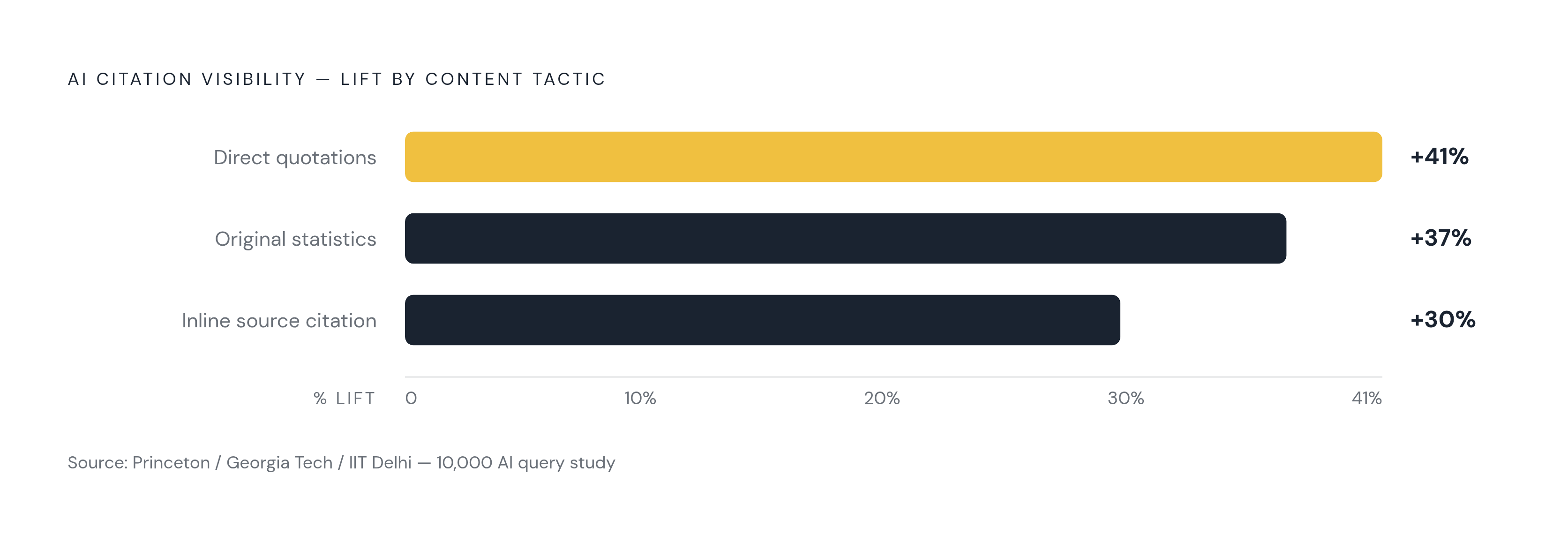
A study out of Princeton, Georgia Tech, and IIT Delhi, built on a benchmark of 10,000 queries across nine domains and presented at ACM SIGKDD 2024, found that data-dense, structured expertise gets rewarded far out of proportion to generic content, which gets mostly ignored digitalapplied.com. The same research isolated which specific moves actually move the needle: adding direct quotations lifted visibility by 41%, adding original statistics by 37%, and citing sources inline by 30% Princeton University GEO research arXiv study (Zhang et al., arXiv:2512.09483).
Structure at the section level matters just as much as what's in the sentence. Chunk size, in other words, is a real, measurable variable SE Ranking digitalapplied.com. Precision helps too: a sentence reading "the average rate is 15%" gets cited more often than one hedging with "the rate is about 15%," because specificity itself signals that a claim can be verified pixelmojo.io.
Most content teams haven't reckoned with the tension at the heart of this shift. Thought leadership, as a genre, is usually written for narrative satisfaction: the insight lands late, wrapped in qualification, after the reader has been walked through the nuance. Engines don't read arcs. They quote sentences. And a format built to reward patience in a human reader is often the exact format an engine has nothing to extract from.
The format hierarchy: which content types AI engines cite, and under what conditions
Wix's citation research put listicles at 21.9% of citations across AI Mode, ChatGPT, and Perplexity, with standard articles close behind at 16.7% Wix March 2026 citation research Everything-PR Research. The split tracks query intent closely: articles take 45.5% of citations on informational queries, while listicles dominate anything shaped like a comparison Wix March 2026 citation research Everything-PR Research.
The best-performing structure is a specific kind of list, one built with intention. It's a ranked Top-N piece with an answer-first paragraph up top, followed by a numbered rundown of solutions. The insight buried in item eight of a ten-item list almost never gets lifted. The framing sentence sitting above item one, though, gets quoted constantly.
Long-form articles play a different role. Even within articles, engines disagree on length: Copilot favors shorter pieces, around 964 words and 24 paragraphs, while Gemini pulls toward roughly 1,977 words and 53 paragraphs digitalapplied.com.
Within thought leadership specifically, an analysis of hundreds of AI-cited pieces by Stridec found three formats doing most of the work: methodology breakdowns that walk through a real implementation step by step, contrarian analyses that push back on conventional wisdom with data behind them, and detailed case study narratives built around measurable outcomes. Comparative pieces that recommend specific tools for specific use cases round that out.
One structural element outperforms almost everything else and gets used the least: the table. At the sentence level, the pattern holds too. Content that gets cited heavily averages around 18 words per sentence; long, subordinate-clause-heavy prose reads as low-citability no matter how sharp the idea inside it actually is digitalapplied.com. AIO appearance rate stands at 74%, the highest of any format class digitalapplied.com. Citation extraction concentrates in the top 30% of the document, the intro, with an average cited word count of roughly 1,000–1,500 Princeton University GEO research. The structural requirement calls for question-phrased H2/H3 headings, self-contained paragraphs of roughly 60–100 words, and a direct answer leading each section. Tables are a separate structural accelerator, as content with tables gets cited 2.5x more often, comparison tables with proper HTML structure improve AI citation rates significantly, and the structured comparison table is the single most underused format in B2B thought leadership discoveredlabs.com.
Why most thought leadership misses the citation threshold even when it is genuinely authoritative
The standard thought leadership piece opens on an anecdote, spends several paragraphs building nuance, and delivers its actual insight somewhere in the final third, hedged with qualifications. For a human reader with the patience to get there, that can be a satisfying read. For an engine assembling an answer in under two seconds, it's a document with nothing it can lift.
Engines quote sentences, not arcs. A claim that can be attributed cleanly, something structured like "according to [source], X leads to Y," is what gets pulled into an answer. An insight that only exists once four paragraphs of buildup have accumulated around it might as well not exist to the machine reading it.
None of this means the answer is to strip out expertise and write thinner content. B2B buyers actively reject generic AI content for strategic decisions, and the fix for that is original evidence: proprietary survey data, case studies with named outcomes, and expert opinions from real named conversations Everything-PR Research. Proprietary survey data, case studies with named outcomes attached, expert opinions pulled from real named conversations: these are the things a language model cannot fabricate on its own, and they're what earns the citation Everything-PR Research. The stakes here aren't just reputational, either.
The practical diagnosis, then, is fairly simple to state even if it's uncomfortable to act on. Most thought leadership is over-built for voice and under-built for structure. Fixing that means front-loading the claim, naming the evidence precisely, and writing section openings that can stand alone, without abandoning expertise. It means front-loading the claim, naming the evidence precisely, and writing section openings that can stand alone without the three paragraphs that used to lead into them Princeton University GEO research arXiv study (Zhang et al., arXiv:2512.09483). Unverified AI generation costs B2B companies an estimated $10 billion globally in 2026 in lost trust, hallucinations, and abandoned digital initiatives, showing the credibility problem is commercial Klover analysis Everything-PR Research.
Where the citation comes from: the third-party source problem
The citation usually isn't coming from the brand's own site at all.
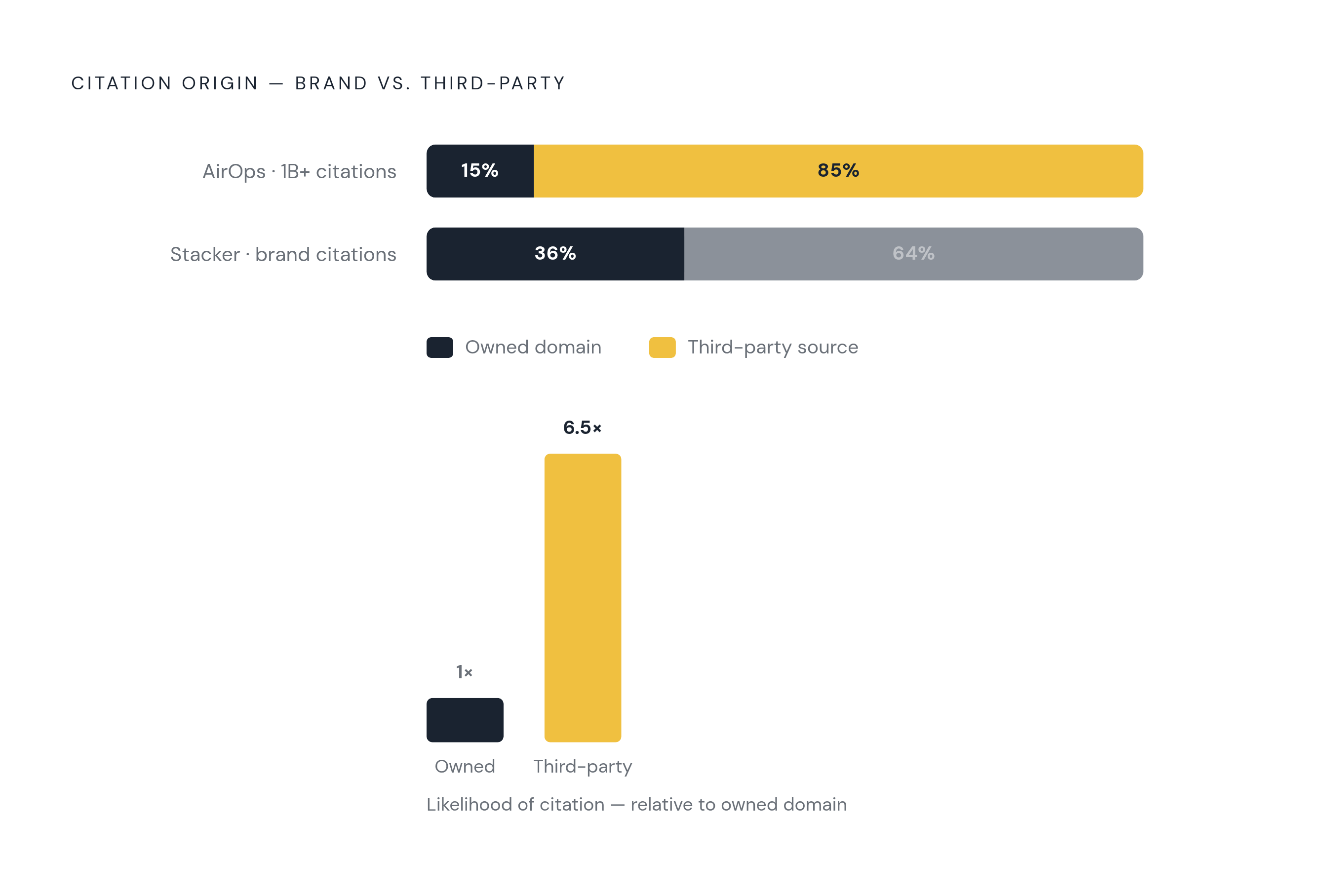
A separate study, run by Stacker in partnership with Scrunch across 87 stories distributed for 30 brands and measured on 8 AI platforms, found that 64% of brand citations point to third-party publishers Stacker study published March 2026 in partnership with Scrunch Everything-PR Research. In one story out of five, the third-party source was the only place the AI drew its description of the brand from at all Stacker study published March 2026 in partnership with Scrunch Everything-PR Research.
Ranking well in traditional search doesn't carry over, either. An arXiv paper from December 2025 (Zhang et al.) found that 37% of AI-cited domains don't appear in traditional search results at all, and Moz's 2026 analysis of 40,000 queries found that 88% of Google AI Mode citations never appear in the organic top ten Princeton University GEO research arXiv study (Zhang et al., arXiv:2512.09483) Everything-PR Research. These are separate channels running on separate logic, not one feeding the other Princeton University GEO research arXiv study (Zhang et al., arXiv:2512.09483) Everything-PR Research.
The engines also don't agree on where to look. Everything-PR's consolidated research, drawing on studies covering more than 680 million citations between August 2024 and April 2026, breaks the preferences out by platform. Perplexity draws disproportionately from Reddit, NIH and PubMed, LinkedIn, and Quora, with 17.35% of its citations coming from discussion forums, more than double the roughly 7.52% average across all models combined. Google AI Overviews leans on Reddit at close to 40% of aggregate multi-engine citation share, making it the single most-cited domain across the board, followed by YouTube at around 19%, then Wikipedia, Forbes, and LinkedIn Princeton University / Georgia Tech / IIT Delhi research Everything-PR Research synthesis of 680 million citations.
Reddit's dominance demands scrutiny. Ahrefs' analysis ranked reddit.com second among cited domains in Google AI Overviews with a 19.6% mention share, and Google's reported $60 million annual licensing arrangement with Reddit only cements that position further Everything-PR Research. A brand with no defensible presence on Reddit is effectively being written out of a large share of the queries buyers are actually typing Everything-PR Research. SE Ranking's research backs that up directly: domains with a heavy footprint of brand mentions on Quora and Reddit run roughly four times higher odds of getting cited by AI systems than domains with minimal activity on those platforms.
The strategic implication follows directly from the data. Earned media in tier-1 editorial outlets like Reuters, Forbes, the New York Times, and the Financial Times, a real community presence on Reddit, Quora, and LinkedIn, and structured third-party reviews on sites like G2 aren't brand-building extras anymore https://everything-pr.com/ai-platform-citation-source-index-2026. They're citation infrastructure. AirOps' analysis of over a billion citations found that 85% of brand mentions in AI search originate from third-party pages, not brand-owned sites, and brands are 6.5x more likely to be cited through third-party sources than through their owned domains AirOps analysis of over a billion citations. ChatGPT favors Forbes, Business Insider, Reuters, and Wikipedia, which account for 26–48% of ChatGPT top-10 citations Everything-PR Research. Claude favors NYT, The Atlantic, The New Yorker, The Economist, and Financial Times. Gemini favors YouTube and Google properties.
Building a publishing system that earns citations rather than just producing content
The hub-and-spoke model is the closest thing to a working blueprint here. A long-form owned blog post acts as the canonical source of record, while LinkedIn posts, Medium republishes, newsletter sends, and community threads act as spokes that point back to it Everything-PR Research. AI Growth Agent's analysis found that ChatGPT and Perplexity cite properly structured, schema-marked owned blog content more readily than they cite social posts or newsletter copy on their own Everything-PR Research. Sequencing matters too: publish the owned piece first to establish it as the canonical origin, then let third-party syndication and community distribution follow, so retrieval systems have a clear source to trace back to.
For the owned piece itself, a handful of structural requirements appear consistently across the research. Headings phrased as actual questions, matching how a buyer would type the query.
The one asset nothing else substitutes for is original research. Proprietary survey data, benchmark reports, named expert opinions, case studies with real measured outcomes attached, these are the things a language model cannot generate on its own, and they're what earns a citation even when a third-party editor picks up the findings and writes about them independently.
Thought leadership, in this frame, isn't a direct citation play so much as it's authority infrastructure. Publishing original frameworks and verifiable claims consistently builds the kind of entity recognition that makes a brand the obvious candidate when some other listicle or informational article needs a named source to cite. Measurement is what closes the loop, since it's the only way to know whether ChatGPT, Claude, Gemini, and Perplexity are actually naming the brand after publication. Letterstory is one platform built around exactly that: it tracks whether those engines name and cite a brand, which lets a team confirm that format choices are actually landing rather than assuming authority alone will do the work. Distribution has to follow the same logic as the citation data: target the wire services and business press ChatGPT prefers, the long-form editorial outlets Claude favors, seed discussion on Reddit and Quora where Perplexity over-indexes, and keep building LinkedIn presence for the B2B queries that route through professional platforms. Embed a statistic or verifiable fact with a named source every 150–200 words. Tables for any comparison are essential, as table-heavy content is cited 2.5x more often than prose-only content in AI Overviews discoveredlabs.com. Self-contained paragraphs, roughly 60–100 words, should be written so they can be lifted as a standalone attributed claim.
Measuring whether the publishing agenda is working in AI answers
The scale here is large enough to need its own measurement track, entirely separate from traditional organic reporting. That's a large enough channel to need its own measurement track, entirely separate from traditional organic reporting frase.io.
The right question to be asking isn't whether the brand ranks.
A few things need deliberate tracking. Mention frequency and citation share broken out by engine, since a brand can be winning on ChatGPT and be completely invisible on Gemini. Whether citations trace back to the owned domain or to third-party sources, given that if 85% of a brand's citations are coming from third parties, the earned media program is the actual lever to pull, not the blog by itself AirOps analysis of over a billion citations. Conversion quality on AI-referred sessions specifically, since the gap between 14.2% and 2.8% conversion means a small trickle of AI-referred traffic can outperform a much larger pool of ordinary organic visits pixelmojo.io. And sentiment within the AI answer itself, because being cited isn't worth much if the surrounding text misrepresents what the brand actually does.
Cadence matters more than most teams assume. A standing process that can draft the moment something relevant breaks, a new data release, a competitor's announcement, an industry event, gives a brand the chance to publish before some other source populates the retrieval layer first. Brands that treat AI citation as something to check, diagnose, and adjust on an ongoing basis will keep compounding their share of citations over time. Brands that treat it purely as a writing-quality problem will end up with better sentences that still, quietly, go unquoted. AI visibility should be measured, not assumed, since the right question is not "do we rank?" but "does ChatGPT, Claude, Gemini, or Perplexity name and cite us when a buyer asks a relevant question?", as these are different queries on different systems requiring dedicated tracking.