Entity Optimization for Brand Recognition in AI Answers
How AI systems resolve brands as distinct entities before deciding whether to cite them.

Before a large language model can recommend a brand, it has to know the brand exists as a single, specific thing in the world, not a string of letters that might mean five different companies. That recognition step is the whole subject of this piece: what it takes for ChatGPT, Gemini, Claude, or Perplexity to resolve a brand as a real, distinct entity, and why so much of that work happens off a brand's own website.
Entity Recognition as a Prerequisite for AI Citation
An entity, in the way AI systems use the term, is a clearly defined thing that can be told apart from every other thing with a similar name. A company, a product, a person, a concept. Large language models and the retrieval systems built around them don't organize the world by keyword the way an older-generation search engine did. They organize it by entity, linking a name to attributes, relationships, and context, then placing that cluster somewhere in a vector space next to conceptually related clusters.
Before a model cites anyone, it effectively runs two questions in sequence. First: who are you? That's entity recognition, sometimes called Entity GEO. Second: should anyone trust what you say? That's authority evaluation: a judgment about whether the brand is worth citing. A brand that fails the first question never gets asked the second. A brand excluded from AI answers receives no signal explaining the omission.
The Shift to AI Answer Engines and Brand Visibility
Gartner predicted in 2024 that traditional search volume would drop 25% by 2026. That's no longer a projection sitting in a slide deck somewhere, it's closer to the ground reality marketers are dealing with. ChatGPT alone grew from 400 million weekly active users in February 2025 to 900 million by February 2026, and AI chatbot referral traffic hit 1.1 billion visits in June 2025, up 357% year over year.
The click math backs this up. By March 2025, only 40.3% of U.S. Google searchers clicked on any organic result. The blue-link page that anchored a decade of marketing strategy simply isn't where most journeys start anymore.
Fewer than 10% of the sources cited across ChatGPT, Gemini, and Copilot rank in the top 10 Google organic results for the same query. Ranking well on Google tells a brand almost nothing about whether it will get cited in an AI answer. These are separate systems selecting from separate signals.
That gap produces a silent shortlist. Buyers now form their preferences inside an AI conversation before they ever land on a brand's site. A brand can lose a deal it never knew it was competing for, crossed off a list that existed only inside someone else's chat window.
Entity optimization within the four types of GEO
Practitioners generally group generative engine optimization into four types, each operating on a different layer of the problem. Technical GEO covers machine-readability: schema, structured data, the plumbing that lets a crawler parse a page correctly. Content GEO governs how individual pieces get written and formatted so an AI system can pull clean answers out of them. Entity GEO is about identity: making sure the system recognizes the brand as one distinct, nameable thing. Brand Authority GEO is about trust: once the system knows who you are, is it convinced you're worth citing?
The order matters. Entity recognition has to happen before authority evaluation can mean anything, because a system can't decide whether to trust something it hasn't yet identified. Most brands get this backwards. They start with the technical 20%, patching schema markup and chasing crawl errors, when the actual work is 80% strategic: positioning, presence across the wider web ecosystem, and the accumulation of authority signals that technical fixes alone can't produce.
The six signals AI systems use to resolve, trust, and recognize a brand entity
AI recommendation systems lean on three broad pillars when deciding what to surface. Information Extraction means content has to be readable and summarizable by a machine, which usually comes down to technical schema and modular formatting that breaks ideas into clean, liftable chunks. Entity Consistency means the brand has to be recognized as the same, trusted thing across the entire web. Citations and Verifiable Facts means AI engines favor content carrying specific data, named benchmarks, and documented outcomes over vague claims.
Those three signals rest on more granular signals that produce them. Structured data, Organization schema, Product schema, Person schema, exists to answer a short list of foundational questions a model needs settled before it commits to citing anyone: Is this a real organization? Is it distinct from other entities with a similar or identical name? What, specifically, does it do?
Consistency itself acts as a trust signal in its own right. When a brand's website says one thing, a press mention says another, and a directory listing says a third, that contradiction reads to an AI system as ambiguity, and ambiguity suppresses citation likelihood. Getting the facts to line up everywhere isn't busywork, it makes a brand resolvable instead of noise.
Citation Research on AI Entity Selection
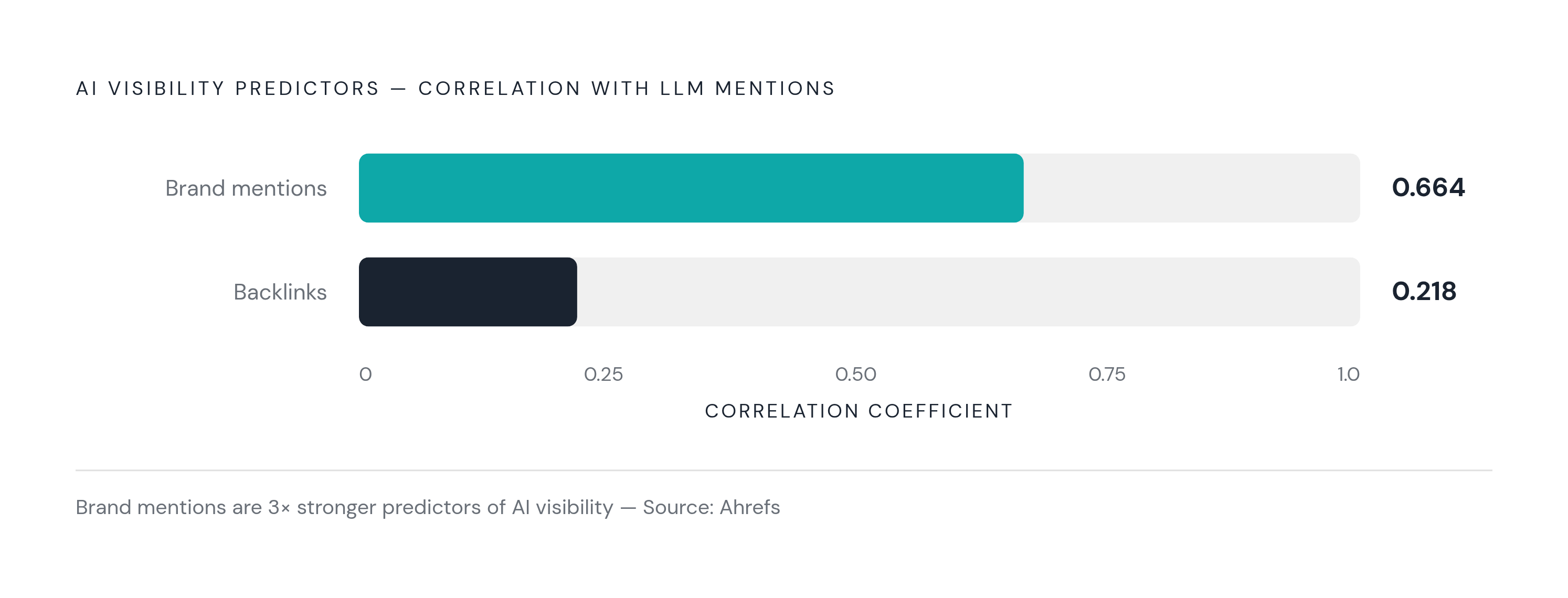
The strongest predictor of AI visibility is not backlinks, not domain rating, not sheer content volume. It's branded web mentions, the references a brand earns when other people, on sites and platforms it doesn't own, write about it without being asked to, which is partly why platforms like Letterstory focus on publishing content across independently hosted sites rather than a single owned domain.
An Ahrefs study puts numbers to this. Brand mentions correlated with AI visibility at 0.664, compared to 0.218 for backlinks, roughly three times stronger. Backlinks, the metric an entire industry built itself around for two decades, showed a far weaker correlation with AI visibility than brand mentions, coming in at 0.218 compared to 0.664.
Format matters just as much as source. Listicle-style content, the "Top N" comparisons and ranked roundups, accounted for 59.5% of all cited URLs across domains analyzed in the study. Product pages came in at 8.5%, standalone articles at 7.9%, how-to guides at 6.3%. Structural choices carry weight too: pages using sequential headings and rich schema markup saw citation rates run several times higher than pages without them.
How content structure and format compound entity recognition signals
Treat the most direct, extractable part of any piece of content, call it the answer capsule, as the highest-stakes real estate on the page. That's the concise, factual passage an AI system can lift whole and drop straight into a synthesized answer. Get that section wrong and nothing else on the page matters much.
Modular formatting reinforces entity clarity in a few concrete ways. Sequential headings that map cleanly onto distinct questions. Short, definitive answer blocks placed before the longer explanation, not buried after it. Schema markup that names the entity relationships outright rather than leaving a model to infer them.
Sourcing choices compound on top of structure. Research on GEO techniques found that adding direct quotations from credible sources raised a source's share of the AI-generated answer by roughly 41%. Statistics added about 31%, citations about 28%. Attributed, checkable claims consistently beat general assertions, and taken together, these techniques can lift a piece's visibility in AI-generated responses by as much as 40%.
Limits of Owned-Site Signals for Entity Recognition at Scale
The large majority of AI citations come from somewhere other than a brand's own website: review sites, comparison articles, forum threads, trade publications, social platforms. Brands are far more likely to get cited through a third-party source than through their own domain.
That's a hard number to sit with if a marketing team has spent years pouring resources into owned-channel content. The AI isn't reading a homepage, it's reading a brand's reputation as reflected across everyone else's writing about it. When ChatGPT is asked which vendor to trust in a category, the answer gets synthesized from analyst reports, consumer reviews, trade press, and earned media, drawn from everyone else's writing about the vendor rather than the vendor's own product pages.
Community platforms account for a meaningful share of all citations. These are where entity corroboration actually happens at scale, where consistent, independent corroboration of the same facts about a brand strengthens its recognizability as a distinct entity. They're where entity corroboration actually happens at scale.
That's also the practical argument for treating third-party presence as infrastructure rather than an afterthought. Because so much of entity recognition depends on mentions a brand doesn't control, practitioners are increasingly focused on tools and strategies built specifically for that layer. Whatever the method, the underlying task doesn't change: a brand has to exist, clearly and consistently, in the places it doesn't own, before any AI system will vouch for it in the ones it does.