Building Topical Authority Signals AI Engines Recognize
AI engines cite topical depth over domain authority and backlinks.

Gartner has said traditional search volume will drop 25% by 2026. That number is the reason topical authority, the kind AI engines actually recognize, matters more right now than chasing keyword rankings ever did.
Where AI Overviews show up in search results, click-through on the top organic result falls from 7.3% to 1.6%. Seer Interactive ran a separate study across 3,119 informational queries and found organic CTR falling from 1.76% to 0.61%. Different studies, same direction: fewer clicks make it past the answer itself. And 94% of B2B buyers now use generative AI tools somewhere in their purchase research, which makes this a channel brands already depend on, not one they're still testing. It's the front door now, prepared or not.
The mechanism is what breaks the old playbook. AI engines don't return ten blue links. They synthesize an answer from several sources at once, and ranking position doesn't guarantee a spot in that synthesis. Neither does backlink volume. What gets cited is a different question from what ranks, and most brands are still optimizing for the wrong one.
What topical authority means to an AI engine, and how it differs from domain authority
Domain authority is a backlink-weighted prestige score. It answers how many sites trust a domain enough to link to it. Topical authority answers a narrower question, and for AI engines, a far more important one: how completely does this site cover this specific subject. People treat the two as the same thing because they often move together, but they aren't the same measurement, and AI engines lean on the second one when deciding what to cite.
Google's own systems already work this way. Semantic analysis, entity recognition, and how pages on a site relate to each other thematically all feed into whether Google thinks a site actually knows a topic, separate from how many links point at it. The February 2026 Google Discover update made that split explicit: expertise now gets evaluated topic by topic, not domain-wide. A site can be the recognized authority on one subject and functionally invisible on another, sitting on the same domain with the same backlink profile.
That's what produces a topical authority override, and most SEO teams get it wrong. An AI engine will skip a large, trusted domain in favor of a smaller competitor if that competitor has deeper original data and cleaner coverage of the exact topic in question. Shallow coverage on a famous domain loses to real depth on an unfamiliar one, full stop. Anyone still spending budget to chase domain authority as a proxy for AI visibility is optimizing for a score that increasingly doesn't decide the outcome.
Content cluster architecture and the topical authority graph AI engines read
Bidirectional linking inside a content cluster raises citation probability by roughly 2.7 times. Here's the architecture that produces that number.
When a set of pages covers related subtopics and links to each other with consistent, descriptive language, search engines and language models start reading that set as one connected structure instead of a pile of separate documents. Think of it as a topical authority graph: the pillar page sits at the center, cluster pages branch off it, and the links running between them get read as evidence, not decoration. A pillar page on email marketing that links out to dedicated pages on automation, list segmentation, deliverability, and analytics tells a crawler, in structural terms, that the domain mapped the subject instead of skimming it for keywords.
Direction matters as much as the linking itself. When cluster pages link back up to the pillar using consistent, descriptive anchor text rather than "click here," language models read that convergence as a signal that the pillar is the canonical answer on the topic, worth quoting over a page sitting in isolation with no cluster around it. A single strong page with no supporting structure reads as an island. A pillar with four or five cluster pages linking into it, and getting linked back from it, reads as a body of knowledge. Most sites still publish the island version and wonder why a competitor with thinner individual pages keeps getting cited instead.
Entity recognition: how AI engines identify whether your brand is a known, trusted concept
Entity SEO is the practice of making a brand, person, product, or topic identifiable as a specific, resolvable thing. Structured data, consistent brand naming, semantic markup, and Knowledge Graph presence are the mechanisms that get a brand recognized this way.
An SEO strategist at RicketyRoo, quoted in Lumar's expert survey, said AI engines think in entities and relationships, not keywords. That means a brand can rank well in traditional search and still go unretrieved in an AI answer, because ranking algorithms and entity resolution are answering different questions. One asks whether a page matches a query. The other asks the system to determine, with confidence, that this is a known, distinct thing.
Consistency builds that confidence, and inconsistency spends it down fast. Using the same terminology, the same definitions, and the same framing of relationships between concepts across a site reinforces the entity signal every time it repeats. AI systems compare those patterns against what they already know from the broader knowledge graph, and a brand that calls the same product three different names across its own site isn't building topical authority, it's actively eroding whatever it already earned elsewhere. Entity density, meaning how many recognized named concepts show up across a content cluster, is what ties a domain into the knowledge graph infrastructure that AI retrieval runs on.
Earned media and third-party presence outweighing owned content for AI citation
Roughly 84% of AI citations trace back to earned media, not paid content. Advertorial and paid placements account for about 0.3% of citations, a rounding error by comparison. That gap should change how a brand thinks about the problem it's actually solving.
A brand's own website supplies only 5 to 10% of the sources AI search tools pull from when answering questions about that brand. About 85% of brand mentions surfaced in AI search come from third-party pages instead. That makes this a reputation problem before it's a content problem, and it sits closer to PR and analyst relations than to a publishing calendar.
Ranking on page one doesn't buy the safety it used to, either. Somewhere between 17% and 38% of pages cited inside AI Overviews also rank in the organic top ten for that same query. Most of what gets cited comes from outside page one entirely, which means the old shorthand, rank well and visibility follows, has stopped holding for the answers AI engines actually generate.
The content signals that most reliably increase AI citation rates
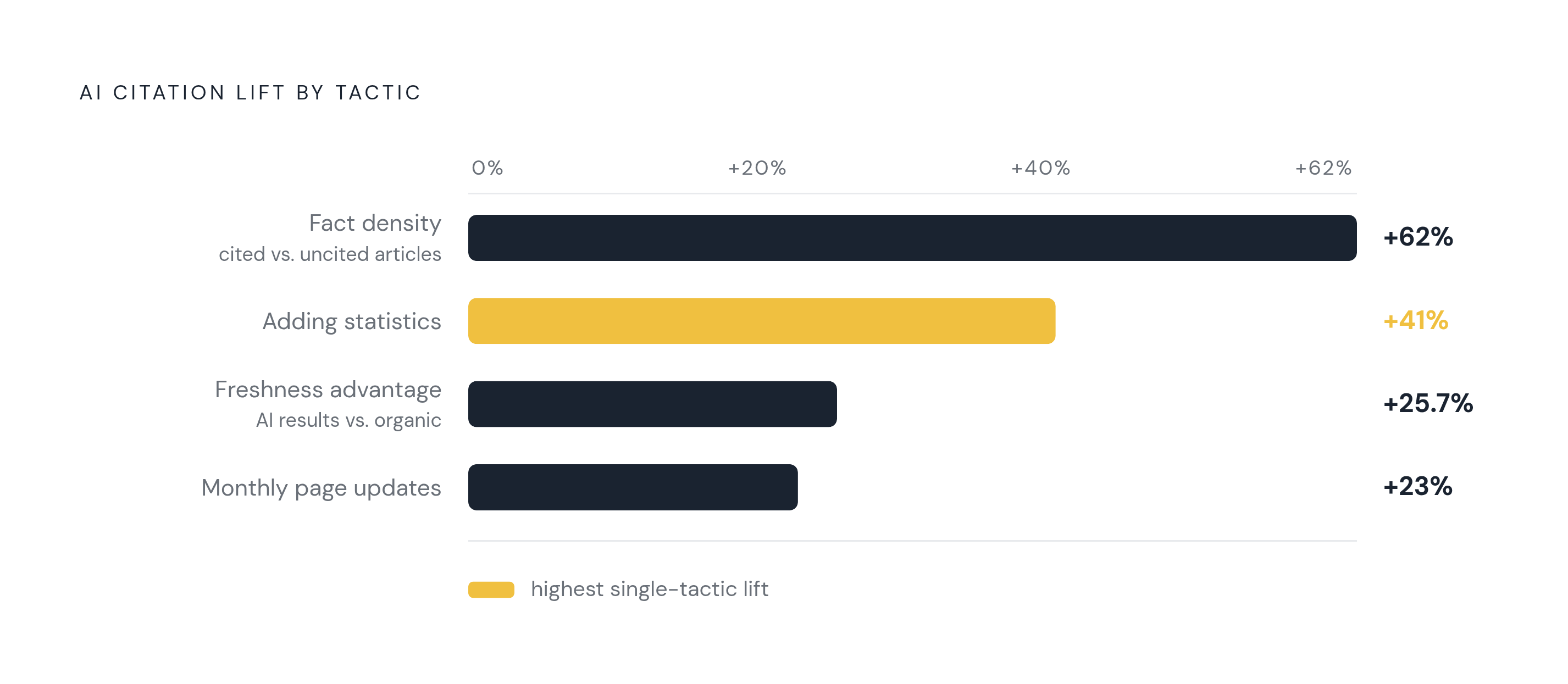
Adding statistics to a piece of content lifts AI visibility by 41%, more than any other single tactic measured. Most content advice points toward structure or length first. The data says numbers on the page move the needle harder than either.
Articles cited in AI Overviews cover 62% more distinct facts than uncited articles on the same subject. Word count isn't the variable doing the work. Fact density is. AI systems extract blocks of roughly 40 to 80 words that can stand alone as a quote or a summary, and that block is the real unit of AI-readable writing. A claim has to live in a passage that makes sense pulled out of its paragraph, not buried on page four of a piece that saves its point for the conclusion, if it's going to be citable.
Freshness carries real weight too. URLs surfaced in AI answers run about 25.7% fresher, on average, than pages showing up in traditional organic results. Brands that update cornerstone pages monthly see roughly 23% more AI coverage than brands that let those pages sit untouched. Stale content doesn't just rank worse. Systems that weight recency as a trust signal skip it.
Conversion economics and AI visibility as a priority
Visitors arriving from AI search convert at 14.2%, against 2.8% for Google organic traffic. Ahrefs found AI search visitors generated 12.1% of signups while making up only 0.5% of total site visits, a 24-to-1 conversion ratio against organic search. That is a substantial gap. It's a different category of traffic.
Intent explains the gap. Someone who reaches a site through an AI answer already ran a specific, researched query and typically arrives with a shortlist forming in their head before the click happens. That's a buyer well into evaluation, not someone browsing the top of a funnel. Call it the silent shortlist: the comparison work already happened inside the AI conversation, so the click that follows is a decision, not a discovery.
Volume is catching up to conversion. ChatGPT alone handles more than 2 billion queries a day and reaches 883 million monthly users, and ChatGPT Search accounts for 87.4% of all AI referral traffic hitting websites today. BrightEdge put AI agent requests at 88% of human organic search activity, a level that signals just how quickly the channel is maturing. Anyone treating this as a bet on where behavior might eventually go is a year or two behind the data.
Building and monitoring topical authority signals across a client portfolio
Every client sits in a different subject-matter world. A healthcare brand and a SaaS company don't share a competitor set, don't share an entity landscape, and don't need the same cluster architecture, because the topics they're trying to own have nothing in common. That's the tension agencies run into: topical authority gets built client by client, but nobody has the budget to start from a blank page on every account.
Traditional SEO platforms solved multi-client management years ago: dashboards, white-label reporting, permission tiers across accounts. AI visibility tooling hasn't caught up to that standard yet. An agency working across a portfolio needs AI visibility monitoring, multi-brand management, white-label reporting, and the ability to actually execute changes, from one place, instead of juggling separate logins for every client and every function.
A one-size-fits-all tool is close to useless here, because the competitor sets are genuinely different from account to account. What Profound tracks for a SaaS client's AI visibility looks nothing like what matters for a healthcare brand's, so any platform an agency adopts has to support distinct competitor sets per account, not a shared comparator list bolted onto every dashboard. As of 2026, platforms like Profound, Ahrefs, and Semrush each approach AI visibility monitoring from a slightly different angle, and other specialist tools continue to emerge in the space. Some specialist tools sit in a different lane entirely, functioning as paid ad networks for running ads inside LLMs and AI chatbots and connecting advertisers to AI publishers. That gives agencies a paid lever alongside the earned-media and structural work covered above, and which lever a client leans on comes down to budget and appetite for paid versus earned, not a single correct answer across the portfolio.