AI-Generated Images Can Now Be Verified—But AI-Written Text Still Can't. Here's What That Means for Content Marketers
Images can prove their origins, but text cannot—and that gap reshapes compliance.
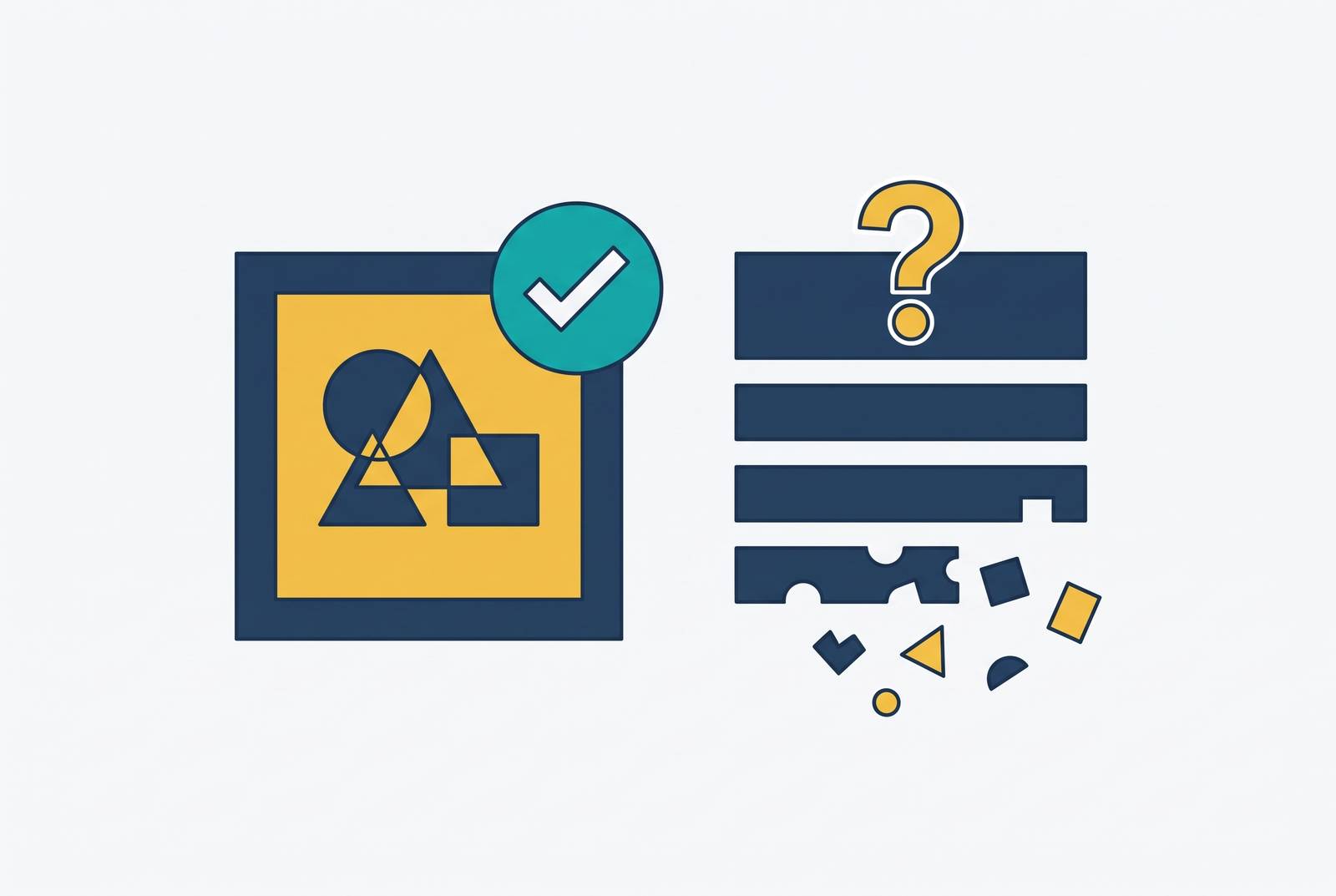
We can verify whether an image was AI-generated with cryptographic certainty. We cannot do the same for text, and that gap has real consequences for every content team publishing at scale.
The C2PA standard, launched in 2021 by Adobe, Arm, BBC, Intel, Microsoft, and Truepic, embeds a cryptographically signed manifest inside a media file at the moment of creation. That manifest records the author, the tool, every meaningful edit, and whether AI was involved. Tampering breaks the signature visibly, so inspection yields a hard result, not a probabilistic estimate. Over 6,000 companies have joined C2PA, including Google, Meta, and OpenAI, and anyone can check a manifest at contentcredentials.org.
Where image verification breaks down (and why the gap matters anyway)
Most social platforms strip metadata on upload, which defeats manifest-based verification immediately. Beyond that, a Microsoft study across more than 600,000 images found human judges distinguished real from AI-generated images at only 62% accuracy. And watermarks without cryptographic secrecy are breakable by a sufficiently motivated adversary.
Even so, image verification has a structural framework: an open standard, hardware adoption, and a path toward platform enforcement. Written text has almost nothing equivalent.
Why AI-written text remains essentially unverifiable in practice
Classifier-based detectors report accuracy in the high 80s in vendor studies, but a Washington Post test produced a 50% false positive rate on a smaller sample. Even light editing of AI-generated text can reduce classifier accuracy meaningfully. OpenAI built a text watermarking scheme and, as of late 2026, has chosen not to deploy it. SynthID for text works through statistical patterns in word choices, but confidence scores drop when text gets rewritten or translated. Given that 71.7% of new web pages blend human and AI writing, detectors face exactly the content type they handle worst.
The bias embedded in text detection tools and what it means for global content teams
Detectors using perplexity-based heuristics flag non-native English writing as AI-generated at alarming rates. In one widely cited study, nearly 98% of TOEFL essays written by Chinese students were incorrectly labeled as AI. Research consistently confirms accuracy-bias trade-offs that fall hardest on non-native English speakers. A tool with structurally skewed false positives functions as a demographic filter, full stop.
What the regulatory environment now requires, regardless of what technology can prove
The FTC applies existing consumer protection guidelines to AI-generated content at up to $53,088 per post for undisclosed AI involvement in advertising, with enforcement targeting undisclosed AI involvement in advertising. The EU AI Act adds transparency obligations relevant to AI-generated content used in marketing contexts. Regulators require disclosure that detection technology cannot reliably supply after the fact, so documented process is the only defensible compliance path.
Why credibility for written content now rests entirely on editorial process
Images have a provenance infrastructure. Text does not, and no near-term fix works at scale for hybrid content. For written content, the credible signal of authenticity is the process behind it: who set the strategy, who exercised judgment, who edited and fact-checked. Documenting those human touchpoints creates an auditable record where technology currently cannot.
Practical decisions content marketers can make now given this asymmetry
For visual content, adopt C2PA-compatible tools. Adobe Firefly, DALL-E 3, and Microsoft Designer all attach Content Credentials as part of their standard output.
For written content, four adjustments matter:
- Stop using AI detectors as editorial gatekeepers; bias, false positive variance, and hybrid-text failures make them unreliable for that role.
- Default to proactive disclosure of AI involvement; it is both legally safer and more brand-credible.
- Build an editorial record by documenting human touchpoints across every workflow: strategy brief, subject-matter review, editorial sign-off.
- Choose tools that treat human review as structural rather than optional. Letterstory combines AI-assisted drafting with human editorial oversight, making the human editor the verification layer at the exact point where detection tools struggle most.