Zero-Click Search Impact on B2B Content ROI
Google's answer engine is dismantling B2B content's traffic model.

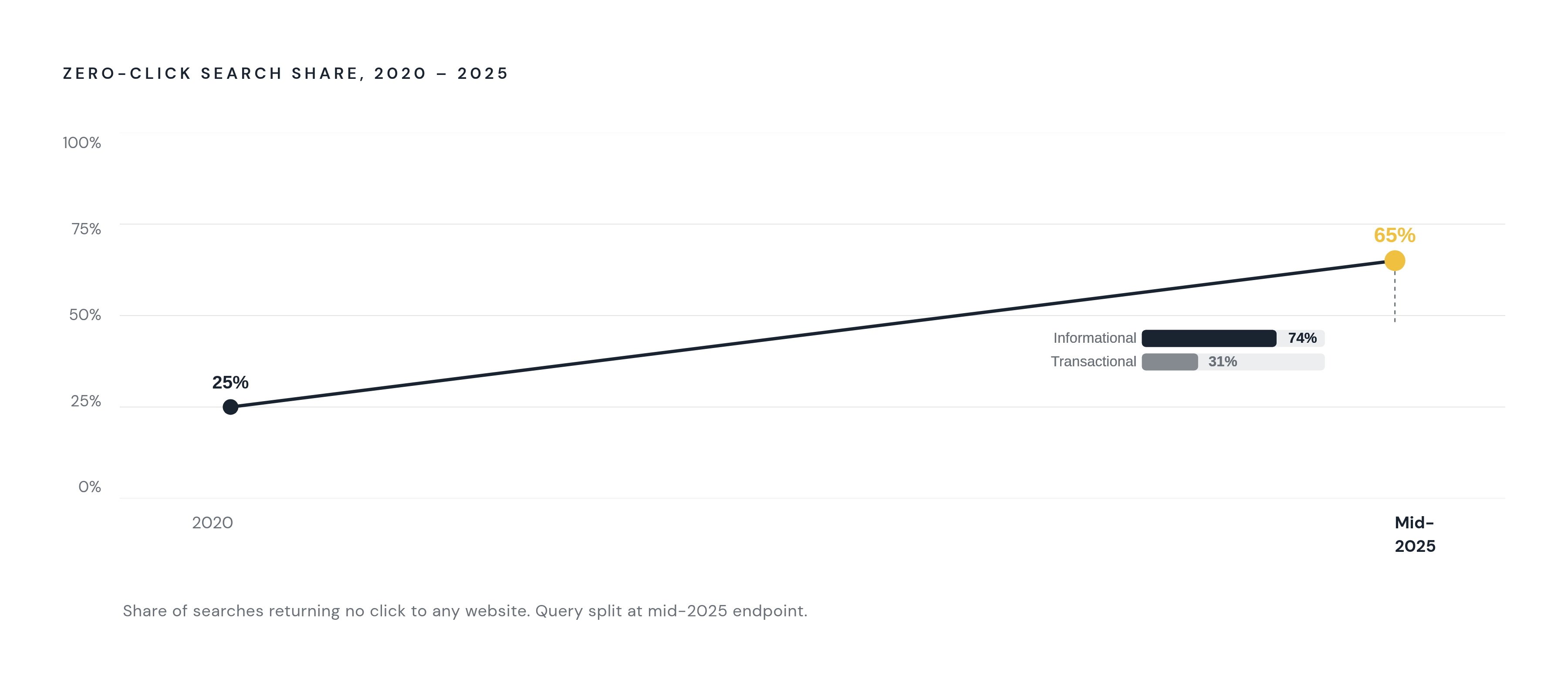
Roughly two-thirds of Google searches now end without a single click to any website, and that number is the whole story: it changes what content marketing is for, what it can prove, and who gets credit for a sale that never touched a landing page. Five years ago, about one in four searches ended without a click. By mid-2025, that figure hit 65% overall, which means run the math on 1,000 U.S. Google searches today and only 360 or so send a visitor anywhere. The other 640 get an answer and leave: no tab, no session, nothing to report to a VP on a Tuesday.
The split matters more than the average does. Transactional queries, the ones where someone already knows what they want and just needs to pick a link, still convert to clicks at a reasonable rate, about 31% zero-click. Informational queries, the "what is," "how does," "why" questions that make up most B2B content strategy, sit at 74% zero-click. Mobile pushes this further: 77% zero-click on phones versus roughly 47% on desktop. B2B buyers do an increasing share of their early research exactly where they're least likely to click through, thumbing around during a commute or between meetings, half-reading, fully deciding.
This is a durable shift, not an algorithm hiccup that reverses next quarter. Google has moved from a traffic engine to an answer engine. The referral model content teams built their ROI logic around doesn't hold the way it used to, and what follows walks through what that means, section by section, for anyone whose job depends on content actually working rather than just existing.
Why B2B content takes the hardest hit
B2B tech queries trigger AI Overviews about 70% of the time, which makes the category one of the most exposed to this shift, and that's no coincidence. B2B buying involves comparison, jargon, and education, exactly the kind of query Google's AI Overview exists to intercept and answer before a human ever gets involved.
The traffic numbers back this up in a way that should worry anyone running a content team. Available analysis found 73% of B2B websites saw meaningful traffic loss between 2024 and 2025, with an average year-over-year decline of 34%. Bain & Company's research put click-through-rate losses in some B2B software categories at up to 30%.
What's most instructive is which queries take the hardest hit: the "what is," "how does," "why" questions, exactly the informational assets B2B teams spent a decade building to catch early-stage buyers before they knew which vendors even existed. The content still answers the question, just to Google's AI Overview now, rather than to the reader who used to land on the page.
Bain's research supplies the number that explains why this matters so much: 85% of B2B buyers purchase from what Bain calls their "day one" list, the vendors already in mind before the search even started. Zero-click search doesn't just cost a session; it removes a brand's shot at getting onto that list in the first place, because the informational search that used to introduce a buyer to five vendor names now gets answered without a single vendor name appearing anywhere.
Here's where most teams get the diagnosis wrong: they treat all traffic loss as one problem, and conflating the two versions of it wastes exactly the effort a shrinking budget can't afford. Top-of-funnel informational losses are mostly AI Overview cannibalization, structural and largely unfixable through better content alone. Bottom-funnel losses on product, pricing, and "vs" comparison pages are a genuinely competitive problem, where a rival's page is winning the click rather than nobody winning it. Mistake one for the other and a team ends up rewriting bottom-funnel pages that were never broken, while the AI Overview quietly eats the top-of-funnel traffic whole, unnoticed, because nobody was watching that half of the dashboard.
The mechanism driving the damage: AI Overviews at scale
The pace here deserves a pause. Google's AI Overviews expanded from a relatively small base to hundreds of thousands of keywords between August 2024 and May 2025. By 2025, AI Overviews were showing up in roughly half of all U.S. queries, according to DemandSage, and the count keeps climbing month over month, not plateauing the way a normal feature rollout would.
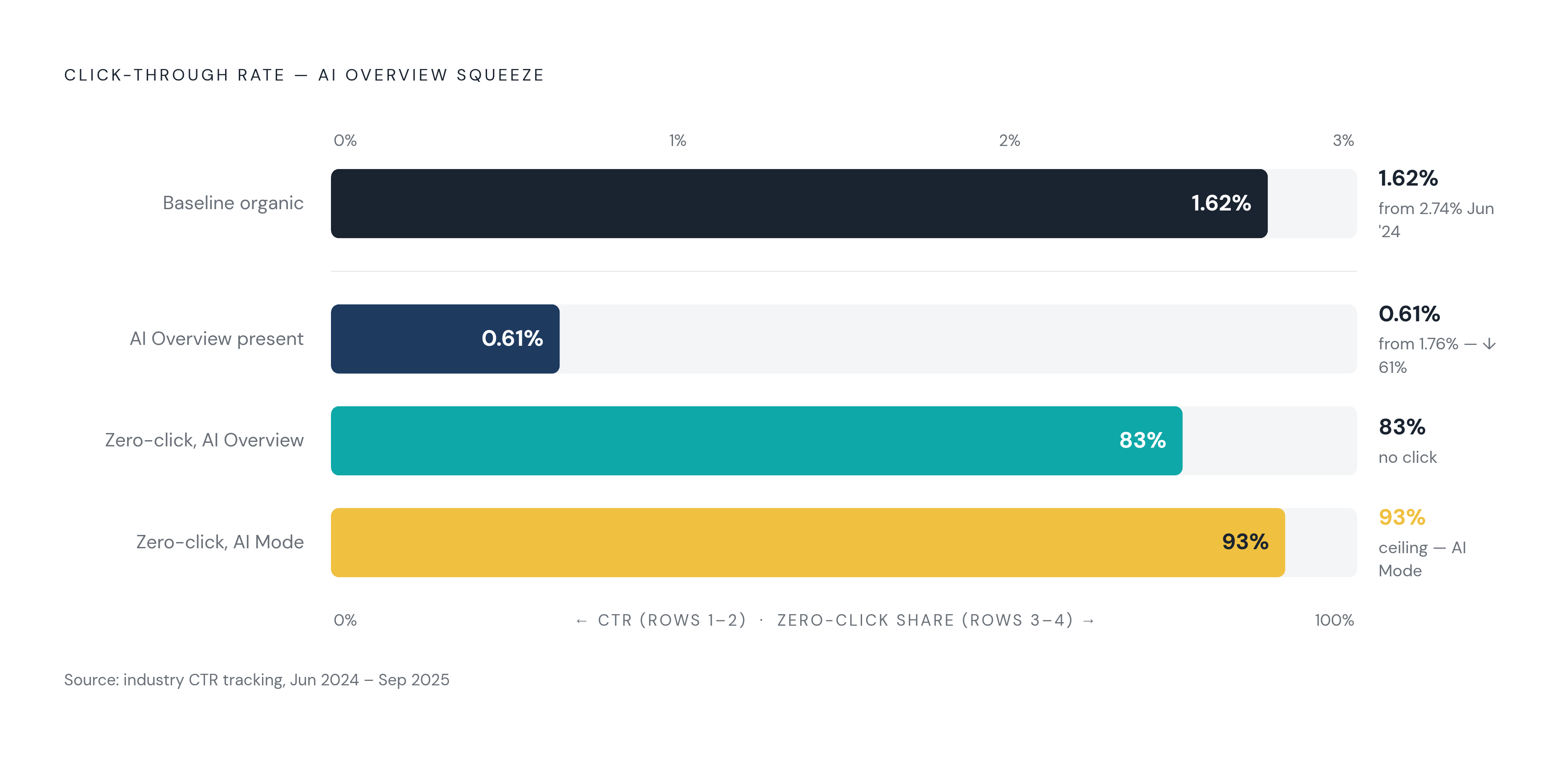
When an AI Overview shows up on a results page, the zero-click rate for that query jumps to 83%. In Google's AI Mode, it climbs to 93%, per Bain & Company's 2025 findings. Seer Interactive's September 2025 analysis found organic click-through rate on affected queries fell from 1.76% to 0.61%, a 61% drop, once an AI Overview landed above the organic results.
The damage isn't confined to queries with an AI Overview attached, which should alarm any content team paying attention. Seer's data shows organic CTR falling from 2.74% in June 2024 to 1.62% by September 2025 across the board, AI Overview present or not. Something more basic has changed in how people read a results page. They scan, they settle, they leave, whether or not there's a summary box telling them to.
By December 2025, tracking data showed content ranking in position one seeing a dramatic CTR reduction whenever an AI Overview sat above it. Ranking first used to mean something close to "wins the click." Now it means something closer to "wins the click 42% of the time it used to," and that's a very different business to be running content for.
The squeeze isn't coming from one direction either. Google Ads appeared on 25.56% of results pages containing AI Overviews by October 2025, up from 5.17% in March of that year. Organic content gets pinched from above by paid placements and from within by the summary sitting on the fold, a sandwich with less and less room in the middle. The effect on the B2B buyer journey: procurement research that used to run across dozens of searches and multiple site visits over weeks is compressing into prompt-and-synthesize. A buyer asks a chat interface to compare three vendors and never visits a single vendor's website for that entire phase of the decision.
The rankings-traffic paradox that breaks the old ROI math
Here's a finding that should make anyone running a content dashboard stop scrolling: analysis across 22 B2B websites found properties where organic rankings improved while click-through rate collapsed, in some cases falling from 2% down to 0.2%. Better SEO performance, worse business outcome, at the same time, on the same page. The old assumption, that rankings and traffic move together, was never actually a law. It was a correlation that held for two decades because the underlying system hadn't changed yet. It has now.
Call it the Great Decoupling. Global search volume keeps rising. Clicks to the open web keep falling. Impressions and ranking position, the two metrics content teams have reported on since forever, have come unglued from the traffic and pipeline numbers they were built to predict. The whole ROI stack rested on one assumption: impressions convert to clicks at some roughly stable rate. That assumption is dead, and it's not the kind of dead that comes back after the next algorithm update.
Is the situation as grim as raw traffic numbers make it look? Not universally. Some B2B sites report flat pipeline despite meaningful organic traffic declines, because citations inside AI engine answers pick up part of the work clicks used to do. But that safety net only exists for brands already earning those citations. If an AI Overview is quoting a competitor's page instead, nothing offsets the decline, full stop, with no citation-shaped consolation prize.
That gap in the middle is worth tracing carefully, because the mechanism isn't obvious at first look. Content that earns an AI Overview citation shapes how a buyer thinks about a category and drops a brand name into their head, but generates zero session data, because there was no click to log. The influence doesn't disappear; it tends to resurface as branded search volume, sometimes 30 to 90 days later, and standard attribution models have no column for "invisible influence that became a direct search two months out." A team measuring content ROI on session counts alone reads that gap as failure. Budgets get cut for content that, judged by what it actually did, was working the whole time.
That's not a rounding error in a quarterly report. It's a direct misallocation of budget: programs generating real brand lift and real day-one-list influence get defunded, not because they failed, but because the dashboard was never built to see them succeed.
What the new measurement stack actually needs to track
Bolting two AI-visibility metrics onto the same dashboard and calling it modernized undersells what's actually required: measuring what survives in a zero-click world alongside what used to matter in a click-based one. Sessions were always a proxy for the thing marketers cared about, which is influence on a buying decision. That proxy's correlation with the real thing is breaking down, so the fix involves measuring closer to the real thing itself.
A handful of metrics hold up better here, though none of them substitute cleanly on their own, and that's worth saying plainly instead of pretending one dashboard swap fixes everything. AI citation share tracks whether a brand actually gets cited in AI Overviews, ChatGPT, Gemini, and Copilot answers for the queries that matter, and it behaves less like SEO rank tracking and more like an entirely separate discipline. Branded search volume lags by weeks, but it's real; it captures SERP-level awareness that never converted to a click at the moment someone first encountered it. Conversion-per-session outweighs raw session volume in importance now, since a shrinking visitor pool converting at a higher rate can mean AI engines are pre-qualifying traffic before it ever shows up. Assisted pipeline, tracked through multi-touch attribution instead of last-click, captures content's role in a deal even when content never got credit for the final click.
Underneath all of this sits a plain tooling gap. A large share of marketers currently have no way to check whether their content gets cited inside AI answers at all. That's not a minor blind spot; it means much of the industry is optimizing for a target it literally cannot see.
Ranking well and getting cited well turn out to be different skills, which is a strange thing to have to say about search marketing after two decades of treating them as the same discipline. SEO rank alone is a poor predictor of AI visibility, meaning traditional ranking signals explain well under half of why a source gets pulled into an AI answer. Available research suggests the overlap between Google's top-10 organic results and AI Overview citations is partial and inconsistent. Emerging data suggests only a small minority of sources cited across ChatGPT, Gemini, and Copilot rank in the top 10 organic Google results for that same query. Ranking high doesn't guarantee a citation, and earning a citation doesn't require ranking high; these are adjacent games that happen to share a scoreboard, and playing one well says surprisingly little about the other.
What that means in practice: raw sessions stop working as a stand-in for content value, and no amount of bolting new KPIs onto the old dashboard changes that on its own.
What content actually needs to do to earn citations and direct traffic
AI engines cite a small number of sources per answer, which keeps the field narrow for any given query. That kills a strategy that's survived on inertia for a decade: publishing more mediocre pages doesn't improve the odds of citation, and any team still chasing volume is optimizing for a game that already ended. Structural quality does the work volume used to do. Reporting on zero-click search consistently points to organized, well-built content beating sheer output; depth, specificity, and a clear information hierarchy now carry more weight than publishing cadence ever did.
Split content investment into two buckets, because they pay out through completely different mechanisms, and conflating them is where a lot of strategies quietly fail without anyone noticing until the budget review. Citation-optimized content, informational and authoritative, structured so an AI system can lift a clean quote from it, builds brand presence inside the zero-click results page itself. The payoff isn't a session; it's branded search lift and pipeline assist, surfacing weeks later under a completely different metric than the one that funded it. Click-worthy content, built around an actual point of view, original data, or decision-stage material with real conversion intent, aims at that smaller 31% of transactional queries still resolving in clicks, and it has to earn that click against a results page more crowded and more compressed than it was two years ago.
Original research carries a structural advantage worth tracing to its root: an AI system cannot synthesize a number that doesn't exist anywhere on the internet yet. First-party data, a genuinely original study, a benchmark nobody else has published, functions like a citation moat, something a model has no choice but to attribute because there's nowhere else to pull it from. Generic explainer content sits at the other end of that spectrum: it's exactly the raw material AI systems train on and summarize away, so publishing more of it is a bit like mailing a spare key to the burglar who already has your address.
There's a link between citation and paid performance worth flagging too. Emerging analysis suggests brands cited inside AI Overviews may earn more paid clicks than non-cited brands competing on the same query. Citation strategy and paid search strategy aren't separate disciplines anymore; a citation acts almost like an endorsement, priming a searcher to click a paid ad from that same brand a moment later.
So the uncomfortable part, for anyone still running a high-volume content operation, is this: pumping out generic informational content amounts to feeding the training data of the exact systems now eating that content's traffic. The shift favors fewer, higher-authority pieces built around a proprietary insight nobody else can supply, over a calendar built for keyword coverage and word count.
For marketing leaders weighing what to keep in-house against what to hand off, that tightens the case for owning strategy and production together rather than splitting them across vendors. What matters now is a brand-specific point of view paired with the speed to react when the AI visibility landscape shifts again, a combination that's genuinely hard for an outside agency to match at the pace this environment moves. Content platforms built around editorial quality controls paired with AI-assisted production, such as Letterstory or Optimist, fit that kind of strategy-first work: helping teams produce the depth and structure that actually earns a citation, at a pace distinct from just adding one more page to a pile the AI has already read and moved past.


