AI Query Behavior Differences Across ChatGPT, Gemini, and Claude
Each AI chatbot retrieves differently, creating separate brand hierarchies.
Why the same query produces different brand shortlists on ChatGPT, Gemini, and Claude
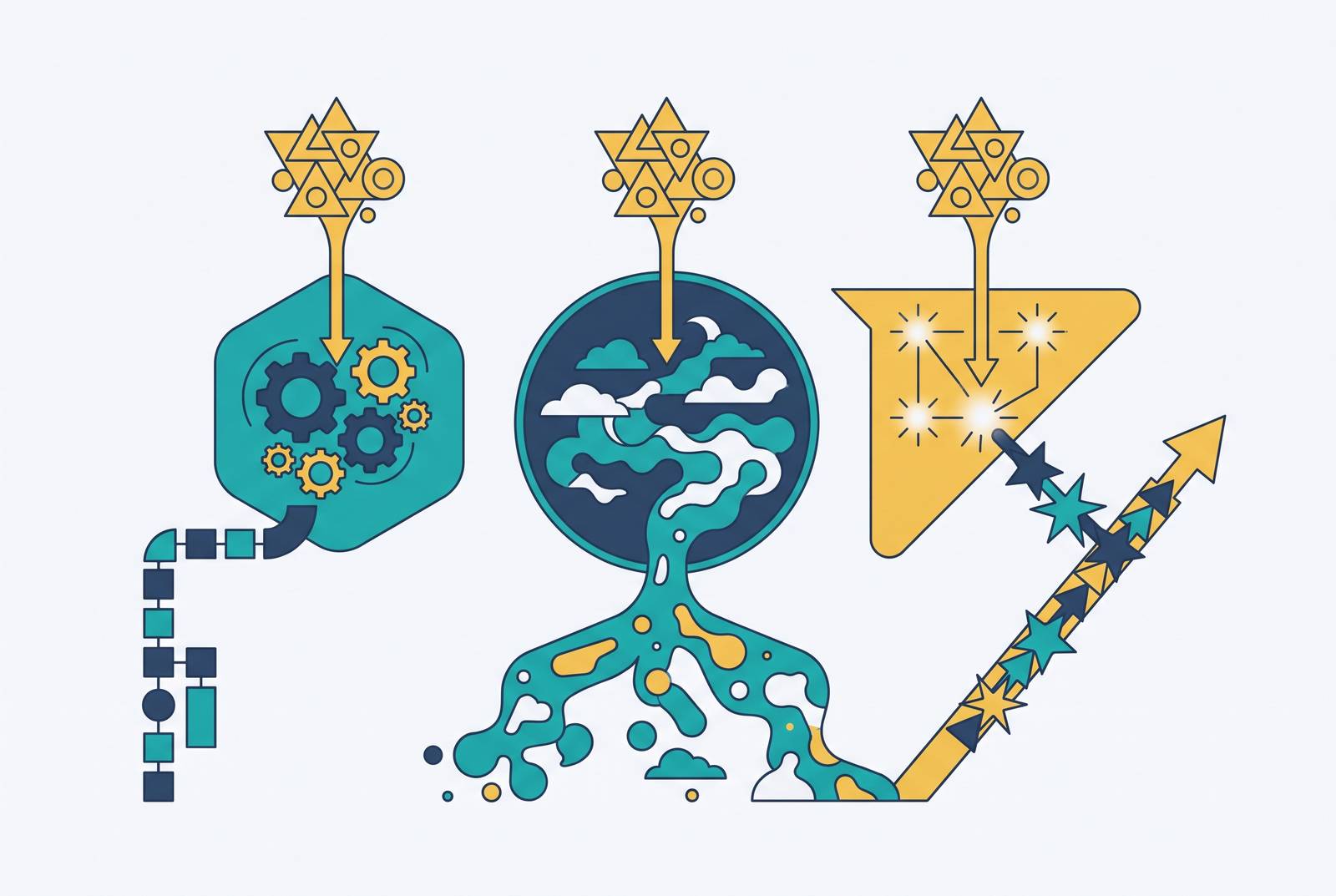
Asking ChatGPT, Gemini, and Claude the same question about project management software produces three shortlists built by three different mechanisms, not three variations on one answer. That's the fact brand teams keep underestimating. ChatGPT tends to generate a confident list drawn from training data plus whatever its web retrieval grabs in the moment. Gemini reaches into Google's own search index, pulling structured, sourced material it already owns. Claude qualifies almost everything: this tool for this use case, that one if the team scales past a certain size, a third if compliance is the binding constraint.
None of that is cosmetic variation. People already route different jobs to different tools: a fast gut-check to ChatGPT, something grounded in current data to Gemini, a complicated tradeoff to Claude. Visibility on one platform does not carry to the next, because each one runs its own retrieval process, pulls from different sources, and ranks what it finds by different rules.
The citation numbers make the gap concrete rather than theoretical. Gemini cites brands at a meaningfully higher rate than ChatGPT, which in turn cites more often than Claude. A brand can sit front and center in a Gemini answer and be absent from Claude's response to the identical prompt. A large share of brands don't appear in AI answers at all, and that gap traces directly to uneven indexing and citation habits across these platforms. Fixing it for one platform does nothing for the other two. That's the argument the rest of this piece has to make, one platform at a time.
How ChatGPT's retrieval logic creates gaps
ChatGPT runs its own retrieval stack: a broad web index with citations layered onto generated text after the fact. The trouble is that it tends to paraphrase sources rather than name them unless SearchGPT triggers explicitly inside the answer, which makes the platform far harder to audit than its size suggests. It's the largest citation surface among the major chat platforms by sheer volume, and simultaneously the least traceable one, since the sourcing behind the sentence in front of you is often invisible.
Research into ChatGPT's retrieval behavior quantifies the instability directly: ChatGPT frequently returns different sets of URLs for identical prompts asked at different times. The same question asked twice will likely return different sources both times. That's a significant structural problem. It means consistent brand presence on ChatGPT is close to impossible to engineer on purpose, because the model isn't drawing from the same well twice.
Where ChatGPT does hold its ground is bounded reasoning, when there's a fixed document to check its own work against. Its document grounding produces a FACTS overall score of 61.8 and a grounding sub-score of 69.6, solid numbers when the model is handed a document and told to stay close to it. Open-ended retrieval across the live web is a different task entirely, and it's the one ChatGPT handles least reliably of the three.
Gemini's structural web advantages and their effect on retrieval
Gemini is two products sharing one name, and conflating them is a common mistake. There's the standalone chat app, which behaves like a workplace assistant. Then there's the model embedded in Google AI Mode and AI Overviews, reaching a far larger pool of users, which behaves like a search results page because that's functionally what it is.
Two structural advantages explain Gemini's numbers, and neither one is about the model being smarter. First, direct access to Google's search index and its partner data, including Reddit content through Google's data-sharing deal worth $60 million annually, signed in 2024. Second, Gemini's crawler renders JavaScript on the pages it indexes, so it sees content that never finishes loading for Claude's or Perplexity's non-rendering crawlers. That's the whole story behind Gemini's 19.8% citation rate, the highest of the three: more completely indexed source material, full stop, not superior reasoning.
The growth curve confirms it. Gemini's web visits grew roughly ninefold between September 2024 and March 2026, against ChatGPT's 84% growth over the same stretch. Credit Google's native distribution through Search, Android, and Workspace, channels no standalone chatbot can touch. Model quality has almost nothing to do with it.
How Claude's calibration-first behavior shapes its recommendations
Claude cites brands at the most conservative rate of the three, and that restraint is a design choice, not a shortfall to fix. Brands that haven't established themselves as verifiable authorities in what Claude trains on and retrieves from simply don't show up, because Claude is built to hold back rather than fill a gap with a plausible guess.
The hallucination numbers back this up. On the AA-Omniscience benchmark, Claude's hallucination rate is 36% against GPT-5.5's 86%. Where ChatGPT tends to keep generating past the point of actual confidence, Claude hedges or declines far more often, and that restraint is what suppresses its citation count.
The discipline holds under pressure instead of eroding. On high-stakes queries, Claude's confident-contradicted rate, the share of confident statements that turned out wrong, is 26.4%, against ChatGPT's 32.2%. Claude gets more careful as the stakes rise, not less. On GPQA Diamond, tested against closed-context documents, Claude scores 94.4% against ChatGPT's 62.3%, a gap too wide to explain away as noise. For any query that depends on synthesizing a fixed, bounded set of documents accurately, Claude is the platform to trust right now.
The citation gap between platforms and its meaning for content and source strategy
Analysis of citations across ChatGPT, Google AI Overviews, Perplexity, Gemini, and Claude finds one source dominating all of them: Reddit, cited at high frequency across every major AI engine. Wikipedia trails close behind, particularly on ChatGPT, with a substantial share of top citations depending on category. The concentration only tightens from there: a small set of top domains across every platform captures a large majority of total AI citation share.
That's the wall most brand strategy hits before any tactic gets tried. A brand with no real footprint on Reddit or Wikipedia is close to invisible to the retrieval layer these platforms run on, regardless of how polished its own website or content program looks.
Most teams keep chasing backlinks the way Google SEO trained them to for a decade, when brand mentions are the stronger signal by a wide margin. Research into AI visibility signals found brand mentions correlate with AI visibility more strongly than backlinks do. Link building isn't dead, but it isn't the lever it used to be either. Being talked about, by name, in the places these models actually pull from, beats being linked to.
Specificity is the other lever, and it's the rare one that transfers cleanly across every platform. Research has found that adding specific statistics to content meaningfully improved AI visibility, a lift consistent across platforms. That's not a ChatGPT quirk or a Gemini quirk. Every one of these systems rewards precision the same way, no matter which one happens to be doing the citing.
The exposure single-platform optimization creates across two-thirds of AI traffic
Building a brand's entire footprint around what ChatGPT tends to cite means that visibility will not transfer to Claude or Gemini automatically. Each platform weighs sources on its own terms, retrieves differently, and decides what counts as citable by its own rules. Optimize for one surface and a single-surface result is what should follow, not a surprise worth complaining about six months later.
Measurement gaps make the blind spot worse before strategy even enters the conversation. Google AI Mode and AI Overviews don't show up in standard GA4 referrer data, and native AI apps strip referrer information. A team pulling AI traffic numbers only from referral logs will undercount everything coming from Gemini, then misallocate effort chasing a channel that looks smaller than it actually is, purely because the measurement tools were never built to see it.
Optimizing only for ChatGPT now covers roughly a third less of the AI traffic landscape than it did a year ago, and the share that moved went to platforms retrieving, citing, and reasoning on entirely different terms. It's already showing up at the enterprise level, where 81% of Global 2000 firms now run three or more model families in production. It's already showing up at the enterprise level, where 81% of Global 2000 firms now run three or more model families in production. Brand audiences are already fragmented across these platforms. Brand teams either catch up to that, or keep optimizing for a single-platform world that stopped existing eight months ago.