Schema Markup Types That Improve AI Answer Inclusion
Specific schema types outperform generic markup in AI answer citations by up to three times.

A major Google model transition led to roughly 42% of the domains that had been getting cited the week before disappearing from AI citations entirely. Not demoted. Replaced. That single number tells you something the SEO industry has been circling around for a couple of years now: citation in an AI answer is not the same contest as ranking in the top ten blue links, and treating it that way is going to leave a lot of brands invisible in the exact channel where visibility now matters most.
The overlap numbers back this up. Depending on whose dataset you pull, the share of AI Overview citations that also come from a top-10 organic result has been declining, with organic rank increasingly failing to predict AI citation. Meanwhile AI Overviews now trigger on a substantial and growing share of all Google queries. This is now a primary channel. It's becoming the default interface for search, and ranking well on it no longer guarantees you get quoted.
How AI systems actually process schema before deciding to cite
Structured data changes the math an AI model runs before it decides to trust a page. Schema cuts the number of tokens a model has to process per entity by something like 2 to 5 times, which lowers computational cost and raises the odds that extraction comes out clean rather than garbled. That efficiency gain is a necessity. It's the reason structured content gets preferential treatment at retrieval time in the first place.
A Data World study put a number on what this does to accuracy: GPT-4 went from 16% correct responses to 54% correct once the underlying content relied on structured data. Research has separately found that schema markup improves LLM comprehension by roughly 300% compared to unstructured content. These aren't marginal lifts.
But there's a hard constraint that undercuts any temptation to treat schema as a shortcut. A controlled experiment by SearchVIU found that information sitting only in schema, invisible in the rendered HTML, gets ignored by ChatGPT, Claude, Perplexity, Gemini, and Google AI Mode alike. Schema amplifies what's already visible on the page. It doesn't substitute for content that isn't there.
Then there's a wrinkle that changes how you should think about the whole exercise. Research into how large language models read JSON-LD suggests they process it as text rather than as semantically validated structured data checked against an ontology. The model reads the schema block, but it doesn't verify whether the block is telling the truth. Which means if your schema says one thing and your visible page says another, you're not fooling anyone, you're just handing the model bad information it has no way to catch.
Google's own May 2025 guidance recommends JSON-LD as the easiest structured data format to implement and maintain, while stating that structured data is not a requirement for generative AI search. Google (April 2025) and Microsoft, for Copilot (March 2025), have both confirmed publicly that they use structured data in their systems. The rule that falls out of all this: schema is a force multiplier sitting on top of content quality. It is not a standalone switch you flip.
The baseline evidence that schema selection changes citation rates
Among pages cited by Google AI Mode, 65% carry structured data. Among pages cited by ChatGPT, that figure is 71%. That's the majority of cited pages sharing a trait that most of the web still doesn't have.
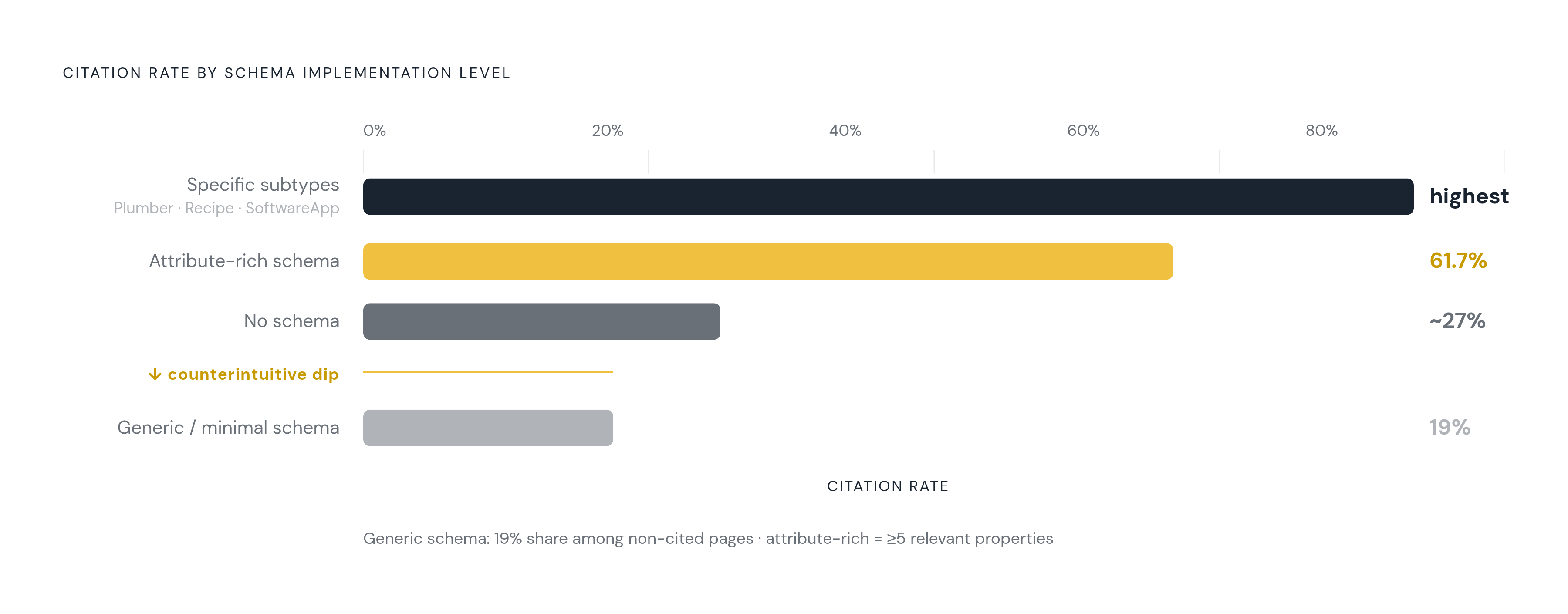
Schema App ran a study in 2025 across 14,200 pages and found something more specific than "schema helps." Pages using specific subtypes, things like Plumber, Recipe, SoftwareApplication, or JobPosting rather than a generic parent type, dominated among cited pages, while non-cited pages using generic schema accounted for only 19%. Specificity of type carries almost as much weight as having schema at all.
Independent research puts attribute-rich schema at a 61.7% citation rate. Minimal or generic implementations, oddly enough, underperform pages with no schema whatsoever, which is a real warning against half-finished markup projects. Meanwhile research indicates that a large majority of Google's first-page results use schema markup, but Schema.org's own figures put total adoption closer to 12.4% of the web. That gap between adopters and everyone else is the opportunity. The difference between "schema present" and "schema complete and specific" is the variable separating cited pages from ignored ones, running through every section below.
FAQPage schema: why conversational AI reaches for it first
Google restricted FAQ rich results back in August 2023 to a narrow band of government and health sites, which means most businesses stopped seeing FAQ snippets in their SERPs years ago. Oddly, that's exactly when FAQ schema got more valuable, not less, for a different reason: generative AI platforms crawl, extract, and cite FAQ structured data on their own terms, regardless of whether Google's classic SERP rewards it.
Research has found pages with FAQPage schema show up in AI Overviews 3.2 times more often than pages without any structured data. Relixir ran a study across 50 sites in 2025 and found a 41% citation rate for pages with FAQ schema versus 15% for pages without, roughly 2.7 times higher. SE Ranking's numbers are more modest, 4.9 average AI Mode citations for pages with FAQ schema versus 4.4 without, which is a real lift but a smaller one, and it's a useful reminder that schema and content quality are both doing work here, not one substituting for the other.
The channel itself is also just growing fast. AI-referred sessions jumped 527% between January and May 2025, reflecting how quickly this channel is growing.
What actually makes an FAQ block usable by an AI model: answers landing around 40 to 60 words, questions phrased the way a person would actually ask them out loud, and factual content that can be checked against whatever else sits near it on the page. Promotional copy dressed up as an answer doesn't extract cleanly and doesn't get cited. And the metric that matters is changing too. Impressions in Search Console for FAQ rich results is a dying signal. Citation frequency inside ChatGPT, Perplexity, and AI Overview answers is the one worth tracking now.
Organization schema and entity identity: the foundation everything else is built on
Semrush's 2025 study, covering more than 80,000 AI Overview results, found that 87% of cited business websites had complete Organization schema, including populated sameAs arrays. Among a random sample of small business sites, only 11% had the same. That gap runs wide. It's close to an order of magnitude.
Branded web mentions correlate with AI Overview citations at 0.664 in that same Semrush research, compared to 0.218 for traditional backlinks. Entity signals have overtaken link signals as the thing that predicts AI visibility, which is a genuine shift in what SEO work should prioritize. Google's Knowledge Graph holds more than 1.6 trillion facts on more than 54 billion entities as of 2024, and Gemini is trained on a broad mix of public sources rather than the Knowledge Graph specifically. Establishing your organization as a known entity, not just a domain with content on it, determines whether you're even in the running to get cited.
The properties doing the heaviest lifting: name, url, logo, sameAs, and @id. sameAs is the connective tissue, linking your Organization schema out to Wikidata, Wikipedia, LinkedIn, Crunchbase, wherever an AI system can go to confirm you're a real entity and not just a string of text on a webpage. knowsAbout declares what topics or industries you actually have expertise in, which builds a topical authority signal that makes you more likely to get pulled into answers within that domain.
One structural detail that trips a lot of organizations up: if your name is spelled or formatted differently across platforms, AI systems can split you into two separate entities entirely. That inconsistency is structural rather than cosmetic, and it undermines everything else you've built. And never fabricate a sameAs link. AI systems cross-check these claims, and getting caught with a false declaration works against you. Organization schema isn't something you set up once and forget either. External profiles change, and the schema needs upkeep to match.
Article and Person schema: how authorship and freshness signals reach AI systems
Organization, Person, and Article schema, linked together through @id references and sameAs connections to real external profiles, form what amounts to E-E-A-T rendered in machine-readable form. Research has found that schema-enhanced E-E-A-T declarations raise AI citation probability by 36% for pages with complete author and publisher schema.
The Article properties worth marking up: author, datePublished, dateModified, and headline, each one matched by a visible byline and a visible date on the actual page (remember, schema alone without visible confirmation gets ignored). Person schema should link authors back to the Organization through worksFor, with sameAs identifiers pointing to Wikidata, LinkedIn, and Crunchbase. This has become one of the highest-leverage things a site can implement for Knowledge Graph recognition and AI Mode citation.
knowsAbout works the same way on Person schema as it does on Organization schema: it builds a topical signal AI Mode can use when deciding whom to cite for a given subject. An author with a demonstrated, declared history in a topic is more likely to get quoted on that topic. The minimum viable stack for 2026 citation work looks like Organization, WebPage, and Article, all as server-rendered JSON-LD with stable @id values and sameAs arrays that are actually filled in, not left as placeholders.
Freshness deserves its own mention because it's a distinct signal from authorship. dateModified tells an AI system the content reflects current information, and that matters more for some platforms than others. Perplexity in particular leans toward recent, up-to-date sources and is more transparent than most about where its answers come from.
Product schema for commercial queries: what completeness actually means
For commercial queries, 84% of Google AI Overview product citations carried full Product schema, meaning Offer, AggregateRating, and brand together, not Product markup on its own. AI assistants need clear product data before they'll recommend anything, and ratings plus reviews add the credibility layer that tips a model toward citing one product over another.
Three properties make the difference: Offer (price and availability), AggregateRating, and brand. All three, not one in isolation. A Product schema block with just a name and a type declaration doesn't do much.
Some organizations have started connecting schema to live data feeds, so that when price or inventory shifts, the structured data reflects that change in real time rather than showing an AI system a stale snapshot from three weeks ago. That matters because a model querying outdated availability data gives a wrong answer with total confidence.
One policy detail worth flagging: self-review schema, where an Organization, Service, or LocalBusiness reviews itself, no longer earns the star rating snippet in search results. The schema still validates technically. The rich result just doesn't render anymore. And the broader principle holds across every schema type discussed here: declaring the type without its key sub-properties gets you little lift, and can leave you worse off than having no schema at all.
Service, LocalBusiness, and HowTo schema: where specificity of subtype determines the outcome
Product schema doesn't fit a business that sells services, which is where Service and OfferCatalog schema come in. Use Service with serviceType, provider, areaServed, and hasOfferCatalog populated, and reach for the most specific subtype available: LegalService, FinancialService, MedicalBusiness, whatever actually describes the business. The more specific the subtype, the more clearly an AI system can match it to what a user is actually asking for.
For LocalBusiness, schema needs to line up exactly with what's on the Google Business Profile. Any mismatch between the two, a different phone number, a slightly different address format, reduces citation confidence. Use the most specific LocalBusiness subtype that applies, and include the name, address, phone number, coordinates, hours, and a canonical URL for the location. Schema App's 2025 study on 14,200 pages backs this up again: cited pages leaned on specific subtypes like Plumber rather than the generic LocalBusiness parent type.
HowTo schema sits in an odd spot. Google no longer supports HowTo rich results, but the underlying structure, numbered steps laid out in HTML lists, is still the easiest format for a language model to pull apart and quote directly. The rich result disappearing doesn't mean the format stopped being useful for AI extraction. It just means you're not doing it for the SERP anymore. The catch: don't force HowTo schema onto a service description or an opinion piece just because you want the structure. Schema has to reflect what the page actually is, not what you wish it were.
Across all three of these types, the underlying principle is the same. Keeping your business information consistent and accurate across a wide range of endpoints, your site, your GBP listing, directories, is the kind of corroboration a model relies on when it's deciding whether it has enough confidence to put your name in an answer.
Schema types with limited AI citation value and one important nuance about how LLMs read JSON-LD
Not every schema type pulls its weight. Speakable schema was built for voice assistants, and it doesn't do much for text-based AI citation. VideoObject schema only earns its keep when video is genuinely the primary content on a page, not bolted on as a supplementary signal. And LocalBusiness schema, discussed above as valuable where location is real, simply doesn't apply to a purely digital product or service, so forcing it in doesn't help.
Google has also quietly retired reporting for a handful of types: Course Info, Claim Review, Estimated Salary, Learning Video, Special Announcement, and Vehicle Listing no longer produce rich results, according to 201 Creative's 2025 review of Google's documentation. Time spent implementing those is time better spent elsewhere.
The tokenization nuance from Mark Williams-Cook's February 2026 experiment deserves a second mention here because it changes how you should think about all of this. ChatGPT and Perplexity read JSON-LD as raw text, not as validated, ontology-checked structured data. They see the block, they don't check it against anything. Practically, that means your schema has to mirror your visible page with total accuracy, because a mismatched or fabricated block doesn't get flagged, it just misleads the model reading it.
None of this means schema is a weaker signal than advertised. Google's crawlers do parse and validate structured data formally, and those structured signals shape retrieval before an LLM ever gets near the page. The two processing layers are doing different jobs, and both matter.
Implementing schema so that AI systems can reliably extract and cite it
Format matters more than people give it credit for. JSON-LD belongs in the head of the document, or injected once per content block, not scattered as microdata across the HTML in a dozen different places. Validate regularly. "No items detected" errors show up constantly from mismatched types or from properties a schema type doesn't actually support, and a broken implementation is often worse than no implementation.
Pair schema with what's worth calling a liftable block: a tight 40 to 60 word answer capsule sitting under a heading phrased as a question, mirroring exactly how a user might ask it. That combination lets an AI system extract a complete, citable answer in one pass, instead of stitching fragments together from three different parts of the page and getting it half wrong.
Entity names and entity types should show up in the first 100 words of a page and in the headings themselves, phrased the way people actually talk when they ask a question out loud. Every piece of this, the FAQ block, the Organization schema, the Person and Article markup, the Product completeness, the subtype specificity, is working toward the same outcome: giving an AI system enough confidence, verified through visible content and corroborated by structured data, to put your name in its answer instead of someone else's.


