Using AI Assistants to Stress-Test Content Before Publishing
AI hallucinations require a verification layer before any content goes live.

Publishing content without checking it against a real editorial standard used to mean a typo slipped through, or a stat went stale. Now it means a fabricated citation, an off-brand paragraph, or an invisible page goes out at scale, in minutes, because the draft came from a model instead of a person with a coffee and a deadline. The fix isn't a better model. It's a structured review layer sitting between generation and publish, one that checks facts, voice, and whether AI answer engines will ever surface the piece at all.
The hallucination problem: what the error rates mean for content teams
Start with the spread, because a single number hides more than it reveals. The best-measured models are in the low single digits on any given hallucination test. The median cluster runs mid-teens to twenties. And in Bluejay's broad real-world sample, the weakest performers cross 40% (Bluejay, 2026). That's not a rounding error. That's a substantial share of claims needing a second look.
Citations are their own problem inside the problem. Claude hallucinated in-text citations in roughly 3% of academic passages tested; GPT-5.4 Sol hit about 8% (ProofreaderPro, mid-2026). Both numbers sound small until a piece runs sixty citations and three or four of them point to sources that don't say what the draft claims. Paperpile's scan of recent arXiv submissions puts hallucinated citations at roughly 0.4% of the total, and the report's more unsettling finding is that the artifact is getting more common, not less, even as the underlying models improve (Paperpile).
Model behavior isn't uniform here, and that matters for whoever picks the review tool. Anthropic's Constitutional AI training makes Claude more likely to say "I'm not sure" instead of inventing a fact outright (NeuraPulse, June 2026). That's a meaningfully different failure mode than a model that states a wrong answer with total confidence, and that difference matters when deciding which AI reads the draft second.
Fluency is the trap. A hallucinated stat reads exactly as smooth as a real one. An editor scanning for polish is checking the wrong thing entirely. Across 200 controlled runs, 34% of responses produced materially different answers between competing models on the same question, 27% contradicted themselves across runs, 48% shifted their own reasoning mid-answer, and 61% of identical prompts run twice produced materially different output, a structural pattern rather than noise at the edges (Bluejay, 2026). That's not noise at the edges. That's how these systems behave, structurally, every time.
None of this gets solved by switching models. It gets managed by a verification layer that sits outside the generation step, on purpose, every time.
The four dimensions every stress-test must cover before a piece goes live
Four separate quality gates, not one checklist. Each one fails differently, and each one gets fixed differently, which is the whole reason to keep them apart instead of folding them into a single "does this look okay" pass.
Factual accuracy comes first. Every statistic needs a source someone can actually pull up. Every case study needs to name a real company doing a real thing. Technical claims about how AI systems behave need to reflect current practice, not whatever the model's training data happened to freeze in place months or years ago (Sight AI). Prompt Builder's framing from July 2026 states that AI is often fluent when it's wrong, so facts get checked before anyone touches tone or structure.
Brand voice consistency is next, and it's sneakier than it sounds. A paragraph can be entirely accurate and still read like nothing a specific brand would say. Glean's research flags a convergence problem: when several brands run the same AI tools on the same vague prompts, the output starts sounding interchangeable, which quietly erodes whatever made each of them distinct in the first place. The convergence risk is real: when voice becomes indistinguishable from any other AI-assisted brand, reader trust erodes even when accuracy holds. Trust, in other words, now runs on voice as much as accuracy. Prompt Builder's July 2026 benchmark for high-performing B2B teams sets the bar at 82% or better brand-voice compliance measured at the moment of publish.
Argument structure and originality follow. Drafts built by language models tend to repeat the same point across three sections in three different phrasings, which reads as padding even when each sentence is individually fine. Watching for overclaiming, false certainty, and bias, especially in categories where trust carries regulatory weight, is also part of the ethics pass at this stage.
AI-surface readiness is the fourth gate, and it's the one editorial teams skip most often because it doesn't look like a writing problem. A piece can be factually sound, on-brand, and well-argued, and still never appear in a single AI-generated answer. That's a big enough issue to earn its own section, so the detail waits until the next one.
SEO and on-page tuning come after all four gates, not before. Optimizing for keywords on a draft with the wrong voice just locks in the wrong voice with better metadata (Prompt Builder, July 2026).
Why AI-surface readiness must be a stress-test gate, not an afterthought
The traffic math changed enough that this gate isn't optional anymore. Ahrefs found that AI Overviews cut click-through rates for top-ranking Google content by 58%, up from 34.5% the year before (Jasper, June 2026). Stackmatix reported that over 60% of Google searches now end with no click to any third-party site at all. And ChatGPT alone processes 2.5 billion prompts a day, with 65% of them functioning as search queries, at a click-through rate 96% lower than Google's (Jasper, June 2026). Readers are asking questions. Answers are arriving without a visit.
Answer engine optimization and generative engine optimization, AEO and GEO, get used interchangeably by people doing the work. Both describe the same goal: getting a brand accurately and prominently cited inside AI-generated answers on ChatGPT, Google's AI Overviews, Gemini, and Perplexity (Scrunch).
The baseline numbers are humbling. Citation rates in AI responses average 2 to 8% of monitored queries across industries, with the leaders reaching 15 to 25% on their core topics (Stackmatix, 2026). Accuracy runs similarly uneven: brands get represented correctly by AI systems 70 to 80% of the time on average, while the top performers hit above 90% through deliberate entity optimization and active management of their knowledge graph presence (Stackmatix, 2026).
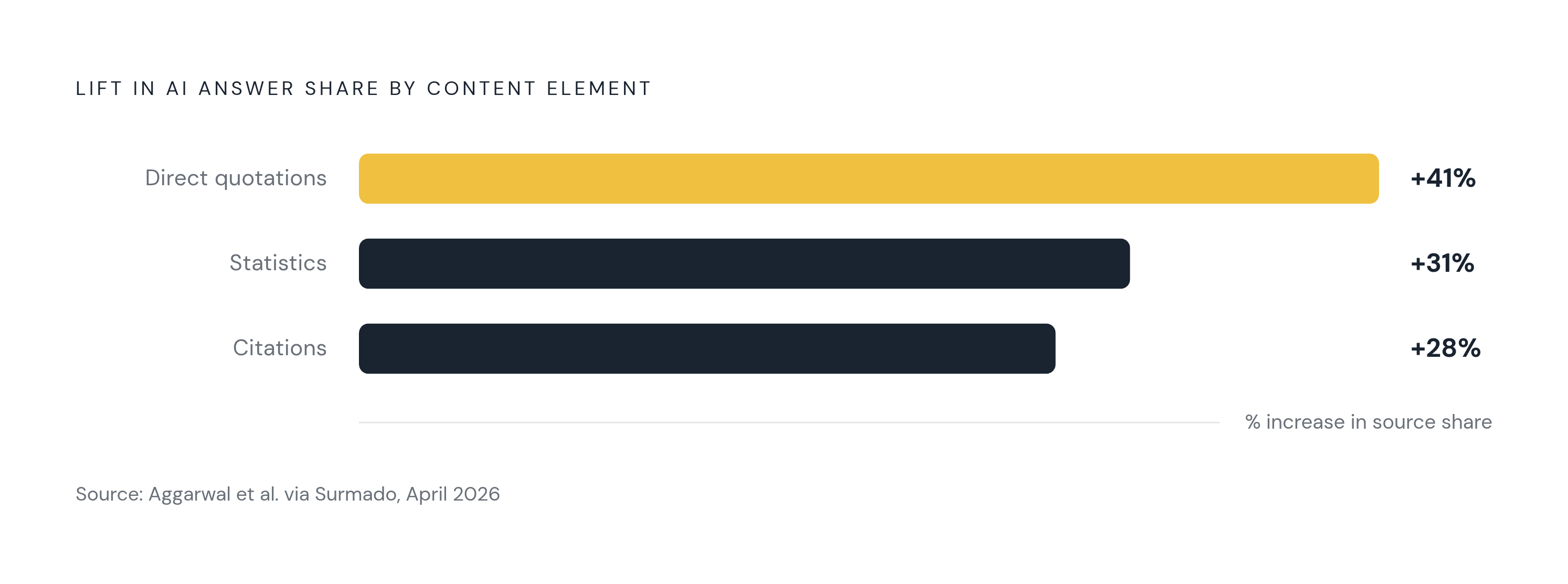
What actually moves those numbers is specific and reviewable before anything gets published. Research from Aggarwal and colleagues found that adding direct quotations from credible sources raised a source's share of an AI-generated answer by roughly 41%. Statistics added about 31%. Citations added about 28% (via Surmado, April 2026). These aren't mysterious ranking signals; they're structural choices an editor can check line by line.
On-page quality alone won't get a brand cited, either. AI systems crawl for credibility signals well beyond the page itself: mentions on industry portals, activity on brand social accounts, expert profiles on LinkedIn. Miss those, and the citation doesn't happen no matter how well the article is written (Delante, December 2025).
Platforms don't weight any of this the same way. A single generic GEO pass misses real gaps. Google's AI Overviews lean on organic ranking strength but pull from well beyond the top 10 results. Perplexity weighs signals differently from Google's organic ranking model. Copilot retrieves through Bing's index, which behaves differently from Google's in ways that matter for what gets surfaced.
Budgets are already following the shift: 94% of CMOs plan to increase AEO spending this year, according to Conductor's State of AEO/GEO CMO Investment Report (via yesoptimist.com). For any team managing client budgets, that number alone makes GEO readiness a commercial line item, not a nice-to-have.
The sequential review workflow: the order of operations that high-performing teams use
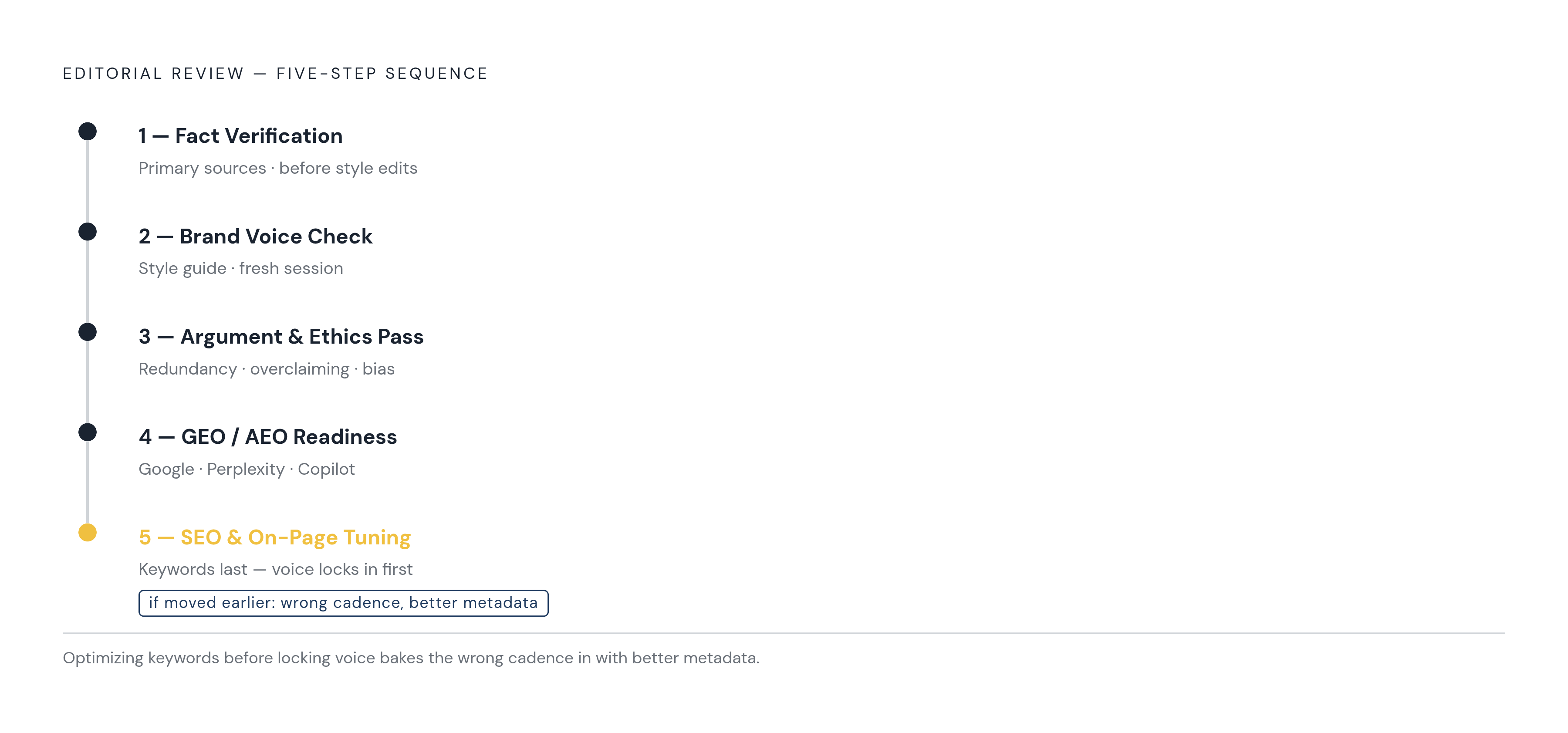
Order isn't a stylistic preference here; it's load-bearing. Fix argument structure before verifying facts, and time gets wasted rewriting sections built on claims that turn out false. Add SEO optimization before locking voice, and the wrong cadence gets baked in with better keyword density attached to it.
Step one is fact verification, done first and done against primary sources, not against the model's own confidence. Every statistic, every named case, every claim about how a tool or a platform behaves gets checked before a single sentence gets touched for style. A model that flags its own uncertainty, the way Claude tends to, makes a better review partner at this stage than one that states everything with the same flat confidence regardless of whether it's right.
Step two checks brand voice, against an actual style guide loaded into the review session, not against a reviewer's general sense of "does this sound off."" A model checking its own output for voice drift has less incentive to notice the drift than a fresh session does. Generic-sounding prose at this stage is a signal the original prompt lacked real brand context, not proof the piece just needs a light polish.
Step three examines argument structure and redundancy. Map where the piece repeats itself before declaring the structure sound. The ethics and sensitivity pass happens here too: overclaiming, unearned certainty, bias, all weighed with extra care in regulated or high-trust categories, where a wrong claim carries more than reputational risk.
Step four is the GEO/AEO readiness audit. Confirm every stat has a source citable by an AI system, not just readable by a human. Check that the piece's key conclusions land early and in a form that summarizes cleanly, since AI tools tend to favor pages where the answer is easy to extract quickly. And run this check per platform, since Google, Perplexity, and Copilot don't weight the same signals.
Step five, last, is SEO and on-page tuning. Keyword stuffing at this stage actively hurts both traditional search ranking and AI citability, so restraint here matters as much as coverage (Delante, December 2025).
Analyst estimates from The Starr Conspiracy put editor rework on first AI drafts somewhere between 20% and 35% (via Prompt Builder). A workflow that catches error categories systematically, in a fixed order, brings that number down by design, rather than by hoping the next draft happens to be cleaner.
Using a second AI instance as a simulated skeptical reader
Open a second AI session, separate from the one that wrote the draft, and have it read the piece in character, as a skeptical buyer, a doubtful editor, a reader looking for a reason to stop trusting the piece.
The separation matters mechanically. The model that generated the draft carries context from that generation, which makes it a weaker judge of its own errors. A fresh session with a different role prompt carries no such bias toward defending what it already wrote.
The prompting style matters too. Asking a model to hunt for specific, named errors tends to produce a shallow pass; asking it to inhabit a skeptical role, "read this like a buyer who doubts the statistics," tolerates more natural variation in how the model responds and tends to reveal real weak points, visible when the model reasons through the role, rather than a checklist of nitpicks (TestBooster.ai, July 2026).
This catches things a rules-based checklist can't. A claim that's technically true but unpersuasive to an actual reader. A tone shift between two sections that isn't grammatically wrong but breaks the read anyway. An argument that feels, on a fresh pass, like it's circling back on itself without adding anything new.
A few prompt patterns do this reliably: asking the model to read as a skeptical CMO deciding whether to share the piece internally, asking it to flag any claim it couldn't verify from the text alone, asking directly whether the piece reads as one consistent voice or several stitched together.
None of this replaces fact verification. The second AI instance is still a language model without access to outside sources, so it can find a claim unconvincing without ever knowing the claim is also wrong. This technique adds a layer. It doesn't substitute for the harder, slower work of checking facts against something real.
How agencies running multiple client brands scale this workflow without losing per-client quality
Agencies feel this pressure hardest, because the demands stack. Clients want faster turnaround, AI search is reshaping how any brand gets found in the first place, and traditional SEO alone no longer guarantees visibility. A content operation now has to cover the full arc, tracking what AI systems already say about a brand, drafting content that fixes gaps, and publishing it in a form built for both readers and answer engines (Sight AI, July 2026).
Voice consistency is the sharpest version of this problem at portfolio scale. The same convergence risk noted earlier, generic prompts producing generic, interchangeable output, gets worse with every additional brand run through the same tools without distinct grounding. Keeping five or ten client voices genuinely separate takes structured voice controls built into each account's setup.
That means the review workflow from the earlier sections can't run once across a whole client roster. It has to run once per client. Each brand needs its own style guide loaded into the review session, its own fact-checking standards where regulatory exposure differs, and its own GEO criteria, since a law firm and a consumer app aren't competing for citations in the same way or on the same platforms.
Multi-agent setups are starting to handle this at the operational level: AI agents that hold long-term context and run multi-step workflows let an agency split research, drafting, review, and publishing across coordinated agents, each following the shared rules for its assigned client rather than one generic set of instructions applied everywhere (AI Growth Agent).
Thrad for Agencies is built around that exact problem: account teams get a structured way to keep each client's fact standards, voice rules, and GEO criteria separate and enforced, so scaling output across a roster of brands doesn't mean quietly flattening what made each one distinct.