How AI Answer Engines Select Citations
AI engines use specific criteria to decide which sources appear in their answers.

AI search reaches 1.5 billion users, according to Google at its 2025 I/O event. ChatGPT crosses 800 million weekly users, roughly double where it stood a year earlier, and fields over 2 billion queries a day. AI-referred traffic to websites grew 527% year-over-year through mid-2025. A while was spent trying to figure out whether these numbers were just noise, another wave of hype metrics that would look silly in a year. They don't hold up that way. Something has shifted in how people find things online, and it's happened fast enough that most publishers are still optimizing for a search engine that fewer and fewer people are actually asking questions to first.
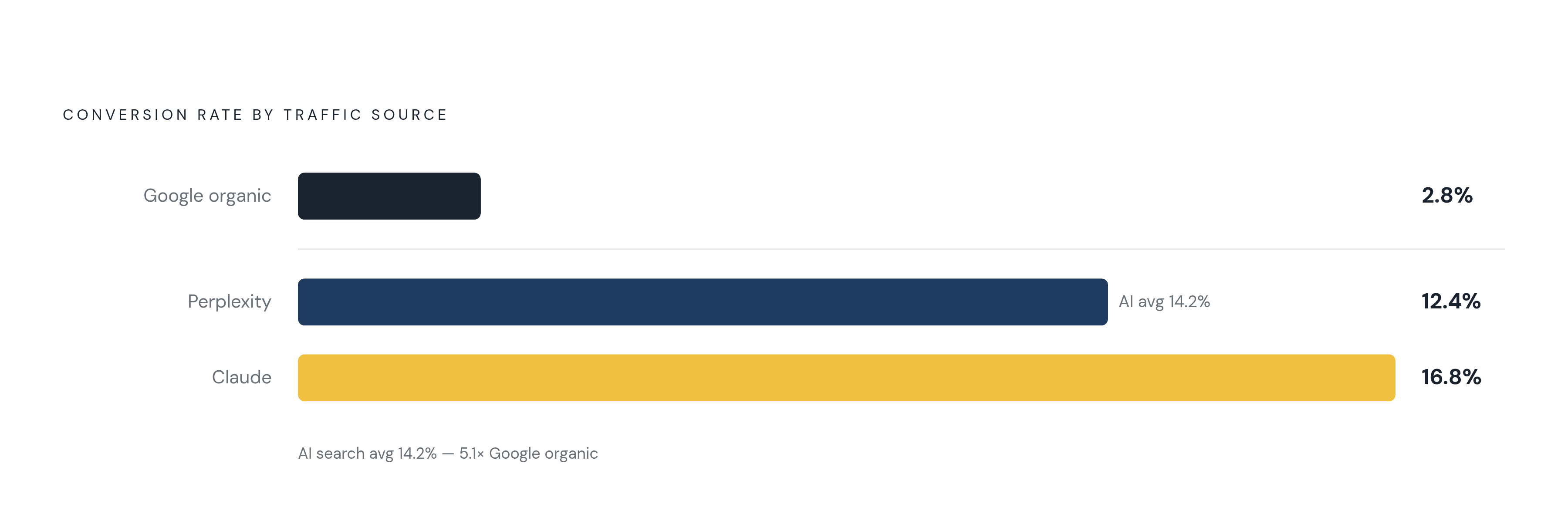
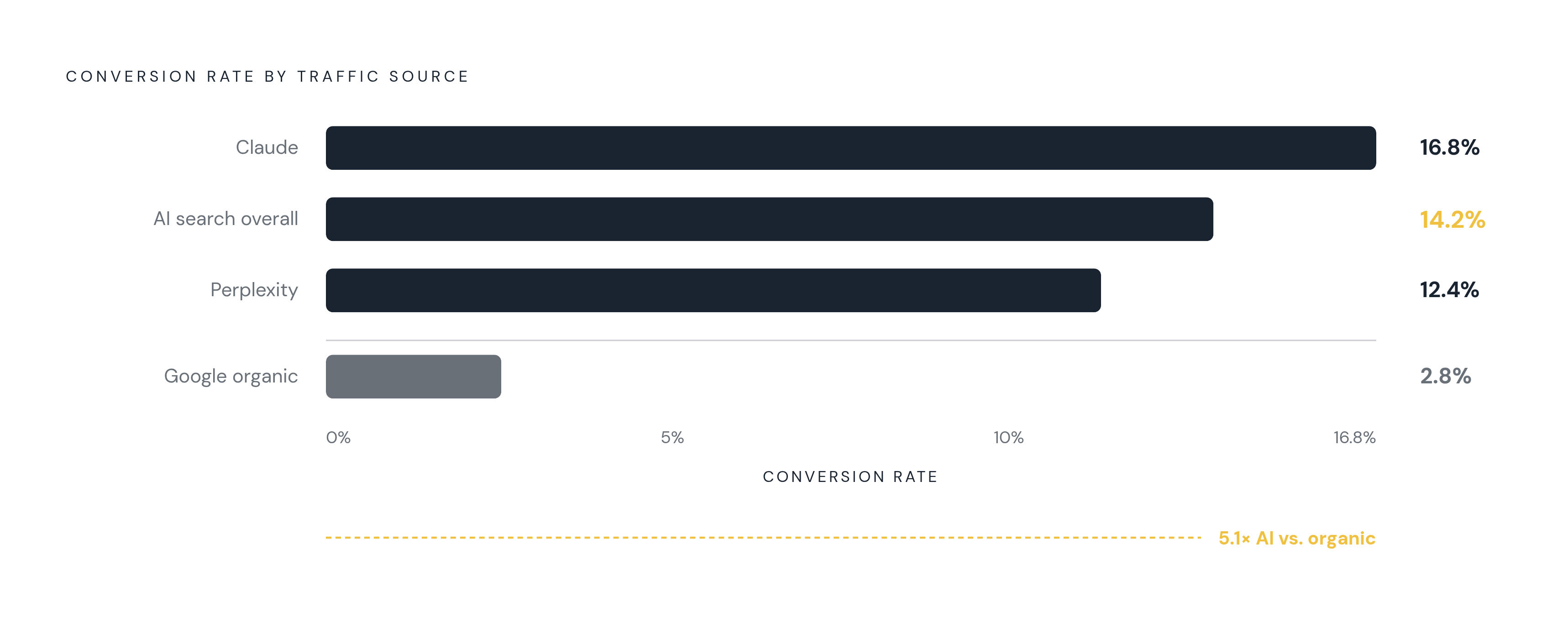
Here's the part that made the numbers worth re-checking three times: this traffic doesn't just exist, it converts. According to Loganix, AI search traffic converts at 14.2%, against 2.8% for Google organic. That's a 5.1x gap, and the first instinct was to assume some kind of sampling bias — smaller volume, easier to inflate the rate. But break it down by platform and the pattern holds with some variation: Claude users convert at 16.8%, Perplexity at 12.4% (Exposure Ninja, March 2026). The logic isn't mysterious once you sit with it. Someone typing a fully-formed question into ChatGPT has already done the browsing. They're ready to act, not still comparing options. Pew Research found 58% of surveyed US adults ran into an AI summary in a Google search within a single month, which means this isn't a niche behavior anymore. It's the default.
What all this adds up to is a strange new fact, one that took longer than expected to actually believe: a page can rank #1 on Google and be functionally invisible to an AI engine. Or it can sit at position 8, buried on page one, and get cited by ChatGPT ahead of everything above it. That's not a glitch. It follows a specific, learnable logic, and the rest of this piece walks through it stage by stage, starting with the plumbing.
How RAG pipelines connect a user's question to a cited source
Most AI engines that pull live web content run on something called Retrieval-Augmented Generation, or RAG. The name sounds abstract, but the mechanics are pretty concrete once you break them down. A user asks a question. The engine converts that question into a vector embedding (a numerical fingerprint of what the question means, not just the words it uses), searches an index for passages that match that meaning, re-ranks the results, writes a response in natural language, and then attaches sources to the claims it made.
Notice what's missing from that list: copying and pasting. The engine isn't lifting your paragraph and slapping quotation marks around it. It's extracting a fact, a number, an explanation, and rewriting it in its own words before crediting you for the idea. That distinction matters more than it sounds like it should, and the next section leans on it hard.
Each major engine also plugs into a different retrieval backend, and that choice alone determines what content the engine can even see. ChatGPT's web-browsing mode runs through Bing. Claude uses Brave Search. Perplexity maintains its own index of roughly 5 billion URLs. Gemini, unsurprisingly, taps Google. A page that Bing has never indexed is invisible to ChatGPT Search, full stop, no matter how good the writing is. That's a search backend 800 million weekly users depend on without realizing it.
Here's a wrinkle that took a few passes through the data to actually pin down: AI engines don't search the web every time. ChatGPT activates web search on roughly 34.5% of queries, according to Semrush. The rest of the time, it's answering from what it already learned during training, no retrieval involved. Perplexity, by contrast, searches the web on nearly every query it gets. Two products that look similar from the outside are running on almost opposite postures. Which means the question "how do I get cited by AI" splits into two separate questions: how do you get into the training data, and how do you get retrieved live. Different problems, different fixes.
All of this explains why RAG citation logic diverges from Google's PageRank logic in a fairly fundamental way. PageRank, at its core, counts votes: who links to you, and who links to those people. RAG cares about something closer to fit: does this specific passage answer this specific question clearly enough to extract and attribute? Domain authority still matters, as later sections will show, but it's no longer the whole game.
The five sequential checks every candidate page must pass before being cited
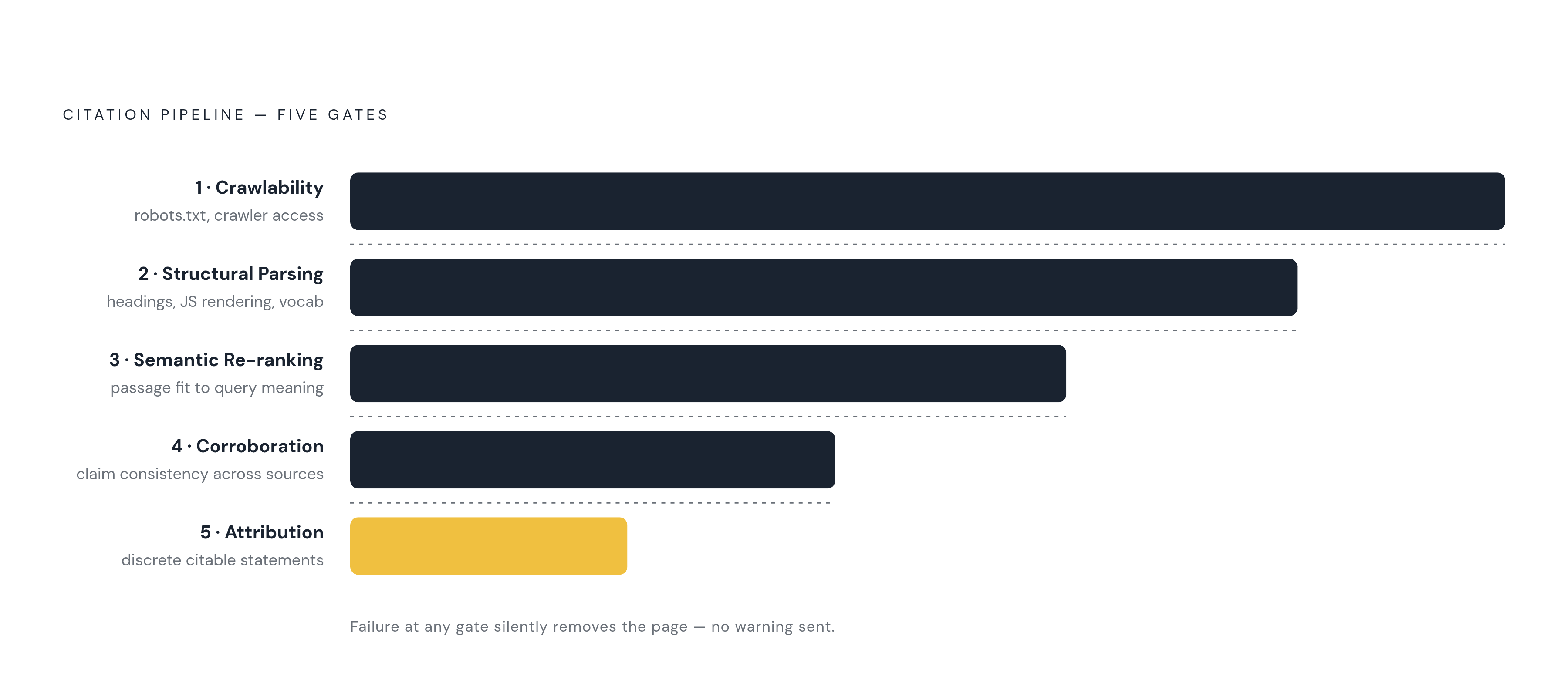
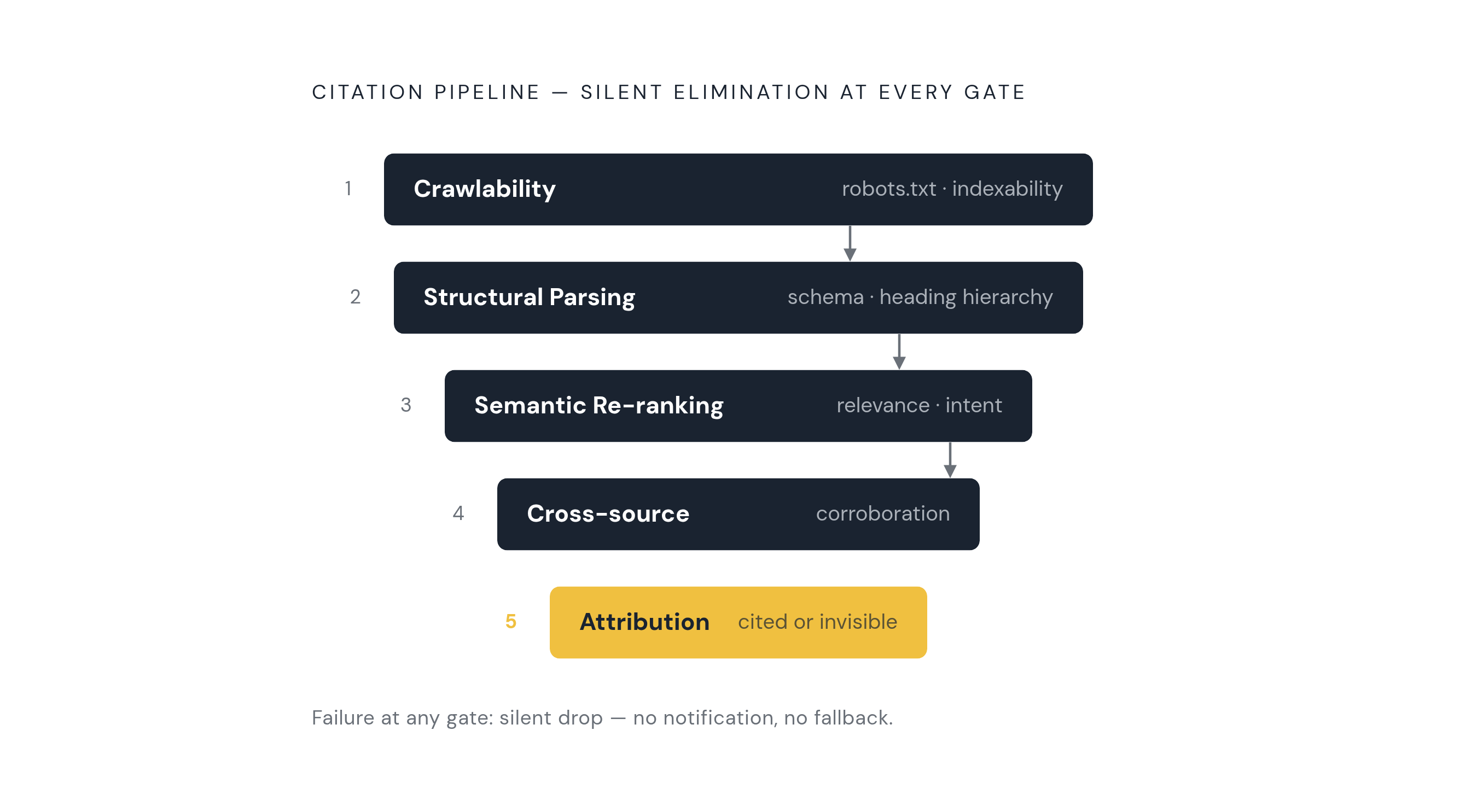
Think of citation as a funnel with five gates, and a page that fails any single gate gets quietly dropped, no error message, no notification, nothing. The publisher never finds out their page was in the running and lost. It just doesn't show up.
Stage one is crawlability, and it disqualifies more pages than any other stage, mostly without anyone noticing. OpenAI's own crawler documentation says, in plain language, that a site blocking OAI-SearchBot in its robots.txt will not appear in ChatGPT search answers. Every other engine has an equivalent rule for its own crawler. One misconfigured robots.txt file, maybe set up years ago by a developer who's long since left the company, can silently erase a site from every AI engine simultaneously. Nobody sends a warning email about it.
Stage two is structural parsing. The crawler got in the door, fine, but can it actually make sense of what it's looking at? A page that renders its content entirely through JavaScript often shows the crawler an empty shell; a page with no real heading structure gives the crawler nothing to hang an extraction on. Add in vocabulary mismatch, where the page uses internal jargon nobody actually searches for, and you've got a page that's technically accessible and practically unreadable. Fix these structural issues and a mediocre writer will often out-cite a brilliant one who never bothered. Letterstory, for instance, automates the drafting and publishing steps around exactly this kind of structural hygiene.
Stage three is semantic re-ranking, where the surviving pool gets narrowed down to whichever passages best match what the question actually meant, not just which words it used. This is where RAG really splits from PageRank: it rewards clear structure, matched vocabulary, and passages that can stand alone as a complete answer, not backlink volume. A page sitting at position 8 on Google, with one clean paragraph that nails the question, can leapfrog the organic #1 result in an AI answer. Google's ranking and the engine's citation choice are simply answering different questions.
Stage four is cross-source corroboration. The engine checks whether a claim shows up consistently across other indexed sources. A claim with zero corroboration gets discounted, even if it comes from a domain with plenty of authority elsewhere. The uncomfortable implication, and one worth sitting with: publishing a genuinely novel claim, all on its own, with nothing else in the index backing it up, is a structural disadvantage at this stage regardless of how true or well-argued the claim is.
Stage five is attribution, where the engine decides which document gets credit for which fact, and how prominently to feature it. Content built around clear, discrete, citable statements tends to win here over content that buries its best insight in the middle of paragraph four. This is the stage where formatting stops being a stylistic choice and starts being a lever you can pull directly.
The signals that most reliably increase the probability of being cited
Start with the widest lens available. A September 2025 study on arXiv (Kumar et al., arXiv:2509.10762) looked at hundreds of citations across Brave Summary, Google AI Overviews, and Perplexity using a 16-pillar quality framework, and found that overall page quality carries an odds ratio of 4.2. Translation: a high-quality page is roughly four times more likely to get cited than a low-quality one. That's not a vague editorial compliment; the pillars behind that number point to specific, checkable attributes on the page itself.
Two of the highest-leverage moves a publisher can make cost almost nothing to implement, which is the most surprising part of digging through this. Research from Princeton's GEO project (2024) found that adding sourced statistics to a page increased citation frequency by 41%. Adding a named expert quote bumped it by 28%. The same research found citing outside sources raised citation rates by 40%, adding statistics by 37%, and adopting an authoritative tone by 25%. None of that requires a rewrite. It requires opening the existing page and adding a number with a source attached, and a quote from someone with a name and a title.
Vocabulary alignment turns out to matter independent of how big or established the domain is, and this is one of the few findings here that actually contradicts old SEO instincts. Research from Discovered Labs (2026) found vocabulary alignment carries a causal effect of β=+0.37, the only page-level signal in that study confirmed to work independently of domain authority. Practically, that means a small site using the exact words buyers actually type into a search bar can out-cite a major brand's page that uses internal product terminology instead. Worth auditing: does the page say "pricing," or does it say "cost structure optimization framework"?
Entity density in the opening passage is another concrete, auditable target. The pattern that shows up across the highest-cited content: 4 to 6 named entities (people, companies, products, places) packed into the first 200 words, with research-heavy content pushing 7 or 8. A generic opening with one or two named things in it consistently underperforms across every platform tested. It's the difference between opening with "companies use various tools to solve this problem" and opening with a sentence that names three actual companies and a specific tool.
Outbound links matter too, and not in the way older SEO advice warned against, which required some unlearning. Research from Authoritas (2025) found that linking out to authoritative sources delivers a 132% visibility boost in AI answers, on its own. Broader GEO optimization research found content built around expert opinions or original data shows 30 to 40% higher visibility in AI-generated answers. The old fear of "leaking link equity" by linking offsite doesn't really apply here; a page that cites its sources is behaving the way the engine wants sources to behave, and gets rewarded for it.
Finally, isolated pages lose to clusters. Sites built around interlinked groups of related content outperformed broader, shallower sites by up to 30% following the June 2025 Core Update. Since the December 2025 Core Update, the E-E-A-T standard (Experience, Expertise, Authoritativeness, Trustworthiness) that used to apply mainly to medical and financial content now extends to essentially every category, and 96% of citations now trace back to sources that can demonstrably back up their authority. Building one great page is no longer enough; the page needs neighbors.
How citation behavior differs across ChatGPT, Perplexity, Google AI Overviews, Claude, and Gemini
A Conductor study tracked citation patterns across AI platforms from September 2025 through March 2026, gathering 1,056 data points, and landed on a finding that should reshape how content teams plan: one strategy can't cover the whole AI search landscape anymore. These platforms don't just look different. They behave differently at a structural level, and untangling that difference is where most of the real work in this piece lives.
The clearest divide is between how widely a platform cites and how deeply it uses what it cites. A separate arXiv study (arXiv:2604.25707) scored citation influence: ChatGPT averaged 0.2713, Perplexity 0.0646, Google 0.0584. Perplexity casts the widest net of the three, pulling in roughly 16 sources per answer, but each one contributes barely anything to the actual response. ChatGPT works the opposite way: it cites around 7 sources per answer but pulls 4.2 times more language and evidence out of each. Getting cited by ChatGPT means the content actually shaped what the model said. Getting cited by Perplexity often means the URL showed up in a list. Both count as a citation. They are not the same event.
Format preferences split sharply too. An 83,670-citation dataset found ChatGPT leans hard toward product pages, at 60.1% of its citations, while Claude favors blog content, at 43.8%. Perplexity, in that same dataset, never cited Wikipedia once. ChatGPT used Wikipedia for 12.1% of its citations. Perplexity also generates 1.26 citations per brand mention, 29% more than ChatGPT, which fits the wide-but-shallow pattern already established: more citations, less weight per citation.
Underneath the format question sits the retrieval-architecture question, and this is where the training-data-versus-live-retrieval split from earlier comes back around. Perplexity and Gemini run on real-time retrieval, which rewards factual consensus, freshly published links, and content broken into clean, modular passages. ChatGPT and Claude lean more on what they absorbed during training, which rewards depth and established topic authority over recency. And the Bing dependency noted earlier still applies here directly: a site indexed only by Google is invisible to ChatGPT's web-enabled search mode, no matter how well it performs on Gemini.
Then there's the industry layer, which took some digging to confirm and nobody seems to talk about enough. Research into industry-specific citation patterns suggests AI engines apply different source hierarchies depending on topic category. Across the board, user-generated platforms and encyclopedic references consistently outrank the sites that have historically won traditional SEO. That's a genuinely strange result if you're coming from a classic search-optimization background: a Reddit thread can outcite a polished corporate landing page, because the engine treats the thread as a corroborating, human-voiced source rather than a marketing document.
What the decoupling from Google organic rank means for how content gets built
Here's the sentence that should anchor all of this: a page can sit at #1 on Google and fail the RAG pipeline completely, while a page at position 8 with one tight, self-contained answer gets cited ahead of it. That's not a bug and it's not random noise in the system. It's the direct, predictable result of a pipeline that weighs passage clarity, semantic fit, and corroboration more heavily than accumulated link authority.
Which raises the obvious next question, one worth circling back to throughout this work: if rank position isn't the target anymore, what is? The answer, based on everything above, is passage-level citability. Content needs discrete, attributable claims sitting inside it, not just broad, comprehensive coverage of a topic, because the engine extracts and credits at the level of the individual claim, not the page as a whole. A lengthy guide that never states a clean, standalone fact is less citable than a 400-word page that states four of them clearly. Structural clarity, meaning real headings, self-contained sections, and entity-dense openings, isn't a nice-to-have UX polish item anymore. It's closer to citation infrastructure, the underlying framework that determines whether the content can be extracted at all. And vocabulary aligned to how buyers actually phrase their questions, rather than internal product language, carries a documented effect independent of how big or established the brand behind it is.
Speed matters in a way it didn't under pure SEO. Perplexity and Gemini reward fresh links and current factual consensus in real time, which means a page that ranked comfortably last year can get quietly pushed out by a newer page saying the same true thing more recently. Comprehensive is good. Comprehensive and current wins.
There's a squeeze happening too, worth sitting with for a second. Google's top 10 results typically surface around 10 different domains for a given query. AI answers usually pull from somewhere between 7 and 16 sources. That's a winners' circle that's, at best, comparable in size, and often meaningfully smaller once you account for how concentrated the actual language-extraction weight is (recall ChatGPT's 4.2x figure from the last section). Content strategies built on broad keyword coverage, without any attention to the specific citation signals covered here, are going to watch their traffic concentrate into a smaller and smaller group of competitors who happened to engineer for citability early.
None of this requires a massive domain or a decade of backlink accumulation to compete on. Vocabulary alignment, entity density, outbound citations, clean formatting, and basic crawler access are all things a publisher controls directly, starting today, regardless of company size. The mechanics aren't secret. They're just underused, and that gap is exactly where the opportunity sits for whoever reads this far and actually goes and checks their robots.txt file.


