Fact-Checking Processes for AI-Generated Content at Scale
Prioritize fact-checking high-risk claims before AI systems propagate errors.

At high publishing volume, fact-checking is no longer a line-item on an editorial checklist but an architecture problem, because a single unverified claim no longer stays contained in one article. It propagates into every downstream AI answer that later cites that content as a source. Language models produce text by predicting likely word sequences, not by checking facts against reality as they go, so a wrong figure or a misattributed quote reads exactly as smooth and confident as a correct one. There's no hedge in the sentence, no flag in the prose, that tells a reader or an editor which parts were actually checked.
Trysight.ai's 2026 guide names the pattern that makes this worse than ordinary editorial error: secondary citation drift. A statistic starts in an academic study, gets summarized loosely in a blog post, gets rephrased again in an industry roundup, then gets absorbed into a model's training data in a distorted form. Compounding this, every model carries a knowledge cutoff, so a statistic that was accurate when the training data was collected can be a year or more stale by the time it's published, and in fields like digital marketing or consumer technology, a stale number can mislead a reader even though it was once true. Named entities fail in their own way too: models routinely merge two companies with similar names, attribute a statement to the wrong executive, or invent a title that sounds plausible but isn't real.
The stakes of this error pattern are set by how generative engine optimization actually works. Content written for AI citation gets pulled apart and resynthesized into an answer, not read start to finish and weighed in context by a human. A reader scanning a flawed paragraph might catch an inconsistency or sense something's off. An answer engine extracting a single claim from that paragraph has no such instinct. It will quote the number, attribute it to the brand that published it, and serve it to thousands of users who never encounter the source article. That's the mechanism that turns one unchecked statistic into a durable, hard-to-trace error running through an information ecosystem the publisher no longer controls. Fixing it later, once an engine has absorbed it, is far harder than catching it before publication, which is the reason triage has to happen on the front end, not after the fact.
Not all claims carry equal risk, and triage is where scale becomes manageable
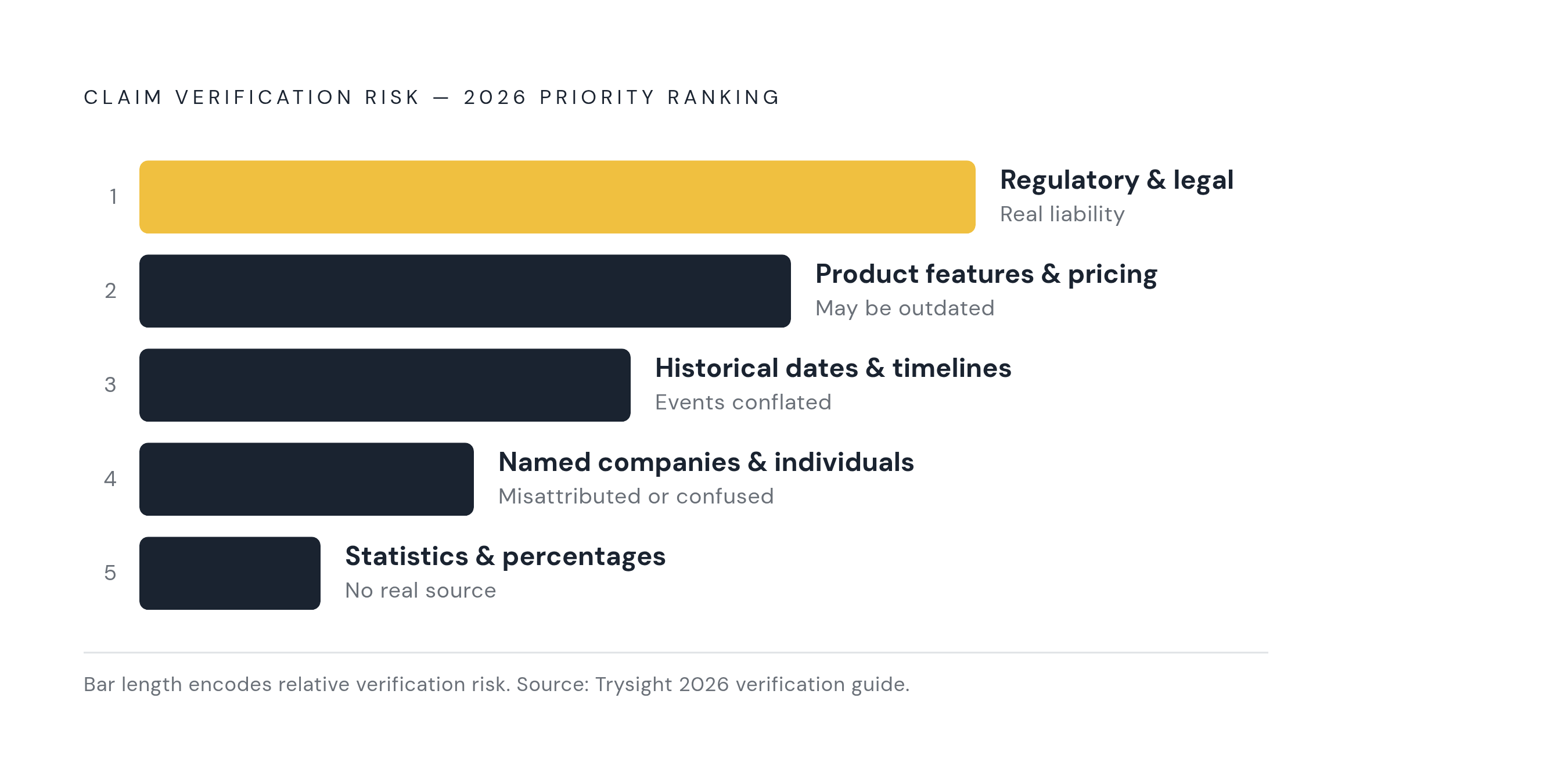
Scale does not require checking every sentence with the same intensity. It requires knowing, before verification even starts, which claims will do the most damage if they turn out to be wrong. Trysight's 2026 guide identifies five categories that consistently carry outsized risk and deserve attention ahead of everything else in a draft. Statistics and percentages top the list, because models are especially prone to generating precise-sounding figures that have no real source behind them. Named companies and individuals come next, since models routinely confuse similar entities, merge two organizations into one, or attribute a quote to the wrong person. Historical dates and timelines follow, with errors clustering around events that happened close together in time or share overlapping context, which makes them easy for a model to conflate. Product features and pricing claims need the same scrutiny, because products change and get discontinued, so a claim that was accurate at training time may no longer match current documentation. Regulatory and legal statements sit at the top of the risk scale, because getting one wrong carries real liability and demands the highest level of scrutiny available.
The practical move here is a highlight pass: read the draft once, not to verify anything yet, but simply to mark every sentence that depends on an external fact for its truth. That single read tells an editor exactly where the real risk sits before a minute is spent chasing down sources. The common failure mode is skipping this step entirely and fact-checking line by line from the top of the piece down, which wastes time confirming low-risk descriptive sentences while a buried statistic three paragraphs down, the one actually capable of causing harm, goes unchecked. Triage means putting the available verification effort where an error is both more likely to occur and more costly if it does, which is what makes checking thousands of pieces a month a workable task rather than an impossible one.
Tracing statistics to primary sources, and what to do when the trail goes cold
Once a statistic has been flagged as high-risk, the standard it has to meet is straightforward: there needs to be a traceable path back to a named primary source. If that path doesn't exist, the number shouldn't run as stated, no matter how plausible or widely repeated it looks. The secondary citation drift described earlier produces statistics with no real origin point, and the warning sign is easy to spot once you know to look for it. A search for the exact figure finds only blog posts and content aggregators citing one another in a closed loop, with nobody pointing back to an actual study, survey, or dataset. That pattern alone should stop a claim from running as a hard number.
When a source is actually located, Trysight's 2026 guide lays out three checks before the claim gets approved. The first is publication year: given how fast a field like marketing technology or AI tooling moves, is the figure still current, or was it accurate only at the time it was gathered? The second is contextual fit: does the statistic actually describe the scenario the article is making it describe, or has it been pulled from an adjacent context and stretched to fit? The third is source credibility, where government databases, peer-reviewed journals, and named industry reports with a clear publication date set the bar, and a vendor's self-published survey with no disclosed methodology warrants real skepticism before it gets treated as fact.
When none of this produces a verifiable source after a reasonable search, the fix is not to publish the number with a hedge attached or to soften it slightly. The fix is to drop the specific figure and replace it with qualified general language, something like "research consistently shows" or "many practitioners report," rather than running a number nobody can stand behind. This isn't a matter of editorial caution for its own sake. A team that keeps publishing unverifiable statistics is building a content library that answer engines may treat as a source. A bad figure gets repeated across every AI-generated answer that cites it, with no way for the original publisher to retract or correct it downstream.
Staged verification checkpoints across a multi-step pipeline
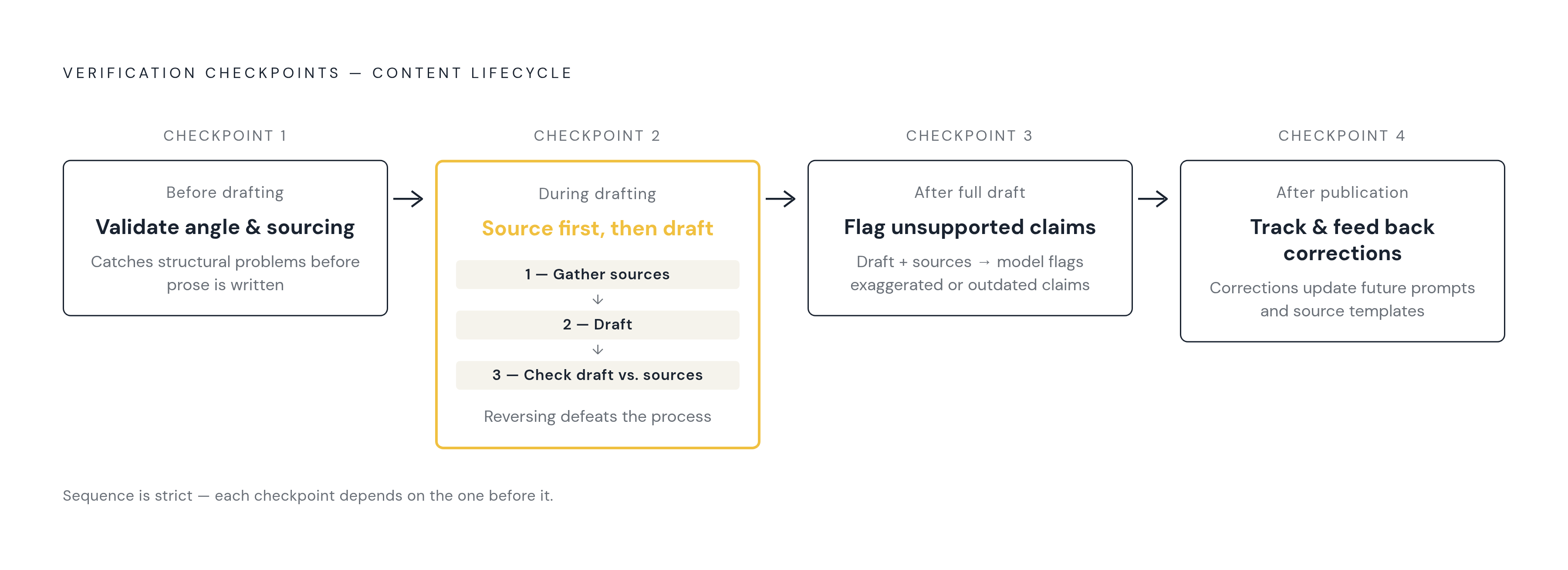
Catching errors only at the final review, right before publication, puts the heaviest verification burden at the point in the process where mistakes are hardest and most expensive to fix. A piece that's already been drafted, formatted, and routed for approval has a lot of inertia behind it, and an editor who finds a shaky claim at that stage faces pressure to patch it quickly rather than rework it properly. Distributing verification across the content lifecycle, instead of concentrating it at the end, changes that dynamic by catching problems while they're still cheap to fix.
The first checkpoint sits upstream of drafting entirely: validating the angle and the sourcing before a single sentence gets written. This step catches structural problems, like an argument built on a contested premise or a claim that assumes a source exists that actually doesn't, before they get baked into finished prose. The second checkpoint sits in the middle of drafting itself, and the order here matters: sources get gathered independently, by a human or a dedicated research process, rather than asking the AI model to supply its own citations as it writes. Source first, then draft, then check the draft against what was actually gathered, in that sequence and not reversed.
The third checkpoint comes after a full draft exists and sources have been independently collected. At that point, both the draft and the source material go back to the model with instructions to flag anything that's unsupported, exaggerated, outdated, or inconsistent with what the sources actually say. This step only works if the sourcing was done independently beforehand. Asking a model to check a draft against sources it generated itself defeats the purpose, since the same blind spots that produced the draft are likely to produce the review. The fourth checkpoint runs after publication: tracking which claims get corrected and feeding those corrections back into future prompts and source templates, so verification functions as a feedback loop that improves the next piece rather than a gate that only judges the current one.
Tiered human review: matching review depth to content risk
Human review doesn't disappear once a pipeline runs at volume. It gets allocated according to risk, so the judgment calls with the most consequence always land in front of a qualified person, while lower-stakes material moves through a lighter process. Practitioner consensus settles on at least two tiers. Content touching legal compliance, health claims, financial advice, or anything with direct brand reputation exposure gets thorough review from subject matter experts and senior editorial staff, with review time measured in hours per piece rather than minutes. Explanatory, evergreen, or otherwise low-stakes volume content gets efficient editorial review with spot-check verification, at a fraction of that time commitment.
A full review chain for a long-form, high-risk article might run through five stages: an SME assessment, an editorial review, a dedicated fact-check pass, an SEO review, and final director approval, each one logged in the CMS with its own time allocation. Added together, that produces a substantial total review time for a single piece, and that cost is deliberate rather than wasteful, because the content sitting in that tier is exactly the content where an error carries the most consequence. The operative principle in both tiers is that human judgment makes the decisions that matter, while AI handles the work that structured prompts, retrieval, and iteration can speed up without reducing accuracy.
This division held up under scrutiny at a Reuters Institute conference, where investigative journalists from Reuters, The Economist, and The Colonist Report discussed how AI is reshaping their work. Their consensus was that AI can genuinely enhance work at scale, but it should never receive complete trust. Every coding decision and every factual claim still needs to be justifiable on its own, by a person who can explain why it's true. One objection to tiered review is that it creates a two-class system, where some content gets real scrutiny and the rest gets waved through. That's a misreading of what the tiers actually do. They calibrate risk exposure, not editorial ambition. Volume content still goes through editorial review; it simply doesn't receive the compliance-level expert sign-off reserved for claims that could create legal or reputational exposure if they're wrong.
What verified content needs to contain
A separate line of research, built for an entirely different purpose, points at the same conclusion from another direction. Content that survives rigorous fact-checking tends to carry specific structural properties, named sources, traceable citations, and claims specific enough to be checked against something, and those are the same properties that AI answer engines favor when deciding what to cite in a generated response.
The clearest evidence comes from the CheckThat! 2026 shared task at CLEF, held 21-24 September 2026 in Jena, Germany, which evaluated automated systems built to generate fact-checking articles. This work was built to test machine-generated fact-checking systems, not marketing or editorial content, so the parallel here is structural rather than a direct study of content marketing practice. The UTS submission to that task, from Galat and Rizoiu, showed that the scoring systems used to grade these outputs, which rely on natural language inference and per-citation judges, only give credit to the parts of a claim they can verify directly against a reference document. A claim that can't be checked against something concrete simply fails the test, automatically, regardless of how well it reads. The design rule that follows from their results is blunt: credit only the tokens the references actually entail. That's close to the same discipline this piece has already laid out for tracing a statistic to a primary source: if the source doesn't back the claim precisely, the claim doesn't get to stand as written.
The same submission introduced a domain-attribution structure called HostCite, which wraps each citation in explicit attribution, in a form like "According to [source], [claim]." That structure measurably improved citation precision in the automated scoring. A claim written with an explicit, named attribution is easier to check, whether the checker is a human editor reading for accuracy or an automated judge scoring a generated article against its references. For a content team, the implication runs past pure editorial correctness. Building a fact-checking process that demands traceable sourcing produces content that happens to be structurally favored by the same kind of system an AI answer engine uses to decide what's trustworthy enough to cite.
Building the system: editorial guardrails that hold at publishing volume
A pipeline that depends on someone remembering to apply the right level of scrutiny will fail exactly when volume is highest and the pressure to publish quickly is greatest.
A CMS functions as the governance layer that makes this reliable: staging every AI-generated draft as unpublished until it clears review, the same pattern newsrooms and content platforms already use, creates a checkpoint that can't be skipped under deadline pressure because it's built into the system rather than left to memory. Claim-tagging can be built directly into the brief or the prompt that generates a draft, instructing the model to flag its own uncertain statements across the five high-risk categories, statistics, named entities, dates, product claims, and regulatory statements, at the moment of generation, before a human ever opens the file. Source-first discipline needs to be a pipeline rule rather than a suggestion: for high-risk claims, sources get gathered before drafting starts, not pulled in afterward to backfill support for something already written. And every correction made after publication should feed back into the system, updating source templates and prompt instructions so each caught error makes the next piece better rather than functioning as a one-off fix that never informs anything downstream.
CUT It's a repeatable process that improves itself with use, where the infrastructure carries the weight that individual judgment can't carry alone once volume climbs past what any one editor can hold in their head.