Content Repurposing for Multi-Platform AI Answer Coverage
AI and Google rank different things, so content needs separate strategies for each.

AI citation and search ranking have become two separate jobs, and content built to win one does not automatically win the other. Traditional SEO optimizes for a ranked position in a list of links. Generative Engine Optimization, as Similarweb's 2026 guide frames it, targets something else: inclusion inside the answer an AI model writes, where there is no ranked list at all, only citations and brand mentions scattered through a paragraph.
Retrieval-Augmented Generation is the mechanism behind that answer: an AI system pulls candidate passages from its index that look like they fit a user's question, then hands those passages to a language model, which writes one synthesized response from whatever it got. Being indexed is step one, not the finish line. A passage also has to be extractable on its own and authoritative enough that the model picks it over competing passages when it writes the answer. A page can rank first on Google and still contribute nothing to an AI answer, because the two systems are not scoring the same thing.
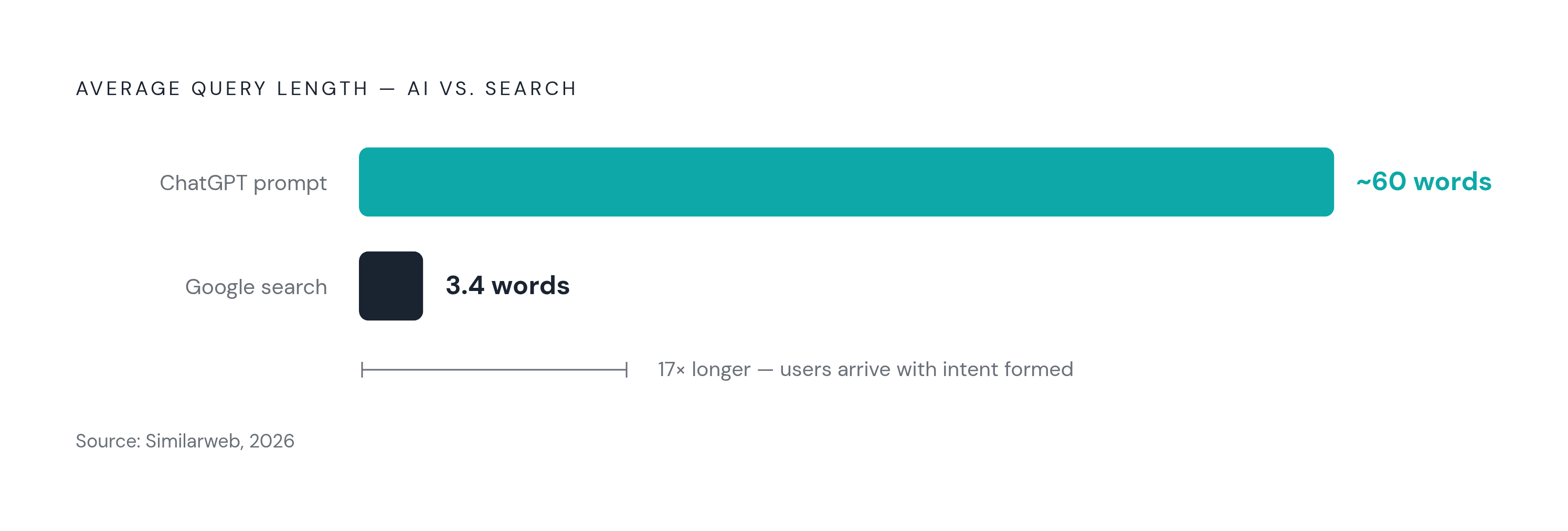
The user behavior on each side of that divide is different too. Similarweb's 2026 guide puts ChatGPT prompts at about 60 words on average, against roughly 3.4 words for a typical Google search. That gap says something about intent: the AI user is already specific, already conversational, and more likely to act on whatever the model tells them, having skipped past the browsing stage. The citation inside that answer is now the moment that decides whether a brand gets considered, regardless of whatever click may or may not follow it.
Different engines also pull from different pools of source material, and that alone explains why the same content can perform unevenly across platforms. Enrichlabs' guide splits RAG-first engines like Perplexity, which fetch live web pages the moment a query is asked, from training-data-first engines like Claude and ChatGPT, where you get cited based on what was indexed and recognized before a training cutoff date. A single well-written page can succeed on one surface and disappear on another, for reasons that have nothing to do with how good the writing is.
How each of the four major AI surfaces selects and cites content differently
ChatGPT, Gemini, Claude, and Perplexity run on four distinct retrieval setups. No single content format can satisfy all of them at once. A piece built for one engine's habits can be invisible to another, even if it is good.
Perplexity works as a RAG-first, real-time retriever: it actively fetches web pages at the moment a question is asked, which makes it the engine most responsive to content that is fresh and clearly structured. Among the four, Perplexity is also the one whose citations most reliably produce referral traffic that shows up in GA4, though tracking it properly takes a custom channel group, since GA4's native AI Assistant channel does not include Perplexity by default, and a meaningful share of its sessions still land in reports as Direct traffic rather than as attributed referrals.
Claude leans heavily on what it absorbed during training, but it also retrieves live pages through Brave Search when its search tools are switched on. When it does cite something, it tends to favor authoritative, institutional sources over thin or fragmented short-form posts. In its default chat mode, if search tools are not switched on, Claude typically gives no citations at all, so a brand cannot assume its content gets seen there just because it exists online.
Gemini and ChatGPT round out the four, and each has its own retrieval logic tied to its own index and training process. A single piece of research needs separate derivative assets, each tuned to a specific surface's retrieval mechanism, rather than reformatted copies pushed out to different channels under the same headline, and that conclusion holds regardless of which engine gets named first.
What makes a passage retrievable by an AI engine
AI engines retrieve passages, not pages, and that fact governs all four surfaces. A passage that cannot stand on its own as a complete answer will not get cited, no matter how well the rest of the page around it performs.
Query fan-out is why passage-level structure carries so much weight for you. When a user asks a question, the AI breaks it down into smaller sub-queries and looks for the clearest available answer to each one individually. If a passage directly answers one of those sub-queries, it gets pulled into the response. A page that answers the broader, parent question only in a holistic, scattered way, with the real answer buried across several paragraphs, often gets passed over even if it covers the topic thoroughly.
A handful of structural markers make a passage easier for a retrieval system to lift cleanly: a clear heading hierarchy that signals what each section covers, direct declarative sentences instead of hedged or roundabout phrasing, definitions placed at the top of a section rather than built up to slowly, numbered or bulleted lists for anything with multiple parts, and real evidence sitting inside the passage itself, named data, named sources, concrete examples, rather than evidence that requires a click to a different page to verify. Research out of Princeton and IIT Delhi, cited in Similarweb's 2026 guide, found that content with statistics and quotations got 30 to 40 percent more AI visibility than content without them. Verifiable statistics and named citations are the specific levers that research validated, not vague gestures toward "clear structure."
One more technical detail belongs here without overshadowing the passage-level argument: some sites now publish an llms.txt file, a plain-language index meant to help AI crawlers understand a site's structure. It is a useful signal to maintain, but it does not substitute for the deeper requirement that the passages themselves be self-contained and extractable.
The hub-and-spoke repurposing architecture that maps onto AI citation coverage
Query fan-out sets up the structural problem repurposing has to solve. A hub-and-spoke content architecture is not just a tidy way to organize internal links. It maps directly onto how AI engines break a question into sub-queries, because you can build each spoke to answer one of those sub-queries at the passage level in a way a hub piece, however comprehensive, cannot.
The hub is the pillar piece: the single comprehensive source an AI system treats as authoritative on the parent topic, structured so that every section inside it can be extracted as its own passage. The spokes are the derivative assets built around it, and each one needs to answer one specific sub-query a user might generate when asking about that parent topic. A spoke is a standalone answer to a narrower question, built to stand on its own if a retrieval system pulls only that one passage and nothing else.
The format of each spoke should follow the surface it is aimed at. A concise, FAQ-structured post suits Perplexity's real-time retrieval habits. If you need strong experience-expertise-authority-trust signals, a longer, structured guide suits Gemini's reliance on Google's index. A data-rich piece built around named sources helps build the kind of training-data recognition that benefits ChatGPT and Claude. A comparison format, the familiar "X vs Y" or "best X for Y" structure, serves a query pattern that appears in all four engines, because users bring that phrasing to AI chat the same way they used to bring it to a search bar.
Comparison and alternatives content needs its own line item in this architecture; it is not just another spoke format. Recited's guide on generative engines points out that these systems lean heavily on "X vs Y" and "best X for Y" content precisely because so many user prompts are phrased that way. A hub piece that covers a topic broadly cannot cover that query pattern on its own, so it needs a dedicated spoke built for exactly that phrasing.
The strategic payoff of building this way is surface area. One research effort, properly spoked out, becomes retrievable at multiple points across multiple engines' fan-out queries, multiplying the chances of citation without multiplying the underlying research cost.
The tiered content workflow for turning one research effort into engine-specific assets
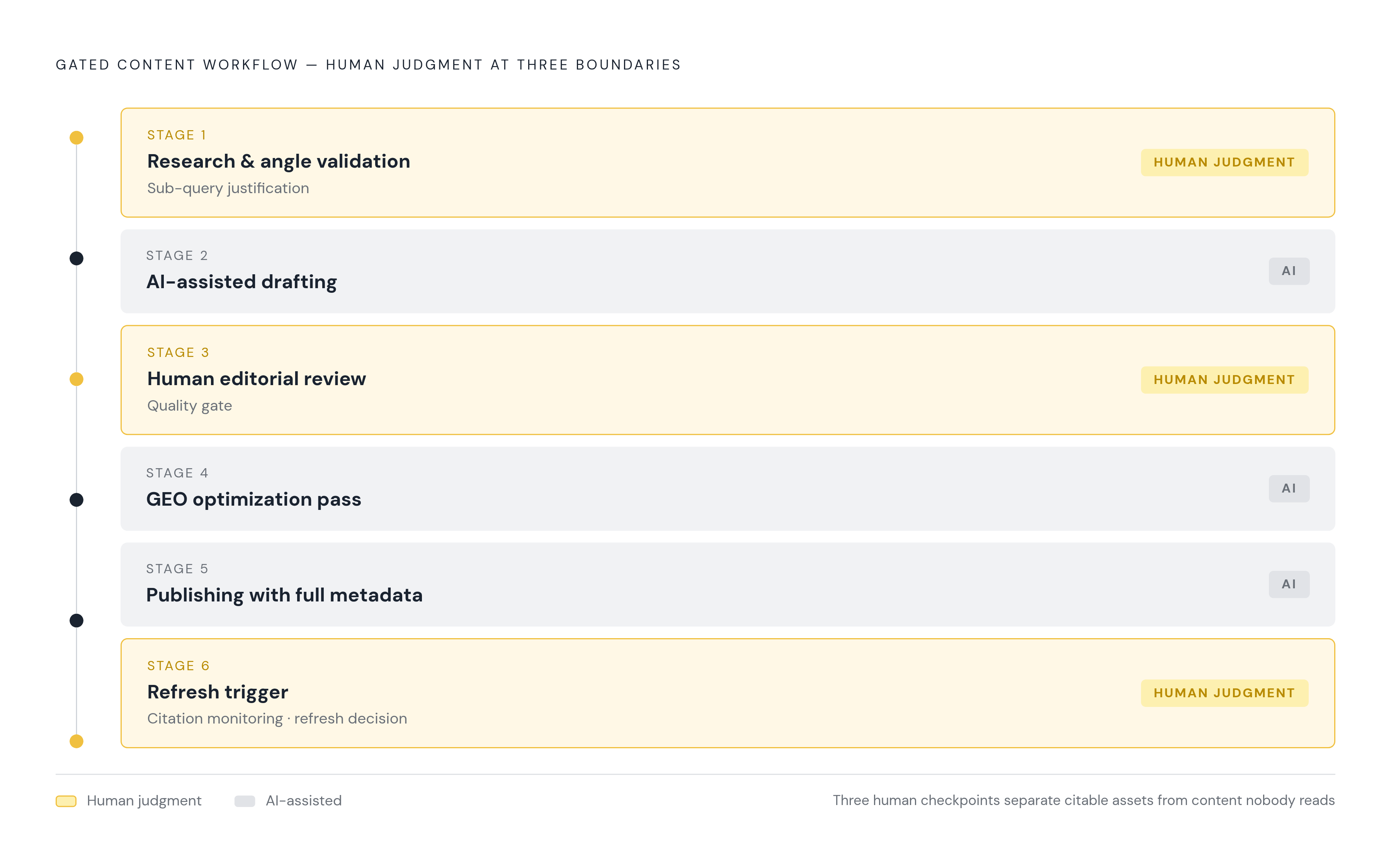
Building a hub and its spokes is an architectural decision. Producing them at any real cadence is a workflow decision, and the workflow that produces citable assets at scale is a gated pipeline, where human review sits at the specific decision points that decide whether an asset earns a citation or just adds to the pile of content nobody reads.
That pipeline has identifiable stages. Research and angle validation happen upstream, before a word gets drafted, confirming that a sub-query deserves a dedicated spoke. AI-assisted drafting follows. Human editorial review comes next, and it is a formal quality gate, not a casual skim. A GEO optimization pass handles passage structure, where evidence sits, and how headings are ordered. Publishing happens with full metadata attached. And a refresh trigger, tied to ongoing citation monitoring, starts the loop over rather than closing it out. None of this is a one-time production run.
Human judgment doesn't spread evenly across every step in that chain. It concentrates at specific boundaries: the upstream decision about whether a sub-query justifies a spoke, the quality gate before anything publishes, and the refresh decision once citation rates start dropping on an existing asset. An agentic pipeline, a coordinated set of specialized agents handling research, writing, critique, and publishing, each working against a CMS as the shared source of truth, is the architecture that makes this workable at marketing scale. A single AI tool running in isolation is not that pipeline, no matter how good its output looks in a single draft.
The strongest objection to producing content this way at volume is quality dilution, and it deserves a direct answer rather than a dismissal. AI-generated text tends to cover ground the underlying model already absorbed from millions of other sources, which makes it surfaceable but not necessarily citable, since an AI system has little reason to cite a passage that just restates what it already knows from elsewhere. What earns a citation is something the model cannot reproduce on its own: original survey data, a proprietary case study, a named expert's opinion pulled from an actual conversation. AI-assisted drafting is the floor a team works from. Original evidence is the ceiling that gets a passage chosen over a thousand others saying roughly the same thing.
Repurposing has to include scheduled re-dating and re-evidencing of what already exists, alongside the steady creation of new spokes. Freshness signals carry real weight with RAG-first engines like Perplexity, which fetch at query time, and a spoke that was accurate the day it published becomes a liability the moment the facts underneath it move on without it.
Why on-site optimization alone fails
A brand can optimize every asset on its own domain and still be absent from AI citations, because AI engines generally give more weight to off-site sources, Wikipedia, Reddit, G2, major publications, YouTube transcripts, than to brand-owned content when answering discovery queries. How much weight varies a good deal by engine and by query type, but the pattern holds often enough that on-site work alone leaves real citation potential on the table.
A two-tiered architecture addresses this gap. One tier is the ground site: the brand's own domain, built and structured for passage extraction the way the earlier sections describe. The other tier is off-site seeding: earned presence on the sources AI engines are actually already inclined to trust. A repurposing strategy that only ever publishes to the ground site is optimizing half the system.
Different engines lean on different trusted pools, so the distribution plan for derivative spokes has to account for where each engine's retrieval is known to look, not just push everything to the brand's own blog. Brand mention frequency across authoritative sources turns out to be a stronger predictor of AI citation than backlink count. That reorders priorities: digital PR, activity on review platforms, genuine participation in forums, and a maintained YouTube presence are citation tactics now, not just brand-building exercises run for their own sake.
That gives the repurposing workflow two output streams rather than one. Owned-channel assets, blog posts, long-form guides, FAQ pages, cover the ground-site tier. Off-site assets, contributed articles, product reviews, structured data entered into third-party databases, video content with transcripts attached, cover the seeding tier. Both streams draw from the same original research; they just get shaped for where each engine is actually looking.
Measuring whether the repurposing workflow is producing AI citation coverage
None of the four major engines gives you native brand analytics, so you need to build a tracking workflow yourself, since no dashboard does this for you. The four engines also have to be tracked as separate surfaces rather than rolled into one combined number, since citation volume for the same brand can differ sharply from one platform to the next.
Four metrics apply across all of them. Mention rate tracks the share of relevant prompts where the brand actually appears. Share of voice measures brand citations against competitors across that same tracked set of queries. Sentiment records whether the brand gets described positively, neutrally, or negatively when it shows up. Citation frequency counts how often the brand's URLs or affiliated sources get cited by name.
Perplexity stays the most consistently trackable of the four for referral clicks that show up in GA4, once a custom channel group accounts for why it is absent from GA4's native AI Assistant grouping. ChatGPT, Gemini, and Claude also produce referral clicks that can be tracked directly, and ChatGPT adds its own marker by appending utm_source=chatgpt.com to outbound links; track that as its own separate line rather than folding it into a general AI referral bucket. With this kind of measurement in place, the next round of hubs and spokes gets built on evidence of what actually got cited, rather than on a guess about what should have, turning repurposing into an instrumented discipline rather than a production exercise.