Content Velocity Benchmarks for Competitive AEO Programs
How often you publish now determines whether your brand stays visible to AI answer engines.

AI answer engines pull from a retrieval-augmented generation system, or RAG, that scores candidate passages against a query in real time. A page that won a citation in one query cycle holds no guarantee of winning it in the next cycle, because nothing about the page is locked in. Recency is one of the four scored variables, and recency decays. A page that was the freshest, most relevant answer to a query six months ago is competing today against everything published since, and if it has not been touched since, its recency score has only gone down.
Google AI Overviews change their cited sources at a rate of 59.3%, per AirOps research. A brand earning a citation this month has close to a coin-flip chance of losing it by the next. That is not a glitch in the system; it is the system working as designed, continuously re-ranking a pool of candidate passages rather than settling on a fixed set of winners the way a search results page tends to. Conductor's 2026 AEO/GEO Benchmarks Report frames this as a parallel surface of visibility, one where brand discovery happens before a user ever lands on a site. A static content library, published once and left alone, is competing against a retrieval pool that refreshes constantly. What works in this pool differs from what used to work in the old one. The Princeton/Georgia Tech/IIT Delhi GEO study (Aggarwal et al., ACM KDD 2024) found that keyword stuffing performs worse than doing nothing at all in LLM-driven engines, while adding machine-extractable provenance, meaning quantified statistics, direct quotations, and sourced citations placed in the visible content, improved citation rates by a meaningful margin. The scoring has changed, and so has the behavior that gets rewarded.
Put those two facts together: publishing cadence is not a scheduling decision but the mechanism by which a brand stays inside the retrieval window. A brand cannot publish once, rank well, and expect to hold that position, because the pool it is competing against is being re-scored on every query, not just on crawl day. Velocity is not a vanity metric layered on top of quality content; re-ranking that never stops is what makes it the operating requirement of the system.
The AEO adoption gap
Most marketing teams already know AEO matters, and most have not built anything to compete in it, which creates a window that is closing as the teams that have moved start to compound their lead. Only 20% have begun implementing it. That fifty-point spread between belief and action is the entire competitive opportunity in one statistic: a large group of marketers agree on where the puck is going and most of them have not moved their feet.
The gap is not closing evenly. Brand stature sets a baseline citation probability before any optimization work happens. Global household names appear in AI answers far more often on a first run than established mid-market brands, and mid-market brands in turn appear far more often than niche or smaller competitors. That baseline disadvantage is exactly what a consistent publishing cadence is built to offset: a smaller brand without the inherited authority of a household name can still build citation probability through sustained, structurally sound output, because the RAG scoring rewards recency and provenance regardless of who is publishing it.
The traffic argument for moving now is modest in scale but strong in quality. Fewer visitors arrive, but each one is considerably more likely to convert. And the competitive intensity of this landscape is not uniform. Conductor's analysis of 21.9 million Google searches found that Healthcare, Financials, and Utilities trigger AI Overview results at far higher rates than sectors like Real Estate or Consumer Staples, so the urgency to move is not identical across industries.
The objection to all of this is predictable: AI traffic is still too small to justify restructuring a content program around it. That objection answers the wrong question. The relevant question is not how much AI traffic exists today, but whether citation position is becoming entrenched before that traffic scales. Brands absent from the retrieval window now do not automatically enter it once volume grows; the engines are not waiting for latecomers, they are re-ranking among whoever is already in the pool. The adoption gap is closing because the brands acting on the smaller side of that Acquia/Researchscape split are building citation history and structural presence while the larger majority wait for a volume signal that will arrive too late to matter.
Content velocity benchmarks by competitive intensity and company stage
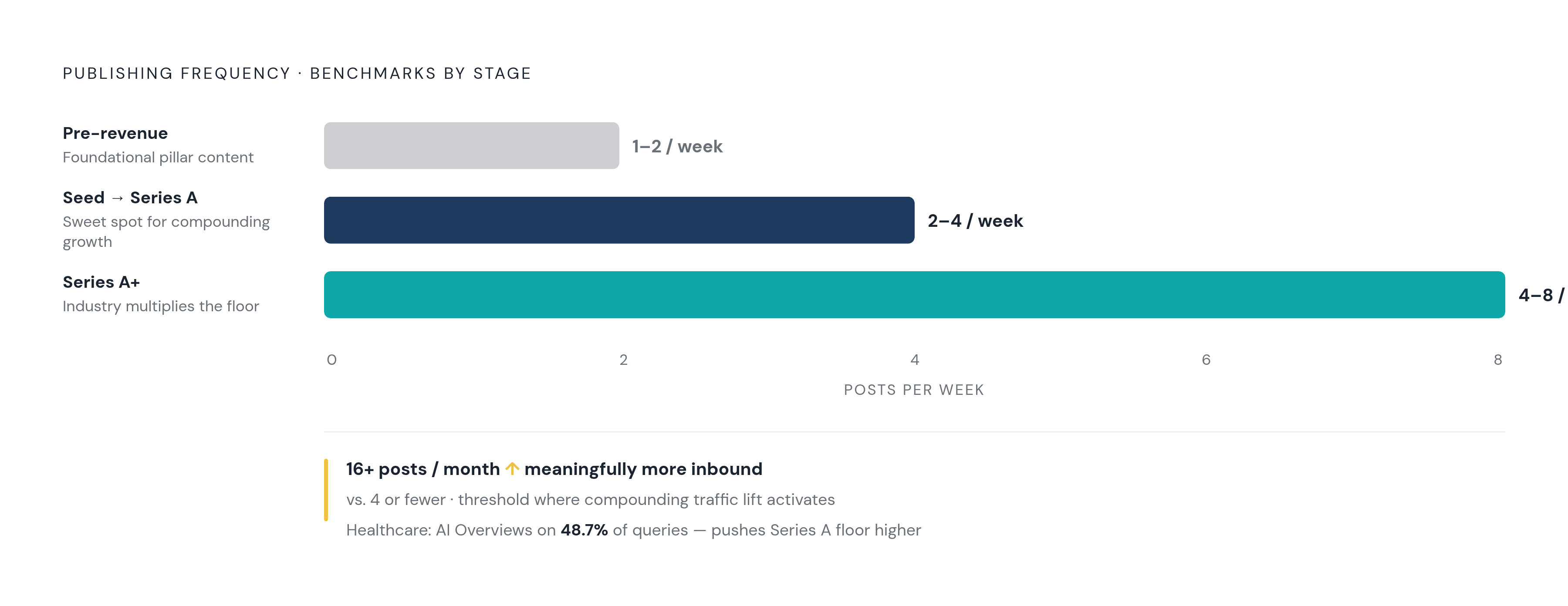
Publishing frequency is the most predictable lever behind compounding AI and organic visibility, but the right frequency depends entirely on where a company sits. A cadence built for a Series A company will undershoot what a later-stage competitor needs and will exhaust a pre-revenue team trying to match it. Averi's 2026 Benchmarks Report lays out velocity targets by company stage, and the value of these numbers is less in any single figure than in giving a reader a way to locate themselves before picking a target.
Pre-revenue startups should aim for one to two posts per week, concentrated on foundational pillar content that establishes the topical ground a brand intends to own. Seed to Series A companies should run two to four posts per week, which Averi describes as the sweet spot for compounding organic growth without overwhelming a lean team. Companies publishing sixteen or more posts monthly generate meaningfully more inbound traffic than those publishing four or fewer, per Averi, with one condition attached: that gain only holds when a quality floor is maintained across the volume, a point the next section takes up directly.
These stage targets are not the whole picture, because industry competitive intensity modifies them. Healthcare triggers AI Overview results on 48.7% of queries, per Conductor's AEO/GEO Benchmarks Report. A healthcare brand at Series A is not really competing at the Series A baseline of four to eight posts per week. A reader should treat the stage target as a floor and the industry rate as a multiplier, combining both rather than picking one.
Frequency alone also undersells the picture, because content type performs differently inside the retrieval window. A content calendar built around sixteen generic blog posts a month is not equivalent to one built around a mix of answer-first explainers, structured Q&A, and original research, even at identical volume.
One more lever belongs in this accounting: freshness updates to existing pages count toward the retrieval window the same way new posts do. Refreshing a high-authority page resets its recency signal without requiring a new URL, which gives programs that cannot sustain high net-new publication rates a second way to stay inside the window. A mature content library with a disciplined refresh cycle can compete against a thinner library publishing only new material, because the scoring mechanism cares about recency of the passage, not the age of the domain.
The quality floor that determines whether velocity compounds or collapses
Velocity compounds only when every piece clears a structural quality threshold, and below that threshold, publishing more content produces worse outcomes than publishing less. This is the condition that makes the stage targets in the previous section meaningful rather than reckless. A company hitting eight posts a week of thin, extractable-proof content is not ahead of a competitor publishing two posts a week that clear the bar; it is likely behind, because retrieval engines that encounter repeated low-value content from a domain have no reason to keep surfacing that domain.
The quality floor for AEO citation is specific and checkable, a matter of structural requirements rather than a subjective judgment about good writing. A page needs an answer-first structure that leads with a direct, declarative response an AI system can extract without parsing the rest of the document, a structural requirement laid out in AirOps's AEO guide. It needs machine-extractable provenance embedded in the visible content itself, not tucked into metadata: quantified statistics, direct quotations, and sourced citations sitting in the text a reader and a retrieval system both encounter, per the GEO study from Princeton, Georgia Tech, and IIT Delhi. And it needs a human checking the work at minimum at the fact-check and schema stages, because an AI system citing a brand's content is, in effect, vouching for that content's accuracy on the brand's behalf.
The failure mode the benchmark targets exist to prevent is simple to describe: a large volume of thin pieces performs worse than a smaller volume of substantive ones. A brand publishing content that does not hold up against a retrieval engine's scoring for authority and structural quality is not merely failing to gain ground. It risks training the citation engine itself to deprioritize the domain, because repeated low-quality retrieval and rejection is itself a signal the system can learn from over time.
The usual objection here is that quality and velocity trade off against each other by nature, that a team can have one or the other but not both at scale. That assumption holds only when fact-checking happens downstream of drafting, as a final check bolted onto the end of a process built for something slower. That distinction, upstream versus downstream verification, is the hinge the next section turns on.
How an 8-stage pipeline achieves velocity and quality together
Sustaining both high velocity and the quality floor described above takes a structured, multi-stage pipeline with human review gated at specific points; a single generative step or a traditional editorial workflow built for a few posts a month cannot do it. The practitioner model gaining the most traction runs eight stages: research, brief, draft, fact-check, schema, staging review, publish, and amplify, with each stage assigned an owner, an exit criterion, and a measurable cycle time, according to Digital Applied's reporting.
A documented case from that same reporting shows what the model looks like in production. At that full run-rate volume, the fact-check pass rate held near-total, and schema compliance ran at a similarly high rate in continuous integration. Those numbers held because fact-checking moved upstream of drafting rather than staying as a check applied after a draft existed: the brief itself carried pre-loaded source URLs, an anti-fabrication rule, and a human verification gate before any content moved forward.
The structural reason this works is that upstream fact-checking scales sublinearly, because every correction made at the brief-template stage improves every post that uses that template afterward. Post-hoc verification scales linearly with volume instead, and gets more expensive, not less, as the publishing rate increases, since each new post needs its own independent check with no compounding benefit carried forward. A team can organize around this in a range of ways: fully human at every stage, AI-assisted with humans still running the pipeline directly, or AI-orchestrated, with AI handling the pipeline end-to-end and humans reviewing only at the gates. Per-post cost at Tier 3 runs substantially below Tier 1 once the brief library has matured, with comparable quality once that maturity is reached.
Letterstory's production architecture follows this same shape: multi-stage AI drafting paired with human review at gated checkpoints, with the option of full autonomy for teams that choose it. The system built to publish at the volume this section describes is the same system responsible for the quality bar the previous section lays out, which is the entire point of building the pipeline this way rather than treating speed and accuracy as competing priorities to be balanced on a case-by-case basis.
Why owned content alone is insufficient
A high publishing cadence on a brand's own site is necessary and still not sufficient, because most AI citations point somewhere else. Distributed stories produced a large median lift in AI visibility compared with owned content alone. Cross-platform brand presence also expanded substantially through earned distribution, which made a brand's presence more consistent across ChatGPT, Perplexity, Gemini, and Claude rather than strong on one platform and absent on the rest.
Third-party platform signals carry independent weight in this scoring as well, separate from anything published on a brand's own blog. None of that visibility runs through the brand's own content pipeline at all; it runs through platforms the brand does not control and can only participate in.
The practical conclusion is that AEO strategy has to be managed as a portfolio rather than a single-channel content calendar. That portfolio includes owned properties like the website and blog, third-party mentions in industry publications and media coverage, review platforms such as G2, Capterra, and TrustRadius, expert profiles that attach a named voice to the brand, and original research carrying the kind of machine-extractable provenance the GEO study found most effective. A brand that pours all of its velocity into its own domain, however well that domain is run, is optimizing one piece of a five-piece system and leaving the other four to chance. The publishing cadence this piece has described, stage-appropriate, industry-adjusted, and quality-gated, is the foundation a brand needs in place before any of the earned and third-party work can compound on top of it. Without that foundation, there is nothing for a review mention or a Reddit thread to point back to.