Prompt Engineering Techniques for Content Research Teams
Structured prompts transform research briefs from fact-checked drafts into publication-ready output.

Prompt engineering doesn't decide whether an agency's research gets used. It decides whether that research ever gets seen by anyone, human or machine. For content research teams, the discipline means building inputs precise enough to produce accurate, brand-consistent output on demand, at whatever volume a client roster requires, and most teams still treat it as an afterthought instead of the infrastructure it actually is.
What separates a research prompt from a generic one
A generic prompt gets a generic answer. Fine, if someone wants a paragraph about lawn care out of idle curiosity. Not fine when the output has to survive a client review, or when it feeds directly into a piece of content that needs to hold up months later. The gap between a usable research prompt and a throwaway one comes down to specificity, context, and stated intent, not phrasing tricks or magic words, and that's the right place to draw the line.
Erlin's 2026 guide identifies five essential elements a research prompt needs: a clear task definition, audience context, brand voice parameters, format specs, and success criteria. Skipping one means the model fills the gap with a guess. Guesses compound across a research pipeline the same way rounding errors compound across a spreadsheet, quietly, until the total is off by a mile.
Platform choice makes this worse, not better. Claude tends to respond best to prompts with XML tags once a task has several moving parts (simple queries don't need them), while GPT models generally prefer a JSON schema. A prompt tuned for one model can underperform on another without anyone noticing, which is a real problem for a team running the same research process across several platforms at once.
There's also the E-E-A-T layer: Experience, Expertise, Authoritativeness, Trustworthiness, the same signals Google has used to judge search content for years. A prompt that explicitly asks for sourced expertise and verifiable authority produces content that both AI systems and traditional search engines tend to rank higher. That's a lever built into the prompt itself, not something bolted on after the fact.
Context here means role assignment (who the model is supposed to be for this task), task boundaries, source constraints, and format, stacked together so there's no ambiguity left for the model to resolve on its own. The real target is the same good answer every time, not a good answer once. It's the same good answer every time. A prompt that nails it on a lucky run is a party trick. A prompt that nails it on the tenth run, and the hundredth, is infrastructure.
The core techniques that research teams should build into their standard workflow
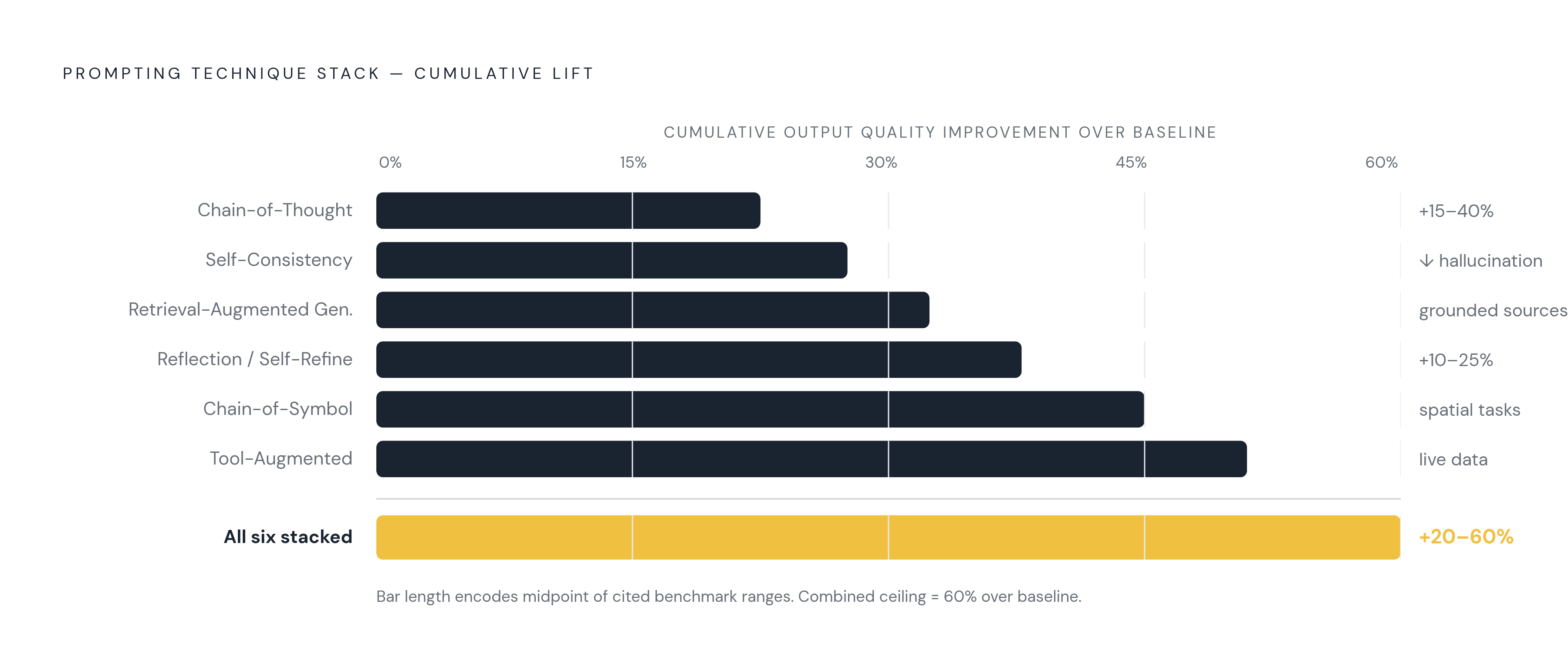
Chain-of-Thought prompting asks the model to reason through a problem step by step before landing on an answer, instead of jumping straight to a conclusion. For research teams, this matters most on fact synthesis, source evaluation, and competitive summaries, where the quality of the reasoning determines the quality of the output far more than phrasing does. Chain-of-thought alone lifts logic and reasoning performance by 15 to 40% on standardized benchmarks. The setup is simple: tell the model to show its reasoning, then structure the prompt so that reasoning stays separate from the deliverable someone actually hands to a client.
Self-consistency prompting pushes further. The model runs several reasoning paths on the same question, and the most consistent answer wins. That cuts hallucination, which matters when a research finding is headed straight into a citation on a client-facing page. In practice, that means running the same question through multiple passes and comparing before anyone signs off on a claim.
Retrieval Augmented Generation, or RAG, pulls in outside knowledge from a vector database or knowledge graph instead of relying on whatever the model absorbed during training. For a research team, this is how a prompt gets grounded in an approved source library, a client's own brand guidelines, or a prior research brief, rather than drifting toward generic training-data answers. It's the single most important technique for keeping research consistent across a portfolio of clients who each have their own facts to get right, and skipping it is where most cross-client inconsistency actually comes from.
Reflection, or self-refinement, has the model check its own work and revise before returning anything. Layered on top of a solid base prompt, self-refinement adds another 10 to 25% in quality on benchmark research. The practical version is a two-stage prompt: generate first, then critique and revise in a second pass. That structure earns its keep on research briefs headed directly into content strategy decisions.
Chain-of-Symbol prompting outperforms standard chain-of-thought on spatial and planning tasks. It comes up less often, but it's useful for teams doing content architecture or mapping out a research structure rather than answering a single factual question.
Tool-augmented prompting lets the model call outside tools: APIs, databases, code interpreters, so the output isn't capped at whatever's baked into the model's training. For research teams, this is what keeps a brief tied to live data instead of a stale snapshot. It's often the difference between a research note that's citation-ready and one that needs another round of fact-checking before anyone can use it.
Stacked together, these techniques improve output quality by 20 to 60% over benchmarks, turning a research brief a writer would otherwise have to fact-check line by line into... That's a substantial gap. Stacked together, these techniques improve output quality by 20 to 60% over benchmarks, turning a research brief a writer would otherwise have to fact-check line by line into one they can build from directly, and any team still relying on plain, unstructured prompts is leaving that entire range on the table.
How the Metaprompt and automated prompt optimization change the meaning of "engineering" for teams at scale
The Metaprompt approach flips the usual process: instead of a person hand-writing a system prompt, a more capable model writes it. Digital Applied's analysis found this consistently beats manual prompt crafting: the model writing the prompt has effectively read more prompting guides than any one person ever will.
DSPy 3.0 pushes further still. A team defines a signature (what goes in, what comes out), supplies a handful of examples and a scoring metric, and an optimizer compiles the actual prompt on its own. Digital Applied frames hand-written prompting, under this lens, as something close to assembly language: technically still usable, increasingly beside the point for teams working at any real scale.
The control knob has shifted, too. Temperature used to be the dial everyone adjusted. Now it's reasoning_effort, with vendor-specific scales, governing how many hidden reasoning tokens the model burns through before answering. That setting drives real gains in logical accuracy, and a research team that ignores it is leaving performance on the table it didn't know was there.
There's a cost wrinkle buried in this, too. Reasoning tokens get billed even though nobody sees them. A prompt that reads as short and simple on screen can chew through far more computation, and far more budget, than its length suggests. Teams need a cost model that accounts for reasoning tokens and other computation happening behind the visible output, not just the word count of the prompt itself, because that hidden computation drives the actual budget.
Adaptive prompting closes the loop: systems that adjust their own prompts using real-time feedback, without a person rewriting anything by hand. Promptitude's guide forecasts that the majority of enterprises will have AI-driven prompt automation running by 2026. For an agency juggling several client brands, that's what makes it possible to keep a distinct, tuned prompt set per client without needing a proportionally larger team to maintain it. Scale stops being the constraint it used to be.
None of this replaces judgment. A system can optimize toward a target, but someone still has to decide what brand voice sounds right, which sources count as credible, and what "good" means for a given client. The automation gets better at hitting the target. It doesn't set the target, and any agency that treats automation as a replacement for that judgment is going to automate its way into a worse product, faster.
The quality of research prompts as the direct determinant of AI visibility for the content those prompts produce
Consider the scale of what these prompts feed into. ChatGPT sees roughly a billion weekly users. Google's AI Overviews reach 1.5 billion people a month. A 2026 study found 35% of US consumers now turn to AI at the product discovery stage, more than double the 13.6% still relying on traditional search for that job. And 93% of AI search sessions end without a single click to a website, with AI Overviews cutting clicks to the top-ranking page by 58%.
Content that gets cited inside an AI answer now reaches readers more effectively than content that gets clicked from one, since AI answers are becoming the primary way people encounter information. Anyone doing content research for a living who hasn't reoriented around that fact is optimizing for a version of the internet that's already shrinking.
That's where the gap between SEO and GEO (generative engine optimization) turns structural rather than semantic. Eighty percent of the URLs ChatGPT cites don't rank in Google's top 100 results. Twenty-eight percent of ChatGPT's most-cited pages carry zero organic visibility on Google. Sixty-seven percent of the top 1,000 pages ChatGPT cites come from sources a brand simply cannot replicate through SEO work: Wikipedia, government sites, universities, major news outlets. The pages that do get cited were built on research solid enough, and structured clean enough, to be lifted directly into an AI answer. That structural advantage starts at the prompt, before a single word of the actual content gets written.
GEO research quantifies what AI systems actually reward. Adding quotations from credible sources, backing claims with statistics, and including citations each raised a source's share of AI-generated answers meaningfully. Statistics and citations each raised a source's share of AI-generated answers meaningfully. Out of 2,225 pages analyzed in that study, 36% were too thin or too poorly structured to extract from at all, 77% had no visible date anywhere, and only 21.2% carried any visible sign of who wrote them. Pages the AI couldn't extract cleanly, date, or attribute to someone didn't get cited, because the model's reliance on those structural signals, rather than on the accuracy of the content, produces this outcome. Pages that were recently updated and carried visible date signals earned meaningfully more citations than those that did not.
Trace that back to the research stage and the connection is direct. A research brief that instructs a team to surface datable statistics, name actual sources, and pull quotable statements from real experts is building the exact raw material that later makes a finished piece citation-worthy. The prompt is the upstream decision. Everything downstream, better content, more citations, more visibility, starts there. That's the business case Erlin's 2026 guide makes for treating prompt engineering as infrastructure rather than a soft skill, and it's the right one.
How research prompts must be designed for platform fragmentation
Across 680 million AI citations analyzed by Averi, only 11% of domains showed up cited by both ChatGPT and Perplexity. Independent research has landed on a similar split. ChatGPT and Perplexity are two separate citation ecosystems that happen to share a label.
Cross-platform research has found that citation volume for the same brand can swing dramatically between platforms. A brand that dominates Perplexity's citation pool can be nearly invisible on ChatGPT, with no reliable way to predict which way that swing goes without checking each platform on its own terms.
The mechanics differ, too. Perplexity averages 21.9 citations per response against ChatGPT's 10.4. Perplexity cites brands at a notably higher rate than ChatGPT, while citation rates vary meaningfully across platforms. Still, ChatGPT processes 2.5 billion prompts a day, with 65% of those functioning as search queries, so a lower citation rate against that volume still adds up to serious reach.
The fix is naming the platform target up front, every time, rather than a universal research prompt tuned to some average of all four platforms. It's naming the platform target up front, every time. A brief written for Perplexity visibility needs more citation anchors packed into it. A brief aimed at ChatGPT needs to prioritize extractable authority signals instead, since that's what a more selective citer is actually filtering for.
Industry context sharpens the stakes further. Fifty-three percent of brands are invisible across ChatGPT, Perplexity, Claude, and Gemini combined. Finance and insurance has the lowest citation rate of any sector, at 2.1%, and legal and professional services has the highest share of brands with zero visibility, at 86%. A research prompt built for a law firm client needs to work considerably harder than one built for a consumer product brand, simply because the baseline odds are so much worse.
AI systems running real-time retrieval, Perplexity and Google's AI Overviews among them, weigh relevance heavily on the opening content of a page. Research prompts should tell teams to front-load the answer instead of building up to it. A model skimming the first 200 words won't wait around for the reveal.
What volatile AI visibility requires of research workflows
Superlines tracked one brand's AI visibility from January 11 to February 8, 2026, and watched it fall from 1.92% to 1.23%, a drop of 35.9%. Citation rate over the same stretch fell from 7.35% to 4.82%, down 34.4%. Share of voice dropped from 0.66% to 0.43%. Nearly a third of a brand's AI presence gone inside a single month, with no algorithm update announcement, no obvious trigger. Just the ordinary churn of how these systems retrieve and rank sources.
A quarterly audit cadence cannot catch that kind of swing before real damage sets in. Weekly monitoring is closer to the actual floor a serious operation needs, and any agency still running visibility checks once a season is finding out about losses months after they happened.
For a content research team, this reframes the job as a cycle: each pass checks what changed since the last one, rather than restating what's currently true as though it were fixed and permanent. Prompts need to be built so that each pass checks what changed since the last one, rather than restating what's currently true as though it were fixed and permanent.
That argues for treating the research brief itself as a living document: version it, date it, update the template the moment platform behavior or a client's visibility numbers shift. Adobe's Digital Trends report found nearly half of organizations have now embedded generative AI across multiple functions in marketing content work. The teams that built monitored, systematic research workflows early are compounding that head start. The ones that didn't are trying to close the gap under pressure, which is a much harder position to work from.
Excellent research done in January, never rerun, can end up briefing a writer in March on a competitive landscape that no longer exists in the AI answers that actually matter.
Building a repeatable research prompt system for a multi-brand agency operation
Marketing budgets have sat at roughly 7.7% of company revenue for a while now, flat, even as content demands keep climbing. Systematic prompt engineering is how an agency absorbs that gap without adding headcount at the same rate the workload grows. Anyone still trying to close it by hiring more researchers is solving the wrong problem.
Aprimo's 2026 AI marketing report identifies multi-agent setups as the standard answer to this pressure: specialized agents coordinating across different functions of a campaign, with compliance agents checking content against brand rules before anything goes out the door.
A prompt library built for a multi-brand shop needs a specific set of pieces, and skipping any one of them is where the system breaks under real client load. Client-specific brand voice parameters need to sit inside reusable system prompts, so nobody's rewriting tone guidance from scratch every time. Platform-specific output specs shape the deliverable's structure, since a Perplexity-ready research brief and a ChatGPT-optimized one don't look the same on the page. Version numbers and dates belong on every template, so it's obvious at a glance what's current and what's stale. And success criteria need to live inside the prompt itself: not "write a research brief," but something closer to "surface three datable statistics, two named expert quotations, and one competitive citation per section."
Aakash Gupta and Miqdad Jaffer's 2026 guide describes a "hill climb" model: optimize for quality first, then go back and optimize for cost. Get that order backward, chase efficiency before quality is nailed down, and the result is rework nobody budgeted for later.
forecast enterprise adoption of AI-driven prompt automation cuts a clear line between two kinds of agencies. The ones that build a manual prompt library first end up with the labeled examples an optimizer actually needs to learn from. The ones that skip straight to automation have nothing to train it on, and end up automating guesswork instead of a process that's already proven itself.