Google AI Overviews vs Perplexity Answers for Brand Discovery
Brands optimized for Google's AI Overviews stay invisible on Perplexity, and vice versa.

Google AI Overviews and Perplexity now sit between roughly half of all search queries and the sites those queries used to send traffic to. Both generate answers instead of links, but they build those answers through completely different mechanics, pull from different sources, and reward completely different brand behavior. That difference matters because a brand optimized for one can be functionally invisible on the other.
By February 2026, AI Overviews were showing up on 48% of tracked Google queries, up from 31% a year before. On queries where an Overview appears, the zero-click rate runs close to 83%, compared to roughly 60% on a standard results page without one. Google's AI Mode pushes that further, to around 93%. Pew Research found that when an AI summary shows up, users click through to a traditional result only 8% of the time. So the answer itself has become the destination. Not a signpost pointing somewhere else, the endpoint.
Perplexity, meanwhile, went from about 2 million monthly active users in March 2023 to 30 million by April 2025, and an estimated 100 million by April 2026. That's a discovery channel that barely existed three years ago, growing fast enough that most brand teams haven't caught up to what it rewards. Two machines now sit between a buyer's question and a brand's website, and they don't work anything alike. Worth sitting with that for a second before going further.
How Google AI Overviews are built and where citations come from
Google isn't fetching new evidence every time someone types a question. It's generating an answer from an ecosystem it already built and continuously indexes: the web index, Knowledge Graph, YouTube transcripts, Shopping feeds, Maps, Scholar. Gemini synthesizes across all of it at once, applying Google's E-E-A-T filtering (experience, expertise, authoritativeness, trust) at every stage rather than at the end.
That means citation sourcing stays tightly bound to authority a page has already earned elsewhere. AI Overview citations draw heavily from pages already sitting in the top organic results, and Overviews maintain meaningful overlap with traditional organic rankings. Rank well already, and there's a good chance you show up here too.
But that grip is loosening. Research has found AI Overview citations coming from pages ranked below position 5, and pages outside the top 100 have started earning citations that would have been unthinkable under classic SEO rules. Top-10 ranking used to be the price of admission. It no longer guarantees a seat.
One signal stands out from research into AI Overview citation patterns: YouTube has become a prominently cited source type, and brand mentions in video titles and transcripts correlate strongly with Overview visibility. That's a strange twist for anyone who spent a decade treating YouTube as a separate channel from search strategy.
Trigger rates vary hard by category. Healthcare queries pull an Overview 88% of the time, B2B technology at a high rate, restaurants 78%. After the March 2025 core update, some verticals saw explosive growth in Overview presence, with entertainment, restaurants, and travel among the categories reporting the largest increases. In categories like these, the Overview isn't an add-on sitting above the results. For most buyer-intent searches, it is the result.
How Perplexity builds answers and selects sources differently
Here's the split that matters most: Google generates from a pre-built ecosystem it already owns. Perplexity retrieves live evidence first, then generates an answer from what it just found. These aren't two flavors of the same process. They're different machines solving different problems.
Every prompt on Perplexity triggers a live web query against a proprietary index running past hundreds of billions of URLs. A six-stage retrieval pipeline (RAG, or retrieval-augmented generation) filters candidates on semantic relevance, freshness, structural quality, authority, and engagement before anything earns a citation. Because the index refreshes live rather than on Google's slower crawl-and-authority cycle, new content that's well-built can show up in a Perplexity citation relatively quickly. Compare that to Google, where authority tends to accumulate over months, and the gap starts to look less like a technical detail and more like a completely different game clock.
Citation isn't a side effect on Perplexity, it's the product. On most complex research questions, every claim in the answer ties back to a specific source, visibly, in the response itself. And the sourcing pool runs wider than Google's: Perplexity draws from a wide sourcing pool, with the cited sources often differing meaningfully from what Google surfaces for the identical query.
The vertical preferences get specific fast. Healthcare answers lean on Zocdoc. Hospitality answers lean on TripAdvisor. Subjective, unbranded queries pull a larger share of niche and regional directories than on any other AI platform tracked. And for e-commerce shopping questions, community and user-generated content features prominently among third-party citations, a source type Google treats in an entirely different way in its own Overviews.
The citation gap brands don't see: third-party sources get the link, the brand gets the mention
Here's the part that trips up most brand teams: when an AI platform recommends you, it usually isn't citing your website. It's citing someone talking about you. A review site, a Reddit thread, a trade publication picks up the citation link, while the brand itself just gets named in passing inside the generated text.
Research into AI search citation patterns has found that a brand's own website accounts for only a small fraction of the sources AI search platforms actually reference. The vast majority comes from publishers, user-generated content, affiliate sites, and review platforms. Your homepage is a bit player in its own discovery story.
It gets stranger across platforms. Citation pools vary considerably across platforms, meaning a meaningful share of cited sources tend to be platform-specific rather than shared. A glowing mention on Reddit that gets you cited on Perplexity does nothing for your standing on Google, and vice versa. Google skews toward YouTube. Perplexity draws more heavily from community discussions and vertical directories. Same question asked twice, completely different evidence trail assembled behind the scenes.
So the asset a brand actually needs to manage isn't just its own website copy. It's the whole scattered mess of pages that mention its name: reviews, forum threads, press coverage, directory listings, video transcripts. This is exactly why digital PR and earned mentions have quietly become AI visibility inputs in a way they never were for classic SEO. Landing the right third-party mention can plant a brand inside an AI answer even when the brand's own page never gets touched.
What citation actually does for a brand on Google AI Overviews
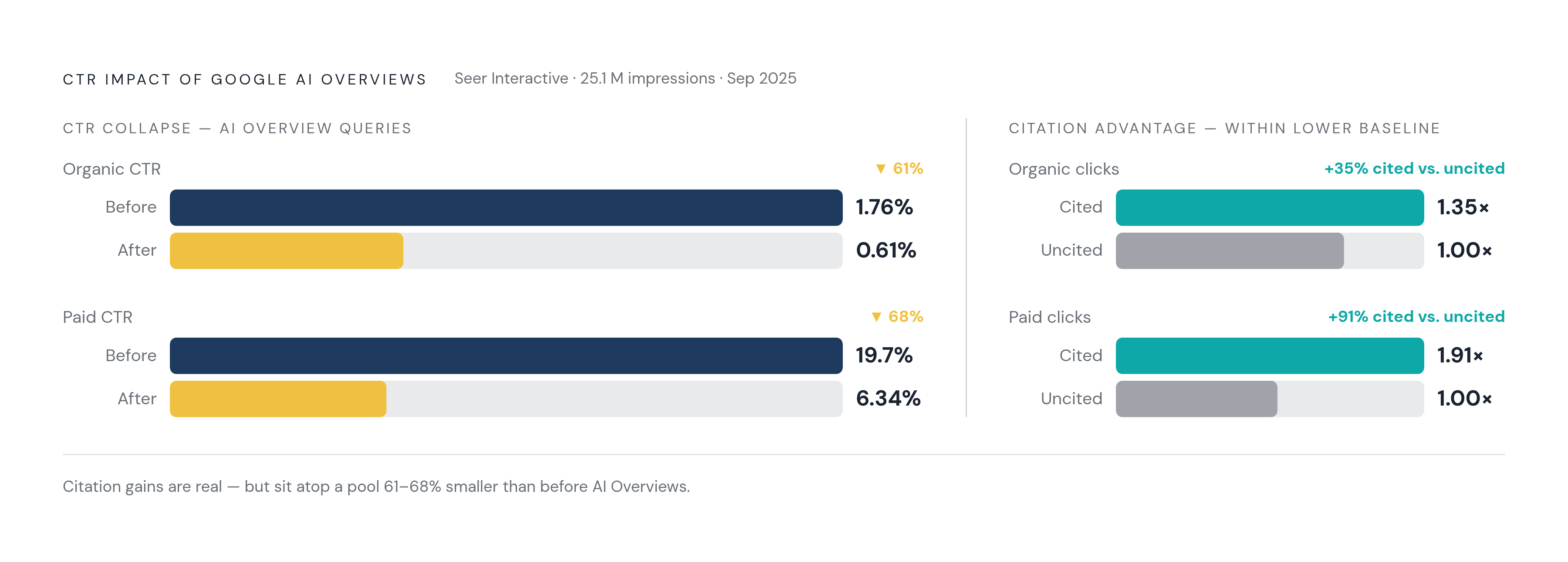
Seer Interactive studied 25.1 million organic impressions across 42 organizations in September 2025 and found brands cited in an AI Overview earned 35% more organic clicks and 91% more paid clicks than brands left out, on the exact same queries. Getting cited pays off. Genuinely, measurably.
But look at the baseline those gains sit on top of. Organic click-through rate on queries that trigger an Overview fell from 1.76% to 0.61%, a 61% drop. Paid CTR fell from 19.7% to 6.34%, a 68% drop. So being cited wins a bigger slice, but the whole pie shrank. Worth asking whether that trade nets out positive for any given brand, and the honest answer is: depends entirely on where that brand already stands.
Branded queries are the one category that breaks the pattern. Semrush found AI Overviews lift CTR by 18.68% on searches for a brand's own name, because the Overview typically cites the brand's own content when someone searches for it directly. So the strategic split runs like this: for an established brand, an Overview on its own name works as an amplifier. For an unknown brand trying to get discovered through a category search, citation isn't an amplifier of anything, it's the entire mechanism of being found at all.
There's a leading-indicator angle worth flagging for B2B specifically. Citation share on unbranded category queries tends to lead branded search volume by some lag. Win citations on the generic terms first, and branded search volume tends to follow a few weeks later. That turns citation tracking into something closer to a forecasting tool than a vanity metric. And the scale underneath all of this is hard to overstate: Google AI Overviews reach more than 2.5 billion monthly users across upward of 200 countries, so even a modest share of citation value plays out at genuinely enormous reach.
What citation does for a brand on Perplexity, and where the e-commerce complication sits
Perplexity's audience skews younger and more research-driven than Google's general population. The 25 to 34 age bracket makes up the largest slice of traffic at 29.14%, with 18 to 24 year-olds close behind at 21.68%. The United States alone accounts for 21.13% of total visits. That's a concentrated group of people actively comparing options, not casually browsing.
Perplexity pulls in a smaller share of total AI referral volume than Google does, no argument there. But observers tracking AI referral traffic have noted it tends to deliver strong ROI per citation, particularly for B2B brands and high-intent buyers. AI search traffic is widely characterized as skewing toward high-intent users, which shapes how even a relatively small volume of referrals can contribute to pipeline.
The growth curve underneath this isn't slowing down either. Perplexity logged 780 million queries in May 2025, with CEO Aravind Srinivas reporting month-over-month growth past 20%. That's an audience closing the distance to Google's reach faster than most brand teams have adjusted their playbooks.
Now, the complication. On many consumer product prompts, Perplexity surfaces retail and third-party sources alongside or instead of the brand's own product page. For DTC and product brands, that pattern turns Perplexity citation strategy into partly a retail distribution question. Which retail partners show up with strong Perplexity presence matters just as much as what content sits on the brand's own domain.
The scale vs. intent-depth tradeoff brands are actually choosing between
Set the two platforms side by side and the tradeoff gets easy to name. Google AI Overviews offer reach that nothing else on this list can touch, 2.5 billion monthly users across 200-plus countries, deep integration with authority a brand has already built through years of organic ranking, and a citation cycle that moves slowly because it's tied to established E-E-A-T signals. That's the right surface for broad awareness at scale, and it's close to mandatory for brands sitting in categories where Overviews already trigger at high rates.
Perplexity offers something narrower but faster-growing: 100 million monthly active users by April 2026, up 122% from where it sat at the end of 2025, live retrieval that lets fresh content earn a citation faster than Google's slower authority-accumulation cycle, and a user base that skews young, high-intent, and actively comparing before it buys. That's the right surface for considered-purchase discovery, the moment a buyer is deep in research mode rather than casually typing a query.
The source preferences split so sharply that one content plan can't serve both platforms at once. Google rewards YouTube presence and E-E-A-T signals baked into third-party coverage. Perplexity rewards active community threads, vertical directories, and editorial coverage that's genuinely fresh. Same brand, two different jobs to do.
That split runs straight through the mention-source divide covered earlier too. On Google, what matters most is YouTube visibility and the trust signals riding along with third-party coverage. On Perplexity, what matters most is showing up inside the actual conversations happening in Reddit threads and niche directories, in near real time. For a brand sitting in a high-trigger vertical like healthcare (88%) or B2B technology (82%), skipping a Google Overview strategy means giving up the top of the funnel outright. For a brand chasing younger researchers or early-stage B2B buyers where Reddit and community discussion drive Perplexity's citations, Perplexity visibility is closing in on Google visibility in importance, fast.
How brands can make deliberate choices about where and how to show up on each platform
Start with what actually moves the needle on Google. Build a real YouTube presence, deliberately, because video titles and transcripts that mention the brand correlate more strongly with Overview citation than traditional backlinks do, according to Ahrefs' study across tens of thousands of brands. Treat digital PR and earned coverage as an AI visibility lever, not just a brand awareness one, since branded mentions across the web correlate strongly with Overview visibility in that same research. Split branded and non-branded query performance in Search Console rather than lumping them together, because an 18.68% CTR lift on branded terms and a 61% drop on non-branded terms are two entirely different stories that call for two different responses. Watch which category queries in a given vertical now trigger Overviews at high rates (B2B technology and healthcare already do, for most of them). And pay attention to citation position: Authoritas's 2026 analysis found citations placed in the first sentence of an Overview earn meaningfully more clicks than ones buried later in the answer. Getting cited is the entry fee. Where you land inside the answer decides whether that fee bought anything.
On Perplexity, the playbook runs differently. Put real effort into the third-party sources Perplexity actually pulls from in a given vertical, Zocdoc for healthcare, TripAdvisor for hospitality, Reddit threads and niche editorial coverage broadly, rather than pouring everything into brand-owned pages. Treat freshness as a genuine lever rather than an afterthought, since the live retrieval pipeline can surface something published this morning within hours. For product brands, audit retail partner presence specifically, because shopping queries get routed to retailer pages far more often than to a brand's own product listing, which makes retail distribution and AI visibility the same conversation now, not two separate ones. And build content in a structured, source-backed format, since Perplexity ties claims to citations on most complex research questions, and content that states specific, well-sourced claims in clean structure is simply easier for that pipeline to grab and cite.
One honest caveat before wrapping up: neither platform makes any of this easy to track through native analytics. Google Search Console doesn't break out AI Overview impressions as their own data type, and Perplexity offers no built-in dashboard for citation monitoring either. Brands chasing visibility on both fronts need third-party tracking tools or systematic prompt testing just to see where they're actually showing up, because right now, both platforms operate mostly as black boxes reporting to no one.
That opacity is exactly why the practical advantage tends to sit with teams that pair AI-assisted content production with real editorial judgment, someone deciding what claims are worth making and which sources are worth being associated with, rather than teams generating volume for its own sake. The platforms reward structured, well-sourced, topically credible content. They don't reward noise. Producing enough of the former without drowning in the latter turns out to be the actual skill here, and it's a skill, not a switch anyone flips overnight.
Sources
- AI Overviews Killed CTR 61%: 9 Strategies to Show Up (2026)
- Google AI Overviews brand visibility | Parse
- The Click That Didn’t Happen: Why Brand Visibility in AI Search Is the Only Metric That Matters in 2026 — Jarred Smith
- Perplexity AI Statistics 2026: Users, Queries, Revenue & Growth
- click-vision.com
- seerinteractive.com
- semrush.com


