AEO vs SEO for B2B SaaS Brands
AI chatbots now drive B2B software buying decisions over traditional search.
B2B SaaS marketing has a new fault line: whether content gets clicked by a human or lifted by a machine. SEO chases the former, AEO chases the latter, and this piece breaks down what each discipline actually optimizes for, where the two overlap, and how a marketing team should split its effort between them. The short version is that neither one is optional anymore, and treating them as rivals for the same budget line misreads what each is built to do.
How the search landscape has actually shifted, and what the numbers mean for B2B SaaS content
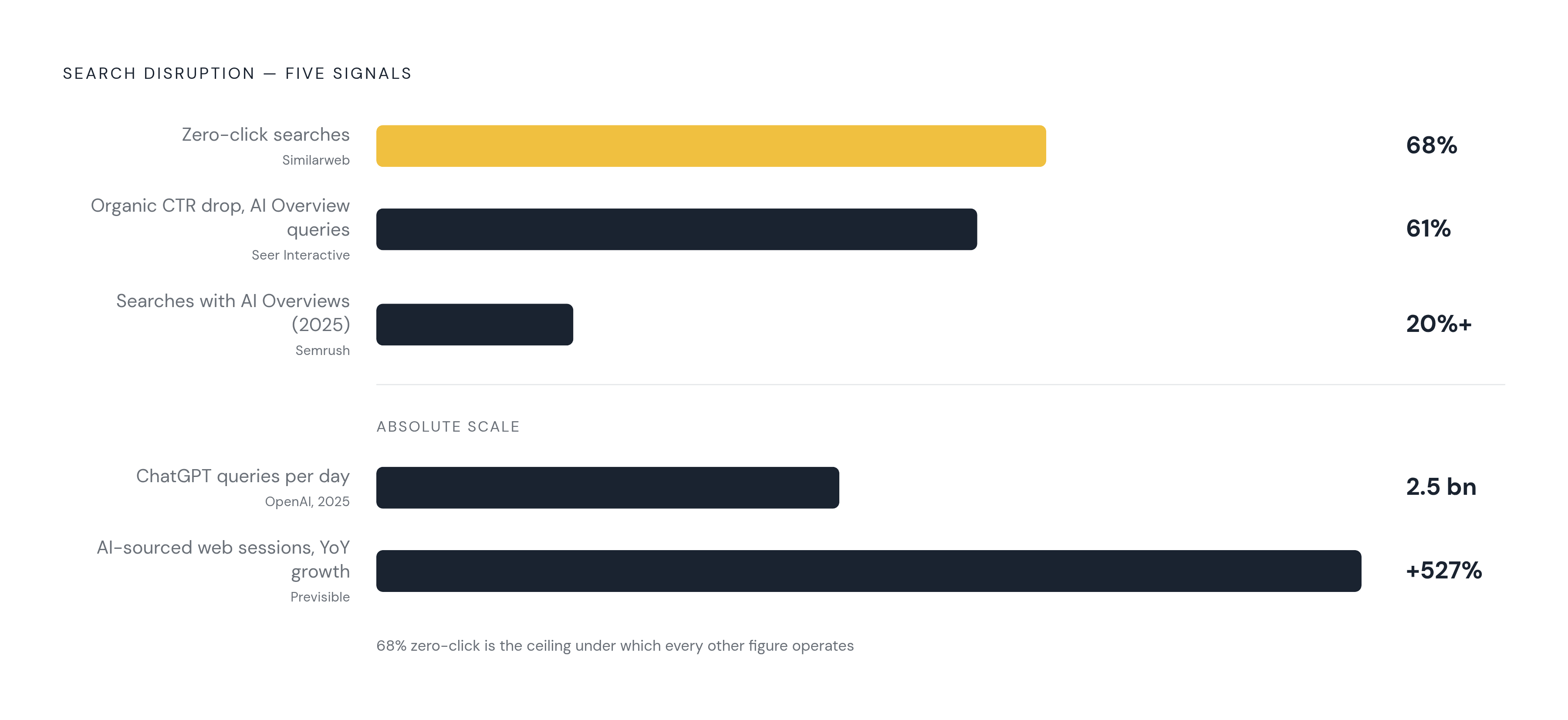
Start with the blunt fact: most searches on Google no longer send anyone anywhere. Similarweb's clickstream data puts the zero-click rate at 68%, meaning more than two out of three searches end without the user leaving Google at all. That's a structural condition of how search results pages now work, with answer boxes, AI summaries, and knowledge panels absorbing the query before a blue link ever gets a chance.
Google AI Overviews are the biggest driver of that shift. Semrush's analysis shows Overviews went from covering 6.5% of Google searches to more than 20% over the course of 2025, reaching upward of two billion monthly users worldwide. That's a tripling in coverage within a single calendar year, which is the kind of growth curve that normally belongs to a startup, not a fifteen-year-old search feature.
Meanwhile the standalone AI assistants stopped being side projects a while ago. ChatGPT was processing 2.5 billion queries a day by July 2025. Perplexity handled 780 million queries in May 2025 alone. Those numbers describe a mainstream habit, one that's pulling volume directly out of the traditional search funnel. Previsible's AI Traffic Report clocked AI-sourced web sessions growing 527% year-over-year between early 2024 and early 2025, which is the kind of growth rate that should make any content team ask an uncomfortable question: is the audience even where it used to be?
The click-through collapse is measurable and it's steep. Seer Interactive found organic CTR fell 61% for queries where an AI Overview appeared, as of September 2025. And the category getting hit hardest is exactly the category most B2B SaaS teams have built their content engines around: informational queries, the "what is," "how does," "why should I care" content that used to be reliable top-of-funnel traffic. Piper Rocket research shows that 99.2% of all AI Overview keywords are informational in intent. That's nearly the entire category.
The result on the ground: CommonMind's survey of 169 B2B SaaS marketers, conducted between November 2025 and February 2026, found 59% already reporting organic traffic that's flat or declining. This isn't a forecast slide in a keynote deck about the future of search. It's the present, and it's already showing up in the analytics dashboard.
Where B2B software buyers actually start their research today
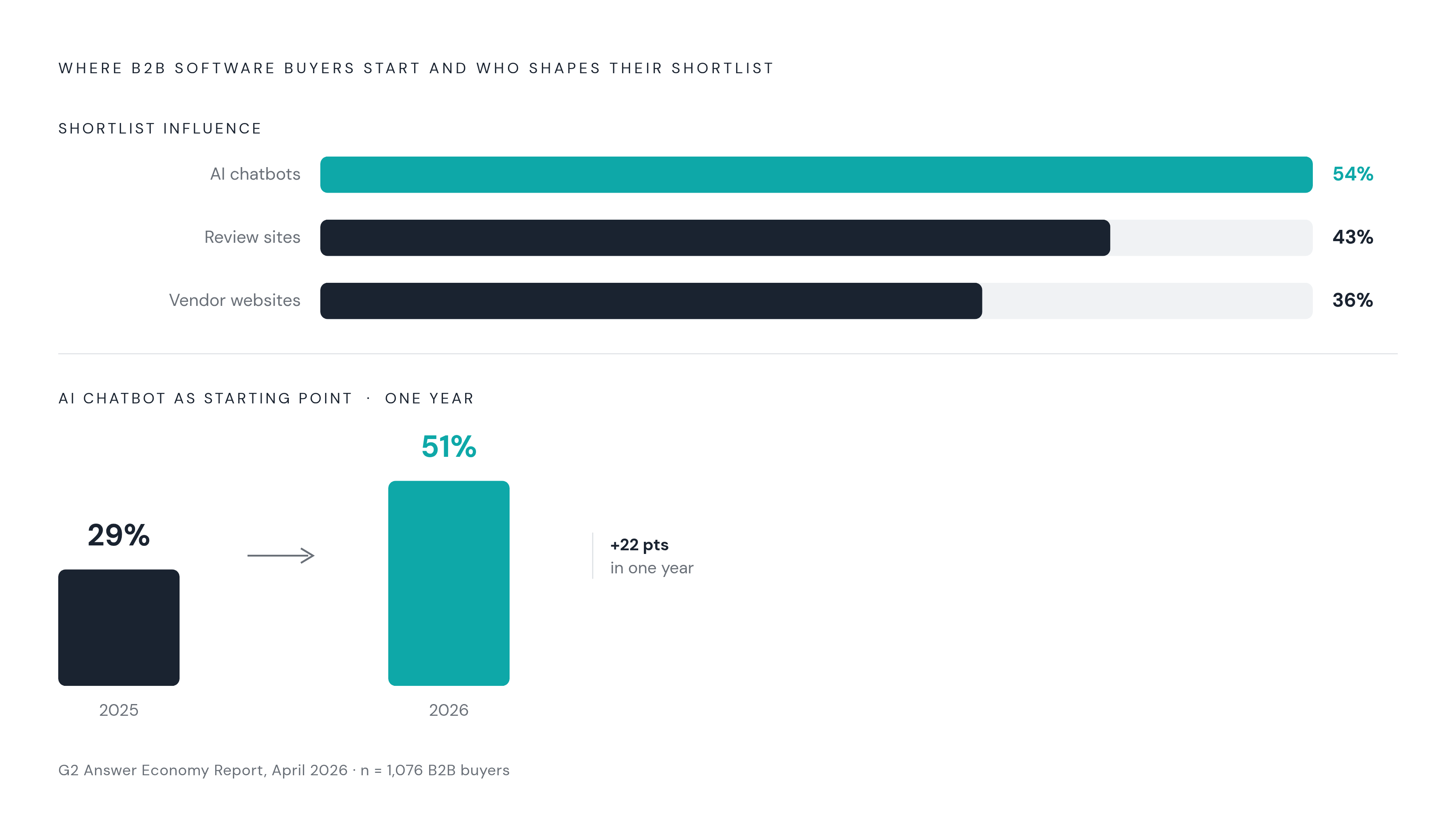
Here's the part that should reorder a few priorities: G2's Answer Economy Report, published April 2026 with 1,076 B2B buyers surveyed, found 51% of B2B software buyers now start their purchasing process in an AI chatbot instead of a traditional search engine. Twelve months prior, that figure sat at 29%. Nearly doubling in a year isn't a trend line, it's a phase change.
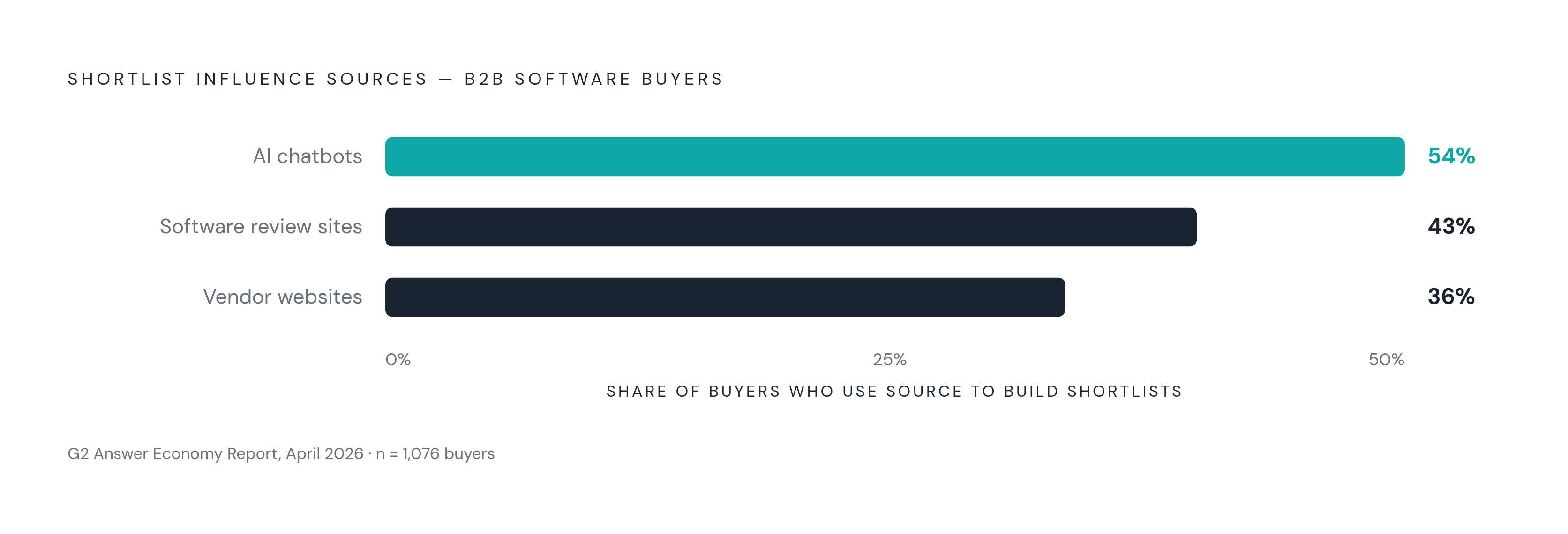
Overall, 71% of B2B software buyers now rely on AI chatbots at some point during software research, per the same report. And when it comes to influence on the actual shortlist, AI chatbots rank first at 54%, ahead of software review sites at 43% and vendor websites at 36%. Sit with that ordering for a second: the vendor's own website, the thing marketing teams spend the most money building, ranks third.
The behavioral data gets stranger. 69% of buyers in the G2 survey ended up choosing a different vendor than the one they originally planned to buy, based on guidance from an AI chatbot. One-third bought from a vendor they'd never heard of before that conversation. The AI is building the decision from a blank page in a large share of cases, sometimes overriding a plan the buyer walked in with.
There's a reputational lift baked into this too. 85% of buyers say they think more highly of a vendor once an AI chatbot mentions it by name, and four out of five say the chatbot sped up their decision. Forrester's 2024 Buyers' Journey Survey backs this up at a broader level: 89% of B2B buyers now use generative AI somewhere in the process, and they name it a top source of self-directed information across every stage of buying, not just the early exploratory phase.
One detail explains a lot of why this works the way it does. Average query length in traditional search sits around 3.37 words, according to The Growth Memo 2025 report; the average ChatGPT prompt runs considerably longer. Buyers aren't typing "project management software" anymore. They're typing something closer to a paragraph describing their team size, their existing stack, their budget ceiling, and the one integration that's non-negotiable. That's closer to a brief than a keyword, and it changes what "ranking" for a query even means.
Why being cited inside an AI answer is a different kind of asset than ranking on page one
Here's the asymmetry that makes citation worth chasing on its own terms: Seer Interactive found brands cited inside an AI Overview earn 35% more organic clicks and 91% more paid clicks than uncited brands appearing on the very same results page. Getting cited doesn't just win the AI surface; it seems to lift the traditional listing sitting right below it too, which suggests the citation itself functions as a credibility signal that carries over into human clicking behavior.
Quality matters as much as quantity here. A buyer who typed a 23-word prompt describing their exact use case and got matched to a specific vendor by name arrives at that vendor's site already pre-qualified in a way a keyword-matched click never is. That tracks with the mechanism: the AI already did the matching work the landing page used to have to do.
Then there's discovery. The dark funnel problem has a new costume here. Word-of-mouth referrals and analyst reports used to be the quiet channels where B2B vendors either made it onto a shortlist or didn't, invisibly, with no way to measure the miss. AI-generated answers are now doing a version of that same early-stage filtering, except at a scale where the vendor left off the list can actually check whether they were mentioned. That's a fixable problem, if someone's watching for it.
One caveat worth sitting with: citation gets a brand into the room, but the deal still has to be closed on the ground. A buyer who hears a vendor's name inside an AI answer still has to land on a website that makes sense, read case studies that hold up, and check reviews that back up the pitch. AEO's job ends at the open door.
Why SEO still earns its place in a B2B SaaS budget, even as the landscape shifts
SEO's overall relevance is holding up, though a specific style of it is fading fast: the high-volume, click-count-obsessed, publish-500-blog-posts-a-year approach that treated informational traffic as an end in itself. The underlying logic beneath SEO, meaning topical authority, technical credibility, and relevance to what a buyer actually needs, hasn't gone anywhere. It's still the thing that makes a brand findable and trustworthy, whether the "finder" is a human or a language model.
Cost efficiency alone keeps SEO in the budget. Organic traffic consistently produces a lower cost per lead than paid search in SaaS, and that gap doesn't close just because an AI Overview ate the click. It shows up over a longer horizon, and it still beats paid acquisition on unit economics.
The buying journey itself is also stretching out at exactly the stage where SEO content earns its keep. G2's 2026 Buyer Behavior Report found evaluation is now the longest stage of the buying journey for 40% of buyers. Evaluation runs on comparison pages, integration documentation, case studies, pricing breakdowns: the deep, specific, click-through-and-actually-read content that AI summaries tend to compress rather than replace. Nobody's letting a chatbot summarize their way through a 40-page security questionnaire.
Review platforms reinforce this. G2's 2026 Buyer Behavior Report puts review sites (G2, Gartner Peer Insights) at the top of shortlist influence at 38%, just ahead of AI chatbots at 37%. And those review platforms are themselves heavily indexed by search engines and heavily cited by AI engines, which means investing in review presence pays into both channels at once. SEO's clearest home turf remains navigational and branded queries, plus the deep-evaluation content that a buyer wants to sit with, not skim past.
How the two disciplines overlap in practice, and where they diverge
Underneath both disciplines sits the same foundation: a technically sound site, content that's accurate and doesn't need a correction six months later, real topical authority built up over time, and links or mentions from sources a buyer already trusts. None of that work gets duplicated between SEO and AEO. It compounds. A well-structured, well-linked, technically clean site is table stakes for both, not a fork in the road where a team has to pick a lane.
The divergence shows up at the sentence level. AEO rewards content that can be lifted whole and still make sense: a definition, a comparison, an answer that stands on its own two feet without needing three paragraphs of surrounding context to be understood. Structured data, direct Q&A formatting, and concise definitions near the top of a section all help an AI engine parse and attribute a claim correctly. SEO, meanwhile, can still lean on things that have no AEO equivalent at all: time-on-page, internal linking that guides a reader deeper into a site, funnel architecture that nudges someone from a blog post to a demo request over several clicks.
Citation diversity is the other big split. SEO ranking depends heavily on a brand's own site and its backlink profile. AEO depends on the whole ecosystem: what G2 says, what independent analysts have written, what press coverage exists, what third-party editorial has published. AI engines pull from all of it when deciding who to cite, so a brand's own website is only one voice in a much louder room. The GEO study by Aggarwal et al., presented at ACM KDD 2024, found that targeted optimization techniques could lift AI citation visibility by up to 40%. That's an emerging discipline, not a mature one, but the number is large enough to take seriously.
There's a simple test for telling the two apart on any given page. Read a single paragraph and ask whether it answers the buyer's question on its own, with no help from the sentences around it. If it does, that paragraph is AEO-ready. If it only makes sense once someone's read the three paragraphs before it, that's SEO-style content, built for a human moving through a page in order, and it needs rework before an AI engine will quote it cleanly.
The gap between awareness and action among B2B SaaS marketing teams
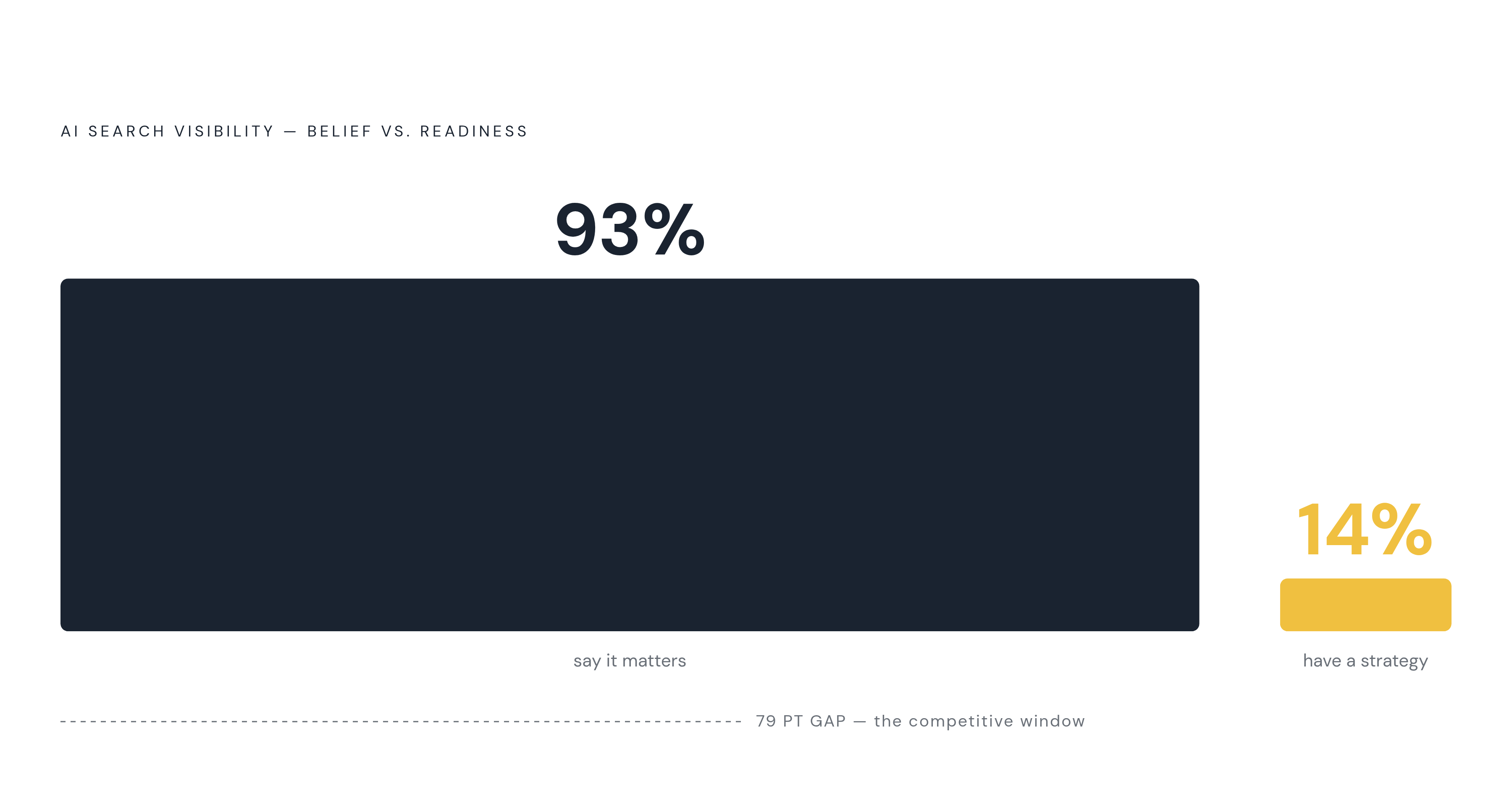
Here's where the story gets a little absurd, in the way most real gaps between awareness and action tend to be. CommonMind's survey found 93% of B2B SaaS marketers call AI search visibility critically important. Only 14% have a mature strategy in place to actually address it. That's a canyon, and most of the industry is currently standing on the wrong side of it, nodding along about how important the other side looks.
The gap between stated importance and actual action is a pattern worth naming.
The measurement side is arguably worse. Most teams have no idea whether ChatGPT is recommending them, ignoring them, or quietly steering a prospect toward a competitor mid-conversation. That blind spot matters most at precisely the stage where G2's data says shortlists are getting built.
There's a lag effect that makes the delay costlier than it looks on paper. AI models train on a snapshot of the web, and that snapshot doesn't update in real time. A brand that starts building citation signals and topical authority today won't necessarily show up in the next model refresh; it'll show up in the one after, or the one after that. Waiting a year to start doesn't just cost that year. It costs however long the next training lag runs on top of it.
None of this is a reason to panic, and panic is rarely a good content strategy anyway. It's a reason to move while the canyon between 93% and 14% is still wide open. That gap is the competitive window, not a warning to sit still.
How to allocate content effort across SEO and AEO by funnel stage and query type
Start where the data points hardest: top-of-funnel informational content is where AEO deserves the most attention, given that 99.2% of AI Overview keywords are informational. The "what is," "how does X work," "X vs. Y" content that used to be a reliable traffic source now needs to be judged less by whether it ranks and more by whether a language model could lift a clean, accurate paragraph out of it and attribute the claim correctly.
Mid-funnel evaluation content is where both disciplines have to show up at once. Comparison pages, integration docs, use-case walkthroughs; these need to rank in traditional search because buyers are actively reading them start to finish, and they need to be structured so an AI engine can cite them accurately when a buyer asks a comparison question directly. Review platform presence amplifies both sides of that equation simultaneously, since G2 and Gartner Peer Insights pages get indexed by search engines and pulled into AI answers alike.
Bottom-of-funnel branded and navigational queries stay squarely in SEO's lane. A buyer typing a vendor's name into a search bar has already gotten past the AI-discovery phase; they know who they're looking for. That's a query type where AI mediation adds little and traditional organic and paid search still do the job they've always done.
On the mechanics: content built for AEO should lead with the direct answer, use headers phrased the way a buyer would actually ask the question, carry structured data markup, and put the definition or conclusion in the first sentence of a section rather than the last. Owned content alone doesn't get a brand cited consistently; that requires active presence on review platforms, real mentions in third-party editorial, and relationships with analysts who get cited themselves.
Measurement has to fork too. SEO still runs on clicks, rankings, and sessions, the familiar dashboard. AEO requires tracking brand mentions inside AI outputs directly, citation frequency across tools like ChatGPT and Perplexity, and the conversion quality of whatever traffic does eventually arrive from an AI-referred click. Different instruments, different questions, same underlying goal.
The strategic mistake worth naming plainly: treating SEO and AEO as a sequence, something to tackle one after the other once the first one's "done." Content that answers a buyer's question clearly and credibly compounds in both channels at the same time, on the same publish date. The teams closing the 93%-to-14% gap are running these as parallel workstreams from day one, not queuing them up like items on a to-do list. The allocation problem, reduced to a single sentence: build the road that serves both at once.


