Managing Brand Sentiment in Comparative AI Answers
How AI engines frame your brand in comparisons shapes deals before prospects ever visit your site.
Asking an AI engine to compare vendors in a category can produce an answer that calls a competitor "the leading solution" while describing your product as "an alternative worth considering"." That single phrasing gap is the whole ballgame: if an AI engine calls a competitor "the leading solution" while calling your product "an alternative worth considering," that framing difference translates directly into fewer deals entered. The answer a buyer receives functions as a shortlist. Brands with favorable framing enter consideration; brands that are absent, or framed with hedges and qualifiers, get screened out before anyone opens a browser tab to the company's actual website.
Writer.com's 2026 enterprise guide has a name for what happens next: the "silent shortlist," a preference formed entirely inside an AI conversation before a prospect ever lands on a brand's domain. By the time that prospect does arrive on-site, if they arrive at all, the decision may already be more than half made. This matters more, not less, for B2B sellers. Research cycles run longer there, and the buying committee is larger, so the compounding effect of one dismissive AI answer is worse than it would be for an impulse consumer purchase. A procurement lead who never sees a brand mentioned, or sees it mentioned with a note of caution, may simply never add it to the list of vendors worth a call.
It's a positioning event that happens at the exact moment a buying decision starts to take shape, and it happens whether or not the brand has done anything to participate in it.
How AI engines form the characterization they deliver in a comparative answer
The characterization an AI engine delivers is a statistical pattern. It's a statistical pattern, assembled from whatever the engine can reach across reviews, forum threads, news coverage, and analyst write-ups, then compressed into one narrative and delivered with the flat confidence of a settled fact. That confidence is part of the problem. Because the response blends dozens of sources into a single narrative, almost nobody cross-checks it against the originals, so the framing in that one answer carries more weight than any individual review or article ever could on its own.
Consistency is not guaranteed, either. Profound's research tracking prompts across ChatGPT, Copilot, and Perplexity documented a "fan out" behavior, meaning ChatGPT effectively never searches the same way twice. Each engine builds its answer through a different process, so a brand described favorably in one system might get a flatter, more hedged treatment in another. That non-determinism has a direct implication for strategy: optimizing one page, or one press release, cannot guarantee a consistent brand presence across engines, because the mechanism generating the answer isn't stable.
Brands going through change face a sharper version of this problem. Google, for all its faults, lets fresh content displace stale rankings fairly quickly. Training data doesn't work that way. Correcting it is slower and less direct: unlike Google, where fresh content can displace outdated results, stale training data is much harder to correct.
Characterization is downstream of the content ecosystem. If the dominant public content about a brand is thin, hedge-heavy, or openly critical, that's what the AI reflects back. Which also means the reverse holds. Changing the ecosystem eventually changes the characterization.
Why a brand's own website loses the vote on what AI says about it
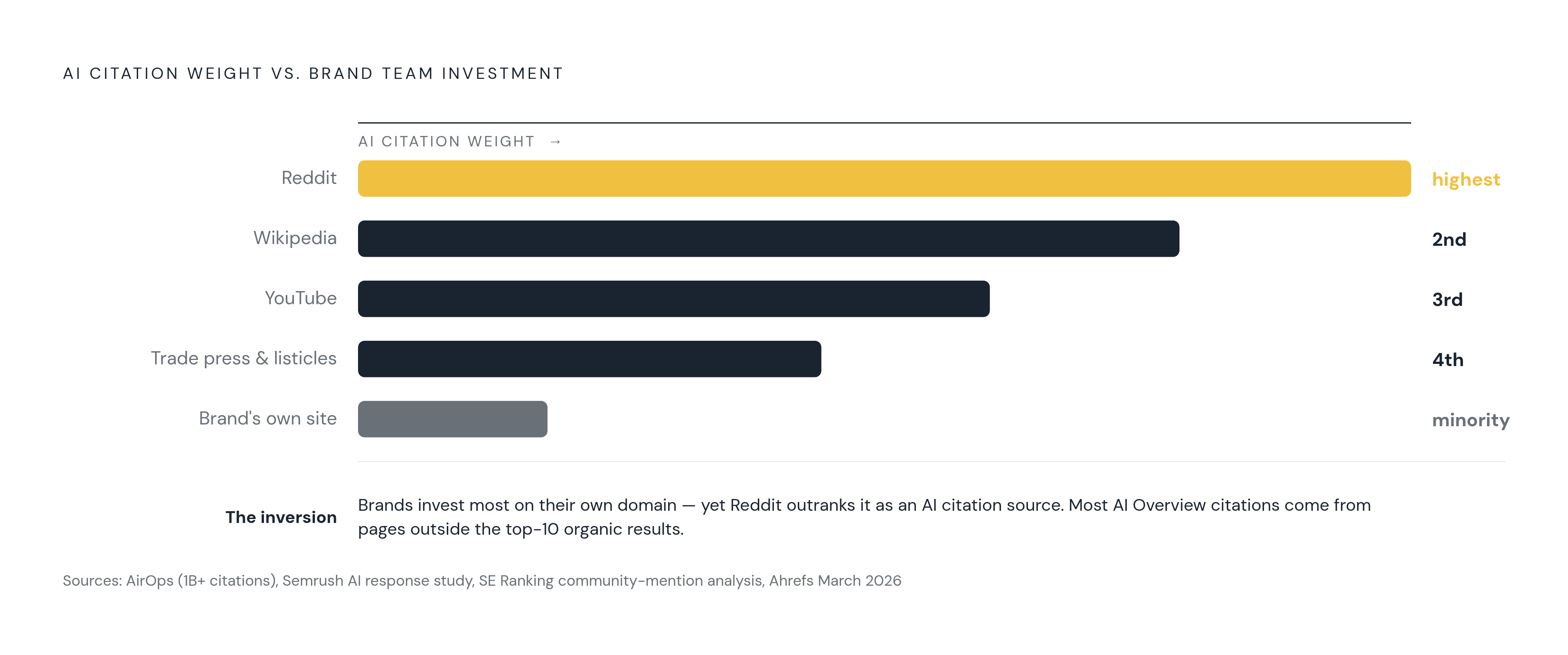
A brand's own website is a minority stakeholder in what AI engines say about that brand. AirOps' 2026 analysis, built on over a billion citations, found that brands are considerably more likely to be cited through third-party sources than through anything on their own domain, with the large majority of AI brand mentions originating off-site. A separate 2026 citation study spanning ChatGPT, Gemini, Perplexity, Claude, and Grok landed on the same conclusion from a different angle: only a small share of citations pointed back to the brand's own site.
So where do the citations actually go? Semrush's study of citations drawn from thousands of keywords found Reddit showing up in the highest share of sampled AI responses of any domain, ahead of Wikipedia and ahead of YouTube. That's not a platform most brand teams have historically budgeted for, let alone treated as a primary channel. SE Ranking's research adds the mechanism behind the number: domains with millions of Reddit mentions have a substantially better shot at AI citation than domains with minimal community activity, and Quora produces a comparable lift at a much lower mention threshold. Community conversation, in other words, is doing real work that a corporate blog post cannot replicate.
The structural logic is straightforward once it's named. An engine treats a company describing itself as a claim. It treats a third party describing that company as evidence. That's the same reasoning that puts G2 reviews, listicles, and trade press ahead of a vendor's own homepage in the citation queue. The Ahrefs finding from March 2026 that the majority of AI Overview citations now come from pages not in the top-10 organic results, with AI Overview citations from top-10 organic results dropping significantly over eight months, underlines that SEO rank alone is no longer a reliable proxy for AI citation.
Running the audit: what AI engines are saying about your brand in comparative answers right now
Observation has to come before optimization. Before touching a single page of content, the right move is to run prompts across the category and simply read what comes back, because the distance between how AI currently describes the brand and how the brand wants to be described is the entire brief for what follows. Skipping this step turns every content decision downstream into a guess.
Helen + Gertrude's playbook organizes the ongoing tracking around four dimensions: rank, meaning how early the brand appears in the response, since position carries real weight; visibility, meaning how consistently the brand shows up across the full set of relevant prompts; citations, meaning how often third parties are the ones doing the mentioning; and sentiment, meaning whether the characterization is not just present but actually accurate and favorable. That last dimension deserves particular attention, because visibility without good sentiment is a trap. Liquid Death is the example the playbook points to: high visibility inside ChatGPT, paired with only middling positive sentiment, which is still a problem even though the brand technically "shows up" constantly.
Platform behavior diverges enough that a single audit run isn't the end of the story. Perplexity, according to research from Discovered Labs and Whitehat SEO, averages more than double the citations per response compared with ChatGPT, and it tends to generate far more website links than actual brand-name mentions, producing what amounts to a ghost citation problem: traffic flows to the site, but the brand doesn't lodge itself in the reader's memory the way a named mention would. Freshness is the dominant lever on that platform specifically, with citation rates for recently updated content running well ahead of older material. Finally, the audit needs to track which third-party sources are actually carrying the brand's mentions, whether that's review platforms, specific trade publications, or Reddit threads, because that list becomes the diagnosis for where earned coverage is already strong and where it's thin. The baseline audit protocol runs a set of prompts relevant to the business category across ChatGPT, Perplexity, Gemini, and Claude, documenting for each mention rate (does the brand appear at all), citation rate (is a source linked), sentiment (what language is used), and competitor positioning (how are rivals framed relative to the brand).
Measurement tools that track AI brand characterization at scale
A manual audit gives a snapshot. It cannot keep pace with the volume of prompts, platforms, and competitive comparisons that a brand actually needs watched on an ongoing basis, which is the gap a small set of purpose-built platforms now fill.
SE Visible focuses on visibility and perception across ChatGPT, Perplexity, Gemini, AI Overviews, and AI Mode, and it works from real AI responses rather than simulated ones, which matters given how non-deterministic these systems are. Writesonic tracks brand appearance across a wider spread, ChatGPT, Gemini, Perplexity, Claude, Google AI Mode, Grok, DeepSeek, and Copilot among others, with prompt-level tracking that shows which specific queries trigger a mention. Yext's Scout product is built for multi-location brands, showing how a business appears across AI and traditional search at the individual market level, monitoring ChatGPT, Gemini, Perplexity, Claude, and Google with benchmarking that goes down to the local market. Profound has become something of a reference point for identifying which platforms actually move brand mentions inside ChatGPT, Google AI Overviews, and Perplexity, and it's Profound's own research that documented the fan-out behavior explaining why consistent presence is hard to lock down in the first place. And HubSpot's AEO Grader delivers a snapshot across five areas, sentiment analysis, presence quality, brand recognition, share of voice, and market position, while also suggesting custom prompts by industry and generating prioritized recommendations from the citation sources it analyzes.
The vendor landscape itself is consolidating. Adobe completed its acquisition of Semrush on April 28, 2026, folding Semrush's brand visibility platform, which covers SEO, GEO, and agentic search optimization, into Adobe's broader CX Enterprise platform. Any enterprise team currently evaluating measurement vendors should note that the tool a brand picks today may sit inside a very different corporate structure within a year.
Underneath all of these tools sits share of model, or SoM, a term coined by Jack Smyth and Tom Roach and picked up in Writer.com's 2026 enterprise guide. It measures how often a brand shows up in AI-generated answers relative to competitors, and unlike paid share of voice, nobody can buy their way into it. Standardized AEO metrics broadly are still being worked out, with wider adoption expected by late 2026, and McKinsey research cited in Writer.com's guide found that only a small minority of brands are systematically tracking their AI search performance today. Teams that build this measurement layer now are, quite simply, ahead of almost everyone else.
What content shifts how AI characterizes a brand in comparative answers
Since most AI citations trace back to third-party sources, the highest-leverage content investment is earned coverage that compounds over time. It's earned coverage that compounds over time, retrievable ground truth sitting in the places AI engines already look. Lumar's 2026 Brand Authority GEO analysis breaks down what these models actually weigh when deciding whether a brand is worth citing. Unlinked brand mentions across authoritative publications carry signal on their own, even without a hyperlink attached. PR placements and media coverage that generate positive sentiment on third-party platforms matter. So do expert citations and influencer coverage that validate a brand's standing within its field. Customer reviews and testimonials matter too, and Helen + Gertrude's playbook recommends putting those reviews directly on the brand's own website as well as on third-party platforms, so AI systems can extract them from owned content rather than relying solely on external sites. Multichannel consistency rounds it out; these models are checking whether a brand's identity and claims hold together across sources.
Digital PR and thought leadership need to be treated as direct inputs to AI visibility, as much a part of content strategy as any other input. Every earned placement adds another layer of corroboration, and that corroboration is what makes the next citation more likely to happen.
On owned content specifically, a handful of tactics help AI extract and attribute claims cleanly: breaking long pages into shorter, more focused pieces, adding FAQ sections to key pages, marking pages with "last updated" dates and refreshing anything older than two years, and structuring answers in Q&A format so an engine can lift them directly into a response. Freshness carries outsized weight on Perplexity in particular. Whitehat SEO's analysis found citation rates for recently updated content running dramatically ahead of older material there, which makes a steady publishing cadence a real lever on that platform.
One shortcut deserves naming and then setting aside. Some brands publish self-referential listicles, the "Best ecommerce SEO agencies" format that conveniently ranks the publisher first, pages that often don't even rank in Google but still get picked up by ChatGPT. It works, for now. It's also the kind of tactic that erodes credibility over time as engines and readers alike get better at spotting it, so the durable path stays earned coverage, not self-published rankings dressed up as objective comparisons. Writer.com's 2026 guide makes a useful correction on this whole domain: GEO is mostly a strategic exercise, about positioning, ecosystem presence, and brand authority, with technical execution playing a much smaller role than most teams assume. Brands that start with schema markup before figuring out where they're actually being discussed on the web have the order backward.
How human review keeps the content pipeline accurate enough to be credible
Shifting how AI characterizes a brand takes publishing retrievable, accurate material at a cadence that keeps pace with how often these engines refresh their indexes, and that kind of volume is realistically only achievable with AI-assisted drafting. But AI-generated content that's inaccurate or generic isn't neutral; it's a liability, because these same engines are evaluating source credibility when they decide what gets cited. Publish sloppy material at scale and the brand risks training the exact systems it's trying to influence to trust it less.
The operational standard that's emerged in 2026 pairs automated monitoring with structured human review: real-time alerts flag significant sentiment shifts as they happen, while deeper manual review runs on a monthly or quarterly cycle. The more sophisticated versions of this pipeline combine natural language processing with sentiment analysis and grammar correction, flagging tone problems or factual inconsistencies automatically, while human reviewers work from dashboards built to identify outliers before anything goes live. That last check matters most in regulated industries, where a misclassified sarcastic mention or an unchecked inaccurate claim doesn't just fail to help, it actively produces the opposite of the intended signal.
Sarcasm, specifically, remains the hardest case for automated sentiment tools to get right. Critical brand mentions need a human set of eyes before anyone treats the automated read as ground truth, because a sarcastic post misclassified as praise, or as an attack, can send a content team chasing the wrong fix. The same human-in-the-loop logic runs through both halves of this system, catching misclassified sentiment on the measurement side and catching inaccurate claims on the publishing side, so that everything going out under the brand's name earns a citation instead of undermining one.
The objection is obvious: doesn't review slow everything down right when cadence matters most? Not if the review gates sit where the risk actually concentrates. Claims, comparisons, and regulated topics get the scrutiny; lower-risk output moves at full speed. Publishing fast and publishing carefully were never actually in conflict, they were just being managed as though they were.