Industry Research Reports as AEO Authority Assets
Research reports earn AI citations when distributed through third-party outlets.

B2B buyers no longer start their research on a search results page. They start it in a chat window, and by the time they land on a vendor's site, if they land there at all, their shortlist is already forming. Forrester's 2026 Buyer Insights data shows 94% of B2B buyers now use AI somewhere in their purchasing process, and twice as many name generative AI or conversational search as the channel that matters most to them, more than any other single source. ChatGPT alone handles over 2 billion queries daily, with AI-referred sessions to websites growing 527% year-over-year through mid-2025. That's not a niche behavior anymore. That default is what those figures show, not a niche behavior anymore.
What makes this urgent rather than merely interesting is what happens to the click. Zero-click searches on Google grew from 56% to 69% in a single year following AI Overviews' rollout, and a Pew Research Center study of 68,879 Google searches found that only 1% of users clicked a source link inside an AI-generated summary. Ahrefs, looking at 300,000 keywords, found AI Overviews cut click-through for the top-ranking page by as much as 58%, from 7.3% down to 1.6% on the keywords where AI Overviews appear. The traffic is dropping sharply. It's being intercepted before the click ever happens.
For a B2B brand, this changes what "winning" the discovery phase even means. Buyers are forming their preferences during AI-mediated research, well before they reach a vendor's site, and a brand that isn't cited in that phase simply isn't in the conversation. Yet the market hasn't caught up to its own data: 70% of marketing professionals believe AEO will significantly impact their digital strategy within 1–3 years, but only 20% have begun implementing it. That gap between belief and action is the opportunity this piece is built around.
Defining AEO and its difference from ranking for clicks
The 2026 chiefmartec MartechMap formally renamed its SEO subcategory to "SEO/AEO/GEO," signaling that the discipline is now recognized as distinct infrastructure.
Modern answer engines run on a retrieval-augmented generation pipeline, RAG for short. A query comes in and the system interprets intent and entities rather than matching keywords. It retrieves candidate pages using semantic similarity, not exact phrase overlap. It ranks and selects among those candidates based on relevance, authority, recency, and structural quality. Then it generates an answer: the AI synthesizes across sources, rewrites in its own words, and extracts what it needs, it does not copy anything verbatim. The final step, citation, is where specific claims get attributed back to specific source documents, and this is the step where all the AEO effort either pays off or doesn't.
The gap between old and new appears directly in query length. The average Google search runs about 3.37 words. The average ChatGPT prompt runs about 23 words. Content built to catch keyword fragments has nothing to offer a system trying to extract an answer to a fully formed, conversational question. That's a structural mismatch.
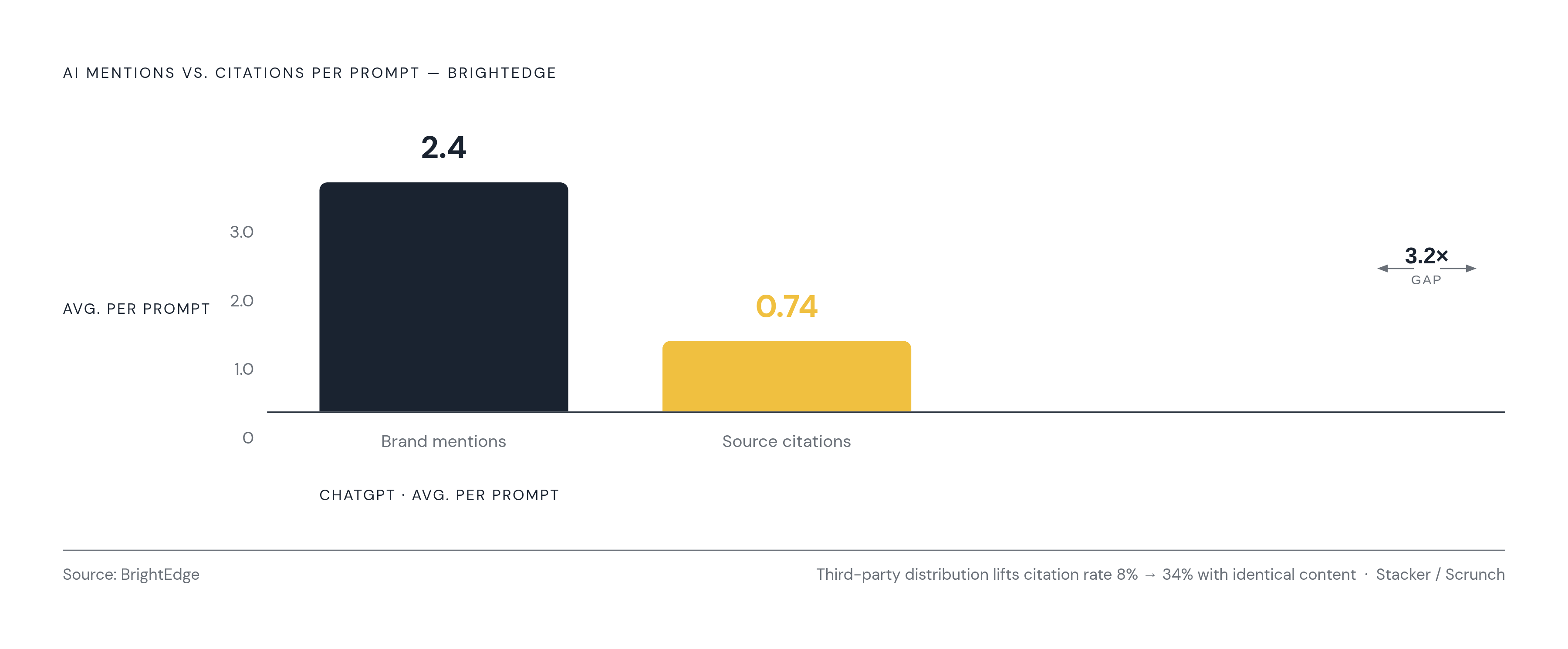
Once a brand starts showing up in AI answers at all, knowing what "showing up" actually means shapes how that appearance should be read. There's a real difference between a mention, where the AI names a brand but attaches no URL to it, and a citation, where the AI links to or attributes a specific claim directly to a brand's URL. SEMrush called this gap the "Mention-Source Divide" and found that fewer than one in five brands manage to achieve both frequent mentions and consistent citations. The 2026 chiefmartec MartechMap even renamed its SEO subcategory to "SEO/AEO/GEO," a small naming change that signals this is now recognized as its own piece of infrastructure. Mentions are nice. Citations are the asset. And that distinction is exactly where the case for research reports begins. AEO is defined as the practice of structuring and enhancing content so that AI-powered search platforms select it as a cited source when generating answers. According to BrightEdge data, ChatGPT mentions brands 3.2x more than it cites them, averaging 2.4 brand mentions versus 0.74 citations per prompt.
What AI answer engines select as cited sources
If citations are the target, the next question is mechanical: what actually earns one? The evidence points in a consistent direction, and it starts with a strong bias against brand-owned content.
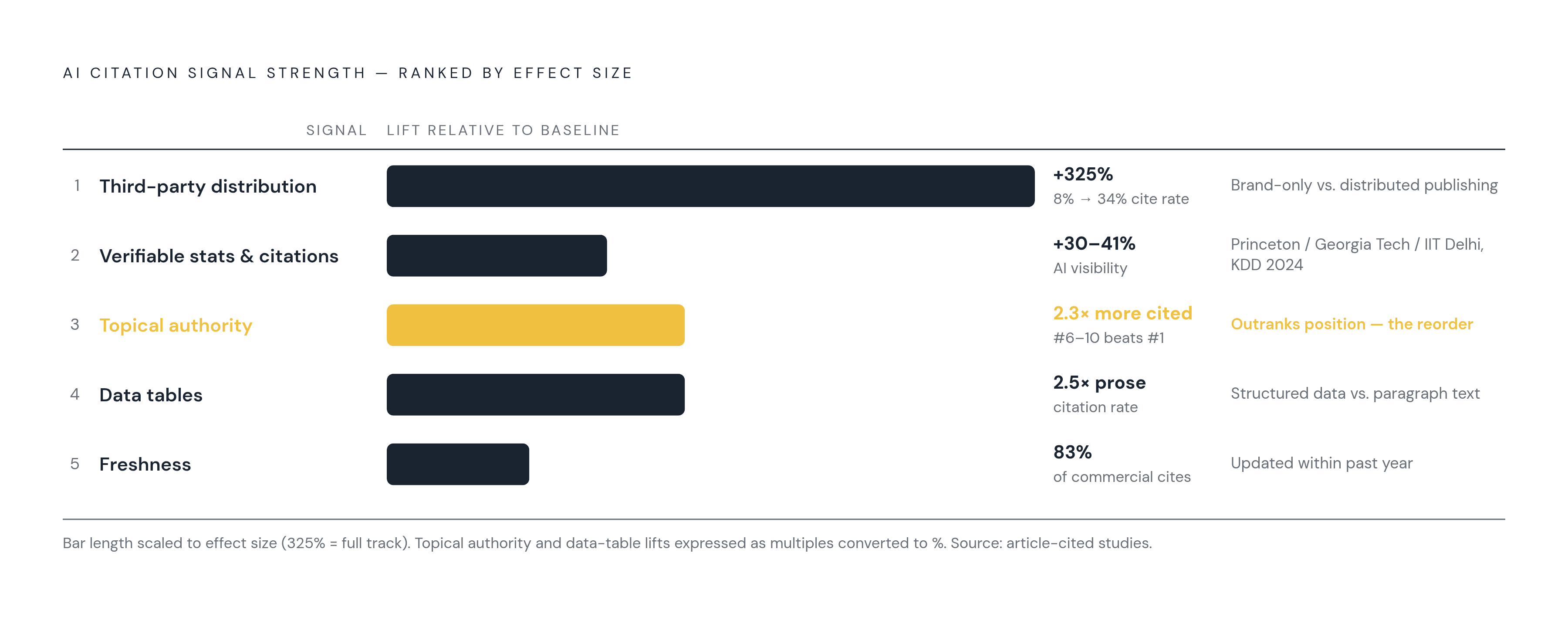
A large-scale controlled study out of the University of Toronto (Chen et al., arXiv:2509.08919) found that AI search shows a systematic, overwhelming preference for earned media, meaning third-party, authoritative sources, over content a brand publishes and promotes itself; social platforms barely showed up in AI answers at all. A Stacker and Scrunch study measured this directly: identical content saw its citation rate climb from 8% to 34% purely by moving through third-party news distribution, with no change to the content itself. Distribution, not quality, was the variable that moved the number. That finding lines up with a broader signal-weight gap: brand mentions correlate with AI visibility at 0.664, compared to just 0.218 for backlinks, and spreading content across a wide range of publications rather than posting only on an owned site can lift AI citations by as much as 325%.
Original data plays a similar role. Content carrying information that isn't easily found elsewhere is disproportionately attractive to these systems, and owned, original insight was the second-strongest differentiator researchers found between cited and uncited pages. Princeton, Georgia Tech, and IIT Delhi researchers (Aggarwal et al., KDD 2024) went further, finding that content loaded with verifiable statistics, named citations, and authoritative quotations achieves 30 to 41% higher AI visibility than content without those elements, making it the single most rigorously validated GEO tactic on record.
Format matters almost as much as substance. An analysis of 177 million AI citations by SEOMator found listicles account for 32% of all citations, with blog and opinion content trailing far behind at 9.9%. CXL research found 55% of sampled AI Overview citations were pulled from the first 30% of the page, so the answer has to arrive before the supporting argument does. Research from Princeton University and IIT Delhi found that topical authority is the strongest predictor of AI citation, with pages ranking in positions 6–10 that carry strong topical authority signals cited 2.3x more frequently than pages ranking number one with weak topical authority.
Freshness closes the loop. AI-surfaced URLs run 25.7% fresher on average than the URLs traditional search surfaces, and AirOps' 2026 State of AI Search Report found that for commercial and evaluation-stage queries, 83% of citations came from pages updated within the past year, with more than 60% refreshed in just the last six months. Pages not updated quarterly lose AI citations at 3x the normal rate. Every one of these signals, taken together, points at the same kind of asset. A paper by Aggarwal et al. from Princeton, Georgia Tech, and IIT Delhi presented at SIGKDD 2024 found that tables are cited 2.5x more often than prose, as structured data that retrieval pipelines can extract without parsing narrative. Research into AI citation patterns found that citation rates peaked for pages carrying 7 to 15 H2s, reflecting more clearly labeled, self-contained answers an engine can lift.
Why an industry research report satisfies citation signals
Lining those signals up next to what a research report naturally produces shows the fit is close to exact. A well-built report generates statistics that no competitor can replicate or predate, which is precisely the modification Princeton's researchers flag as the highest-leverage move available in this space. A line like "based on a 2026 survey of 1,200 enterprise buyers" is exactly the format answer engines extract and cite with attribution intact, because the source name travels with the number wherever it gets quoted.
The structural overlap keeps going. They're built around numbered findings and ranked lists, which is structurally close cousin to the listicle format behind 32% of all citations. And a well-written executive summary puts the sharpest statistics right at the top, following the "bottom line up front" pattern that produces the 55%-of-citations-from-the-first-30%-of-the-page finding.
There's also the earned-media effect. A research report hands journalists, analysts, and industry commentators something genuinely citable, which is what opens the door to the third-party placements that move citation rates from 8% to 34% and can lift AI citations by up to 325% over brand-only publishing. Publish the report on an annual or biannual cadence and the freshness requirement solves itself too, since each new edition resets the update clock that would otherwise trigger the threefold citation decay. Running that cadence for a few years on the same theme compounds the topical authority, building exactly the signal Princeton and IIT Delhi found outweighs raw domain authority. Blog posts and case studies can hit some of these marks individually. A research report is close to the only content type built to hit nearly all of them at once, and that overlap is what makes it worth the earned-media push covered next. Data tables are cited 2.5x more than prose. Clear headed sections match the 7-to-15-H2 citation-rate peak.
Architecting a Research Report for Maximum AI Retrievability
None of this works if the report only lives in one place. It needs to exist in two environments at once. Layer one is the brand's own structured content hub, sometimes called the "ground site": crawlable, marked up with schema, organized so an AI system can actually retrieve and index the findings. Layer two is earned-media distribution, the same underlying data seeded into third-party publications that carry their own trust signal, since a story that runs in a respected trade outlet earns citations the AI attributes to that outlet's authority, not just the brand's.
On the ground site, the structural choices determine how the page's citable statistics, data tables, and comparisons get surfaced and used. Lead with findings, not methodology, keeping the most citable statistics inside that first 30% of the page. Use data tables for any cross-cut or comparison rather than folding the numbers into paragraph prose. Build a clear H2/H3 hierarchy that names each finding explicitly rather than using vague section titles. Add schema markup that actually reflects what's visible on the page and who wrote it, and make the researchers' credentials and methodology visible rather than buried in an appendix.
Consistency across the wider ecosystem is its own requirement. The brand name, the report's title, and its headline statistics need to match exactly across the brand's own site, its LinkedIn presence, industry directories, and anywhere else the report gets cited, because inconsistency here just dilutes retrievability and trust. Handled well, a report published natively and pushed out as earned media wires straight into the forums, review sites, and verified data sources that large language models treat as ground truth, working both channels at once. Seer's 2026 Winter Olympics LLM study found that brands with strong entity authority, real third-party validation, and active community discussion showed up in AI answers far more often than brands missing those layers, and the gap between strong and weak "signal architecture" wasn't small.
The distribution playbook that makes this work is straightforward, if underused. Pitch the key findings to trade and industry outlets ahead of the report's full publication, embargo-style. Hand journalists a quotable, standalone statistic rather than a link to a PDF they'll never open. Syndicate individual findings into the forums, newsletters, and community spaces that large language models actually index, rather than syndicating the whole report. And cite the report again in later content, building the kind of internal topical-authority signal that compounds over time.
Maintaining AI citation presence after the report publishes, the freshness and pipeline problem
Publishing the report is not the finish line. Pages not updated quarterly lose AI citations at 3x the normal rate, and for commercial and evaluation-stage queries, more than 60% of cited pages were refreshed within the last six months. A research report published once as a static PDF and never touched again sits squarely inside that decay curve. It has to be treated as a living document instead, with updated findings, refreshed data cuts, and a publication date that's visible to crawlers, not buried in a footer.
That's a resourcing problem as much as a content problem. Producing research on a real cadence, annual studies, quarterly pulse surveys, supplementary data drops, needs an actual production system behind it. Multi-stage AI pipelines can now handle a good chunk of that load: research synthesis, draft structuring, data formatting, all done fast. But speed alone raises the risk of errors slipping through unchecked. Human review is the checkpoint that ensures a report contains accurate, verifiable claims an AI system will propagate, rather than fabricated ones that get suppressed and, worse, actively drag down a brand's AI-perceived authority. Skipping that checkpoint can make the whole exercise backfire.
Even brands doing the work often can't tell if it's landing. Acquia and Researchscape found that 63.1% of marketers are already publishing AI-optimized content, while only 13.6% are measuring AI inclusion rate or agent-referred conversion. That's most of the market working without a feedback loop. Citation frequency, mention rate, share of voice inside AI answers, and whether a brand's named statistics are showing up attributed to the correct source are what marketers need to track, not just site traffic or keyword rank. That tracking also has to span more than one platform: ChatGPT, Claude, Gemini, and Perplexity each weight citations differently, and Perplexity in particular has shifted shape in 2026, moving to a subscription-first model and retiring its Sonar API, so checking a single platform gives an incomplete, possibly misleading picture of where a brand actually stands.
Treating the research report as the anchor of a broader citation asset ecosystem
None of this works as a standalone project. A research report earns its citation weight because it feeds everything around it: the earned-media placements that reference its findings, the follow-up blog posts that cite its statistics back to the original source, the sales and marketing collateral that borrows its numbers, the conference talks and trade press quotes that keep its named findings circulating. Treated as a single asset published once, it decays like anything else. Treated as the anchor of an ongoing content and distribution system, it keeps generating citation opportunities long after the initial launch window closes.
That's also why measurement can't stop at "did the report get picked up." Brands serious about AI visibility need to know whether they're being mentioned or actually cited, and whether that citation is landing on the right URL with the right attribution. Platforms like ChatGPT, Claude, Gemini, and Perplexity each have distinct citation weighting, and a single-platform check gives an incomplete picture of AI answer presence. A research report can be the single highest-leverage asset a B2B brand publishes this year. Whether it stays that way depends entirely on what happens to it after the launch date passes.