Reporting AEO Progress to Non-Technical Marketing Leaders
AI visibility now happens where traditional search metrics can't see it.
The dashboards marketing leaders open every Monday morning were built to answer one question: did someone click through to the site? Ranked position, organic traffic, click-through rate: these are all measures of a single event, the click, and for most of the last two decades that event was a fair stand-in for "did our marketing work." The problem now is not that answer engine optimization is some new invention marketers need to chase. The tools leadership has trusted for years are structurally blind to where a growing share of brand visibility actually lives. CXL's guide on answer engine optimization makes the related point that zero-click search is now the norm rather than the exception: Similarweb's clickstream data puts the share of Google searches that end without an external click at 68%, a figure Search Engine Land corroborated independently, reporting that the same pattern held 68.01% of the time in the U.S. across the first four months of 2026. Most searches, in other words, already produce no traffic event at all for a dashboard to catch. Google's own response is telling: the company rolled out dedicated generative AI performance reporting inside Search Console in June 2026, and building a whole new reporting surface for this is itself an admission that the old tools weren't picking up what was happening on AI surfaces. The result for anyone running a leadership report is a brand can be gaining ground in AI-generated answers while every chart the CMO reviews shows flat or declining performance.
What AI Answer Engines Measure
Search engine optimization and answer engine optimization are built around two different jobs, and that is why they call for two different sets of numbers. SEO exists to get a page ranked highly enough that a person clicks on it, so its scorecard is position, traffic, and click-through rate. AEO exists to get a brand named as the source an AI system draws on when it writes an answer, and its scorecard is how often that citation happens, how often the brand gets a mention, and what share of voice the brand holds inside AI-generated responses. AirOps's 2026 guide to answer engine optimization states the distinction: "A page can rank well and still never appear in an AI response. The reverse holds too: a page can earn a citation inside an AI answer even when nobody ever clicks through to read it. That gap between ranking and citation means a single aggregate "AI visibility" score can hide more than it shows, because performance on one engine says little about performance on another; any usable number has to be broken out engine by engine. Layered on top of that is a second complication: AI answers are not fixed outputs. The same question, asked twice on the same platform, can pull a different set of sources each time. A single manual check of whether ChatGPT mentions a brand on a given day is closer to flipping a coin than it is to taking a measurement.
The four metrics that replace rank-and-traffic in an AEO report
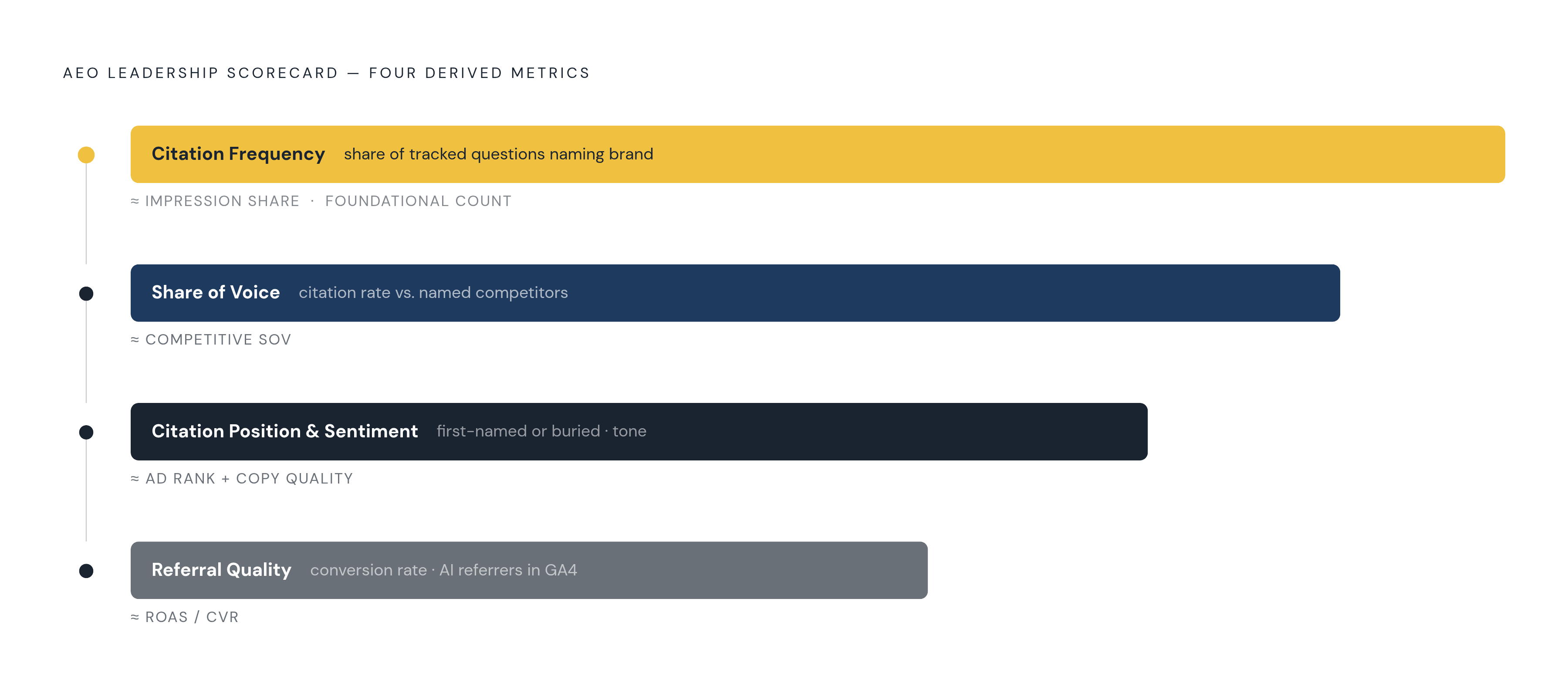
A report that leadership can actually trust rests on four numbers, and each one maps to something a marketing leader has already managed in some other channel. Citation frequency is the share of tracked questions where an AI answer names or sources the brand, and it works the same way impression share works in paid media: any leader who has run a paid program already knows how to read a number like this. Share of voice in AI answers measures citation rate against named competitors across the same set of questions, and it answers the exact question leaders already ask about every channel, which is whether the brand is gaining or losing ground against a specific rival. Citation position and sentiment track where in the answer the brand shows up, first-named versus buried further down, and how the AI describes the brand once it's there, so a brand mentioned in passing as one option among several is worth far less than a brand cited as the clear authority on the subject. Referral quality from AI platforms rounds out the set, and it is the metric that ties AI visibility back to numbers leadership already watches: because Perplexity always attaches clickable citations to its answers, traffic from perplexity.ai appears cleanly in GA4 under Acquisition and Referral, giving leaders a clean, trackable bridge between AI visibility and site activity. Each of these four deserves a caveat the raw number won't show on its own: a large share of AI brand mentions never produce a clickable link at all, so GA4 alone will always undercount what's happening, and citation rates read very differently depending on whether the underlying questions are informational, commercial, or navigational, since showing up when someone searches a brand's name directly is a far weaker signal than showing up when someone asks which vendor solves their problem.
Connecting citation metrics to pipeline outcomes leaders already own
These four numbers earn a place in a leadership deck for one reason: they predict and explain pipeline results that leaders are already held accountable for, not because they're interesting as abstractions. Start with conversion. A visitor who arrives from an AI platform has already been told, by that platform, that the brand is a credible source worth following, so it follows that referral traffic from AI platforms converts at meaningfully higher rates than traffic from traditional organic search. A leader watching flat organic traffic alongside rising pipeline contribution from AI referrals should read that as a shift in channel mix, not as a sign that growth has stalled. Next comes branded demand: when direct search volume and branded query volume rise in the weeks following a gain in AI citation share, that is a signal of awareness built inside answers that generated no click. Plotting citation share against branded search trend over the same time window makes that influence visible without building any new attribution infrastructure. Then there's timing: for most B2B buyers, the encounter with an AI answer engine happens early, well before a form fill or a sales call, so the right reporting frame is assisted conversion influence rather than last-touch credit, the same logic marketing leaders already use to justify spending on content and brand. The number that tends to cut through fastest with a CFO or CEO is the risk framing: a brand that never appears in AI-generated answers is absent from the research process of buyers who never make it to the website, the ad, or the sales team, and that's a pipeline-entry problem, not a traffic problem.
Why a single-engine snapshot understates or overstates actual visibility
The single most common mistake in AEO reporting is treating one engine, one question, one run as if it represented the whole picture. AI answers are probabilistic by design: the same question, asked on the same platform on the same day, can return a different set of sources each time. A single manual check isn't a measurement at all; it's one draw from a distribution, so a credible report has to run each query across multiple sessions and aggregate the results before you draw any conclusion. A second distortion comes from query mix: citation rates on branded queries, where someone searches the brand's name directly, tend to run very high, while citation rates on up-funnel discovery questions, like which vendor actually solves a given problem, can run dramatically lower. A report built only on branded queries measures the easiest case rather than the one that matters for new pipeline, so it will overstate real market visibility every time. None of this makes the underlying measurement impossible, but any number presented to leadership needs to specify which engine it came from, what query set it's based on, how those queries break down by intent, and how many runs went into it. A figure missing any of those four details isn't actionable, and presenting it without them will generate more confusion in the room than confidence.
A credible AEO measurement cadence in practice
Getting credible measurement requires three things working together: a defined set of queries, a consistent schedule for running them, and tooling that aggregates results across engines, not a single person checking a few prompts once a month. Query set design comes first: the prompts tracked should reflect how buyers actually talk about the category, including conversational questions, direct comparison requests, and plain descriptions of a problem, not just searches for the brand's own name, and those queries should be segmented by intent, informational, commercial, and navigational, so the report shows exactly where in the funnel citation coverage exists and where it's missing. Run cadence follows from the fact that the same query can return different results from one run to the next: each query needs to run multiple times within a given measurement period with the results aggregated, and a monthly cadence with weekly spot-checks on the highest-priority queries is a reasonable minimum for most B2B marketing teams. Engine coverage should, at minimum, include ChatGPT, Gemini, Perplexity, and Google AI Overviews, the four platforms that together account for the majority of AI-assisted research among B2B buyers, with each engine reported on separately before any numbers get rolled up into a combined share of voice. Any team with a Google property should also activate the dedicated generative AI performance reporting Google added to Search Console in June 2026, which gives a segmented view of AI Overview and AI Mode impressions that also remain folded into the standard organic performance report, a useful baseline even if it covers only one engine. What ultimately lands on the leadership page should stay simple: the trend in citation frequency over time, share of voice against two or three named competitors, a breakdown of citation rate by query intent showing whether commercial-intent questions are being won or lost, and the Perplexity referral conversion rate as the metric that bridges AI visibility to pipeline. Four numbers, one page, updated every month.
Framing AEO progress in a leadership QBR
None of this vocabulary earns trust in a QBR if it's introduced through the mechanics of how AI models work. It earns trust when it's tied to outcomes the leader in the room already owns. Open not with a claim about new technology but with an observation about buyer behavior: a growing share of research now happens inside AI answers before a buyer ever reaches the website, and that's a shift in how buyers behave, something leaders are already primed to respond to. From there, you anchor each new term to something already sitting on a familiar dashboard. Citation frequency reads the same way impression share reads in a paid media report. Share of voice in AI answers reads the same way share of voice reads in a brand study. AI-referred conversion rate reads the same way any channel quality comparison already does. None of these numbers mean much to someone seeing a citation frequency figure for the first time, so lead with direction rather than the absolute value: show whether the number is climbing, falling, or holding flat, and show it next to the same trend for two or three named competitors, since relative movement is immediately readable even to someone with no baseline for what a "good" score looks like. Name the risk in plain terms rather than letting it sit implied: a brand absent from AI-generated answers is absent from the research process of buyers who never reach the site, and framing that as a pipeline-entry exposure, rather than a traffic shortfall, is what gets it onto the agenda of a leadership team focused on revenue. Close the conversation on a single decision rather than a methodology lecture: approve the query set and the run cadence, commit resources to closing a specific citation gap against a named competitor, or greenlight a content program aimed at the commercial-intent queries where citation share currently lags. The leader should leave that room not just better informed about how AI answer engines work, but ready to sign off on the next concrete move.