Topic Cluster Architecture Designed for AI Retrieval
Content clusters must now serve AI systems that absorb passages, not rank links.

Topic cluster architecture built for search ranking no longer produces content that AI systems cite. The goal has shifted: instead of concentrating authority in a pillar page, you make topical relationships clear to systems that synthesize answers rather than rank links, and that shift changes nearly every design decision a content team makes.
Why the original logic of topic clusters no longer fits what AI retrieval systems do
The classical topic cluster had one job: pull PageRank toward a pillar page. Spokes existed to send link equity upward, and a spoke's own merit mattered less than how well it funneled authority to the hub it served. That model made sense in a world where a search engine returned a ranked list and the user clicked through to decide for themselves which page deserved their attention.
AI retrieval systems don't work that way. A measurement study by Zhang, He, and Yao frames the shift: the publisher's goal is no longer high placement and click-through but answer participation, where the page gets retrieved, absorbed, and cited inside a generated response the user may never click through at all. That changes what a cluster needs to accomplish. A cluster built only to channel authority upward leaves its spoke pages as thin funnels, pages that exist to pass link equity rather than to stand as self-sufficient answers. Thin spokes like that underperform in AI retrieval, because embedding-based retrieval and RAG systems chunk content at the paragraph or sentence level and score each retrieved passage on its own. A spoke page's depth is the actual unit AI systems retrieve and judge, not a nice-to-have on top of its linking function. The purpose of cluster architecture now is topical clarity, entity coherence, and the ability of a spoke page to stand on its own merit when cited, not the flow of PageRank toward a hub, and every design choice that follows in this piece should be measured against that standard.
How AI systems process a query (and why that makes cluster depth matter)
Before a model answers a question, it expands that question into several semantic variations and retrieves sources against each one. A single page, however well built, can't cover the full retrieval surface a model maps across those variations. Only a cluster with coverage across the topic's real question landscape can meet that fan-out, because each variation of the query may surface a different page within the cluster rather than the same page every time.
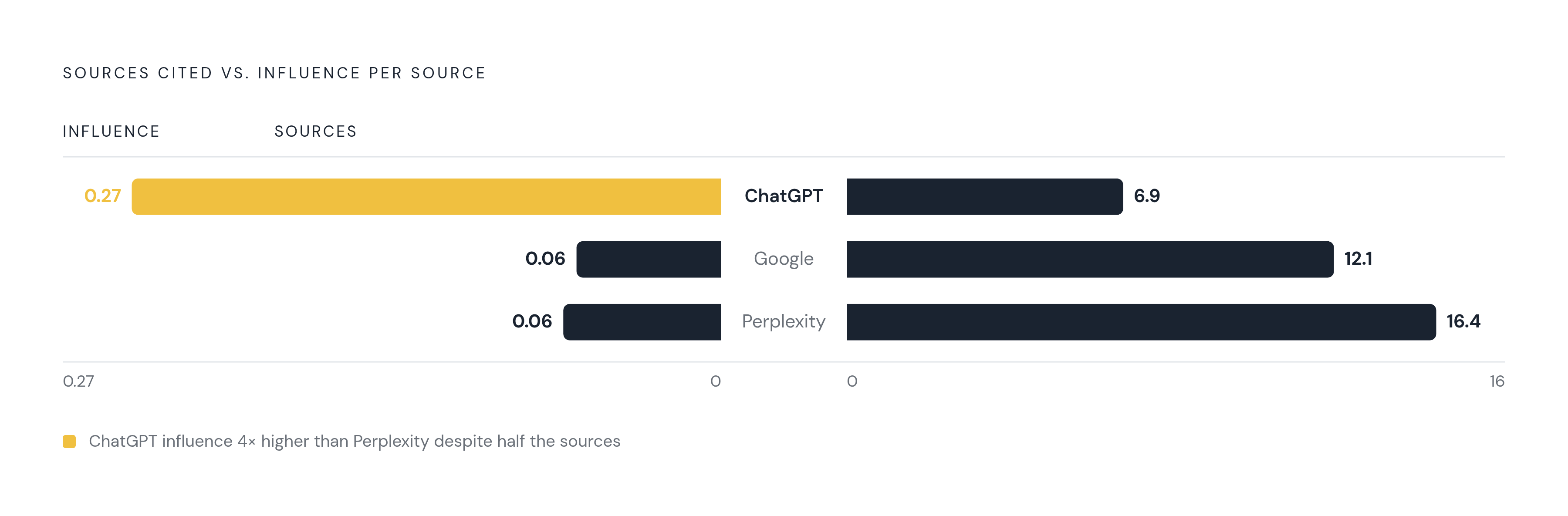
Retrieval and absorption are two separate outcomes, so each needs its own optimization. Zhang, He, and Yao draw this distinction directly: citation selection happens when a platform retrieves a page and lists it as a source, while citation absorption happens when that page's language, evidence, or structure actually shapes the words in the generated answer. A page can appear as a citation in a generated response while contributing nothing to the words the model actually produces. That gap is visible across platforms. Perplexity cites the most sources per prompt on average, at a mean of 16.35, with Google close behind at 12.06 and ChatGPT lower at 6.88. But the pattern reverses when you look at how much influence a cited page has on the finished answer: ChatGPT's fetched pages carry a mean influence of 0.2713, far higher than Google's 0.0584 or Perplexity's 0.0646. Perplexity casts a wide net and cites broadly, but ChatGPT cites fewer sources and leans on each one more heavily when it does. A cluster aimed at both platforms needs enough spoke pages to get swept into Perplexity's broad retrieval, and each of those spokes needs the depth to survive ChatGPT's narrower, more demanding absorption filter. Neither condition substitutes for the other.
Pillar page design when the goal is AI retrieval, not just topical breadth
A pillar page built for 2026 retrieval has to do three jobs at once: target the primary keyword cluster, answer the AI queries people actually ask about the subject, and serve as the hub that links out to every spoke in the cluster. None of these jobs can be handled in isolation, because the structural choices that serve one, clear headings, direct answers, tight modular sections, serve all three simultaneously.
Length functions as a retrieval variable here, not a matter of production convenience. A pillar that's too short can't demonstrate the topical authority an AI system is checking for, while one that runs long for its own sake dilutes the relevance of any single passage, since AI systems extract individual passages rather than whole pages. Teams that publish shorter pillar content to save production time are trading away SEO and GEO authority for speed, a bad trade on any topic that matters to the business. The opening section of the page carries outsized weight in this system: it needs to answer the primary query directly, not ease the reader in with framing or background. And every H2 section below it needs to work as a standalone answer in its own right. A pillar that reads as one continuous essay, however well argued, fails the passage-level extraction test even if the writing is excellent, because the system pulls individual sections out of context and judges them as if they were separate documents. Fact density matters in this structure too: statistics, named sources, definitions, and numerical facts are a visibility signal, not decoration. Princeton's GEO research found that adding statistics, citations, and quotations improved AI visibility by 28 to 41%, with citations lifting lower-ranked pages by as much as 115%, and that a hybrid of data and argument produced substantially higher citation rates than opinion content alone.
Spoke page design, why standalone cite-ability inverts the funnel logic
The old model treated spokes as funnel bait meant to deliver traffic upward; the retrieval-first model treats each spoke as the destination, a complete answer that AI systems can cite and absorb without ever sending the reader anywhere else.
Building the spoke set well starts before the pillar gets written, not after. The sequence runs the other direction: map the full question landscape of the topic, identify which of those questions the existing web answers poorly, and treat those gaps as the highest-priority spoke targets. That mapping work is what a GEO layer is for, surfacing which questions AI systems are asked at high frequency and currently answer badly with what's already published. Depth at the spoke level is what lets a cluster get cited across the full spread of a query's semantic variations. A cluster can cover every box on the topic map and still fail at passage-level scoring if each spoke is thin, because the absorption evidence from Zhang, He, and Yao shows that pages with real influence on generated answers tend to be longer and more modular. If a spoke is built only to pass internal links, it gets selected rarely and absorbed even less. FAQPage JSON-LD still matters for Q&A spokes even though Google fully deprecated FAQ rich results for all sites on May 7, 2026, because the markup's value now is making the underlying question-and-answer structure legible to machines rather than winning a visual treatment in search results. For glossary-style clusters, DefinedTermSet markup on the pillar declares the authoritative scope of the whole set, making the cluster's collective boundaries explicit at the schema layer.
Internal linking structure as a topical coherence signal, not just a navigation aid
The links connecting a cluster's pages are what make it a cluster instead of a loose pile of articles that happen to share a subject. That structure, pillar links to every spoke, every spoke links back to the pillar, related spokes link to each other where the connection is genuine, signals to both search engines and AI retrieval systems that the site treats the topic with real depth rather than skimming it.
The strength of that signal scales with how coherent the linked pages actually are to each other. Pinterest's production-scale GEO system offers a clear illustration of the mechanism at a much larger scale: it deployed authority-aware interlinking structures using hybrid VLM and two-tower ANN architectures to propagate link equity across billions of images and tens of millions of collection pages. What the Pinterest case confirms about the underlying mechanism is that generative systems favor consolidated sources over scattered, isolated ones, and interlinking is the structure that does the consolidating. The same principle holds for a text-based cluster at any size. Links that extend beyond a single cluster, when the connection is genuine, build a wider form of coherence too, helping establish a domain as a recognized source on a subject rather than a site that happens to have one good cluster. The test for any internal link should be whether the linked page genuinely extends a reader's understanding of the page they're on. A link that exists only to pass authority, with no real topical reason behind it, adds the same structural bulk without coherence that a funnel-style spoke adds, just at the level of the link itself.
Why owned-site cluster architecture is necessary but not sufficient for AI citation
A well-built cluster on a brand's own domain raises the odds of AI citation, but it only ever competes for part of the citation pool a model draws on when it describes that brand. Research on AI citation patterns finds that the majority of brand mentions in AI search come from third-party sources rather than the brand's own site, and that brands are substantially more likely to be cited through a third party than through their own domain. A meaningful share of AI citations point to publisher sites that have nothing to do with the brand, and in a notable share of brand stories, that third-party source is the only one the AI draws on at all.
Commercial queries make this sharper still. Third-party listicles, roundups, comparisons, curated lists published on neutral sites, dominate the citation mix for commercial questions, and an analysis of AI citations found that listicles account for the large majority of commercial AI citations, with third-party placements driving most of that volume. Appearing in those formats is a structural requirement for showing up in commercial AI answers at all, not an optional distribution tactic sitting alongside the cluster strategy. Distribution through third-party publisher networks compounds this effect: wire-distributed press releases saw AI citations grow substantially between July and December 2025, and placing content across third-party news sites produced a large median lift in AI citations for the brands that did it. None of this works, though, if the facts don't match across surfaces. Conflicting data between a brand's own site, its social profiles, and third-party listings undermines the trust an AI system places in that brand, and systems will skip citing a source whose facts contradict themselves from one surface to the next. Reciprocal listing networks, where brands promote each other inside listicles to manufacture third-party coverage, are being flagged by AI retrieval systems alongside other self-promotional patterns. Earned third-party placement and manufactured placement are starting to read as different things to these systems, and that distinction functions as a real quality signal now, not only an ethical line.
How to sequence cluster buildout so early content earns citations while the cluster is still incomplete
A finished cluster is the eventual goal, but no team builds a complete topic map in a single publishing cycle, and what gets built first decides whether the cluster earns citations while it's still half-built or sits invisible until it's done. The highest-priority spokes are the ones answering questions AI systems get asked often but that the existing web answers badly. Publishing those first creates a citation opportunity immediately, even while most of the cluster around them is still unwritten. The same GEO layer that maps the full question landscape also flags which of those questions represent a search gap and an AI citation gap at the same time, and those overlapping gaps are where early publishing effort should concentrate.
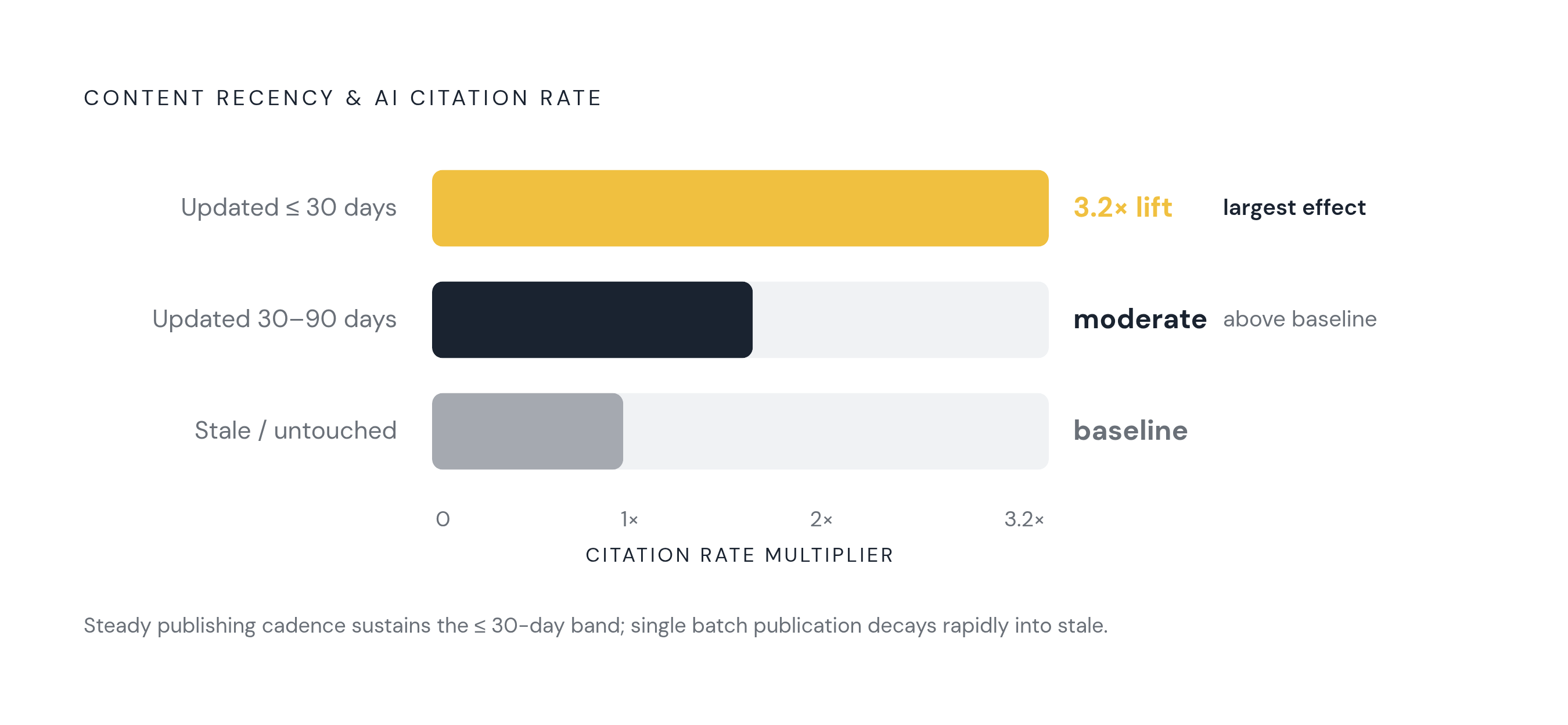
Freshness works as its own retrieval signal, and it favors a cluster that grows on a steady cadence over one published in a single batch and left untouched. Content updated within 30 to 90 days earns substantially higher citation rates than stale content, and the strongest effect, a 3.2x lift in citations, occurs for content updated within 30 days. Sustaining that cadence across a growing cluster without a drop in quality takes a production system built for the volume, typically a multi-stage pipeline where AI handles drafting work but a human reviewer sits at every real decision point. The point of that pipeline is that the structure lets a team hold spoke-level depth steady across a cluster that keeps expanding, with human judgment checked in at research, at sourcing, and again after publication, not only at a single final sign-off.
Measuring whether the cluster is earning AI retrieval, the metrics that matter
None of this architecture means anything until it's measured, and measuring it correctly means tracking retrieval and absorption as two separate events across more than one platform. Collapsing the two into a single score, or watching only one model, produces a misleading picture of how visible a cluster actually is. A cited page may contribute almost nothing to the finished answer, so counting citations alone misses whether those citations carry any real weight. Platform spread matters: a majority of brand mentions in AI search show up in only one model, so a team watching a single platform is seeing a fraction of its actual visibility, and cross-model measurement is a structural requirement for an accurate read, not an added layer of thoroughness.
Topic visibility score, the share of the topic's full question landscape the cluster actually has content for, is the leading structural metric, because it measures how complete the coverage is before any citation event even happens. Alongside it, AI citation frequency tracks how often the cluster's content turns up in generated responses across the topic domain. Citation volatility is the strongest operational argument for building depth across a cluster rather than betting everything on one strong page: citation status changes at a high rate across every major AI platform, so a brand relying on a single highly-cited page carries steady exposure to losing that citation, while a cluster with many independently citable passages spreads that risk much thinner. The starting point for all of this is a baseline audit, run across ChatGPT, Perplexity, Google AI Overviews, and Gemini with a fixed set of prompts, documenting mention rate, citation rate, and competitor presence for each one. That audit produces a gap map, and that gap map is what drives the spoke priority sequence described above. Brand visibility score, the share of relevant AI responses in which a company appears, gives a useful benchmark here: scores above 30 to 50% indicate strong AI search performance, with even category leaders rarely clearing 70%, while scores below 10 to 15% signal a real visibility problem. None of these numbers mean much on their own without a connection to outcomes. AI referral traffic, Answer Share of Voice, and assisted conversions tie AI visibility back to the business, showing whether a citation drives real discovery or reaches nobody who matters, which citation frequency alone cannot show.