AI Search Engine Market Share Among Knowledge Workers
Claude punches above its weight in referrals despite lower usage share.
AI search market share among knowledge workers reflects a distinct mix of platforms, tasks, and referral habits. For marketers and content teams, the useful question is not just which assistant gets the most queries, but which ones cite sources and send relevant readers to them.
Why the headline "AI search market share" means something different for knowledge workers than for the general population
Google’s near-monopoly share of search referrals can sit awkwardly beside a marketer’s own analytics. How can traditional search look so dominant while Perplexity and Claude send meaningful visitors to a business website? The apparent contradiction starts with the denominator. Search-engine referral figures count visits that reach websites. A platform can therefore be important to a reader’s research without occupying much space in that referral chart.
The distinction becomes sharper when the audience is knowledge workers. This group uses AI tools disproportionately and clusters around particular platforms for particular tasks. Aggregate search figures describe a broader population and a narrower behavior. They do not show the full path from a workplace question to an AI answer and, sometimes, to a source website. Understanding this audience requires a segment-specific reading of the evidence.
How the overall AI-assistant market is actually divided, and why methodology determines the answer
Query share shows where questions are processed, while web visits show how much traffic goes to the assistants themselves. Referral clicks show when people leave those services for other websites. None is a substitute for the others. A content team interested in being cited inside an answer is studying a different outcome from one interested only in inbound traffic.
The query-share picture in the mid-to-late 2026 landscape places ChatGPT well ahead of the field. Gemini sits a distant second, while Perplexity, Claude, and Microsoft Copilot divide a smaller remainder. On that measure, the market looks heavily concentrated. This ranking gives a baseline for overall activity.
Similarweb’s web-visit data from around the same time shows a closer race. ChatGPT still leads, but Gemini has a stronger second position and Claude is a meaningful presence. DeepSeek, Grok, and Perplexity follow in that order. The change in perspective is substantial.
StatCounter measures search-engine referrals and shows that Google sends the vast majority of visits from search to websites, with Bing a distant second. AI chatbots account for a small but growing slice on that measure. These findings need not cancel each other out. They count different things people do in markets that overlap, so they are not rival estimates of the same activity. Before treating a ranking as a guide to investment, a marketing team needs to decide whether it wants to influence answers, citations, or visits.
Where knowledge workers concentrate within that broader market, and what drives their platform choices
Knowledge workers do not form a single, uniform audience. Their platform choices reflect the task at hand, including analytical problem-solving, source-based research, drafting, and finding information inside workplace systems. A broad user base offers reach, while a smaller platform can bring together people doing a narrower kind of work. The relevant unit is often the query type.
ChatGPT has the largest raw user base and the highest query volume, making it difficult to overlook for reach. Knowledge workers use it for analytical problem-solving, coding, and drafting. But those uses should not be mistaken for the whole platform. Open-ended information-seeking, described as “Asking,” remains its largest usage category overall. Primary research does not clearly name software selection as a top use case, so ChatGPT’s size alone cannot show how much it matters when enterprises decide what to buy.
Perplexity and Claude have a more specific place in this picture. Research-intensive knowledge workers favor these platforms, making them relevant when the work calls for expertise, evidence, and named sources. That is a narrower proposition than general popularity. It points to people who want more than a quick answer and are looking for sources that help them dig deeper. For a brand publishing substantive research or technical explanations, this concentration can be more useful than a platform’s position in an all-purpose usage chart.
Microsoft Copilot captures a different slice of work. Its uses include corporate workplace queries, Microsoft 365 file lookups, and IT help. Knowledge workers already operating inside the Microsoft 365 stack tend to reach for the assistant embedded there. This is clustering by work environment as much as by preference for a particular answer style.
B2B technology procurement adds a commercially important dimension to these patterns. It has moved toward AI search faster than consumer retail queries, with a substantial share of technology buyers using an LLM as their first research step for enterprise software or infrastructure. That does not assign every buyer to one assistant. AI answers can reach buyers before they visit a vendor’s website. For content teams, the question becomes which platform handles that early research and which sources it puts in view.
Why referral behavior, not usage volume, is what determines a platform's actual value for reaching this segment
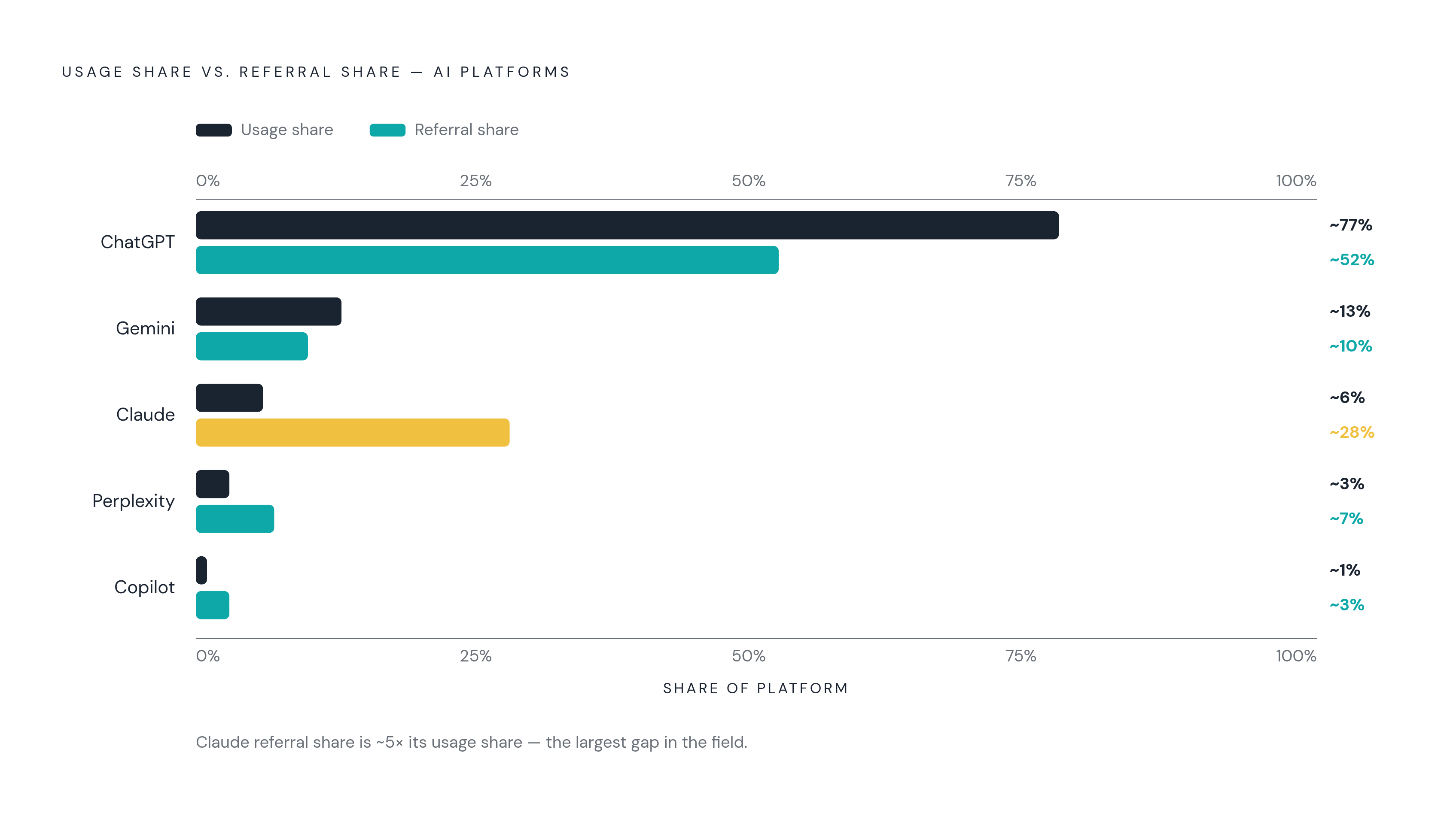
Claude provides the clearest example of the gap between usage and channel value. Its measured usage share is small, while its share of B2B referral traffic is many times larger. Its knowledge-worker users click through to source sites at a much higher rate than the usage figure would suggest. The audience and its behavior change the picture.
This distinction raises a practical question. Is a platform valuable because many people use it, or because the right people follow its sources? For a team seeking website visitors, referral behavior is the closer measure of success. Query volume shows how much exposure a platform might offer, but it does not show whether people then visit a website. The gap is especially relevant for research-intensive platforms, where source material is part of the reader’s task.
A knowledge worker may receive an answer that names or cites a brand without clicking through during that session. Zero-click behavior is therefore a reason to measure citation presence alongside referral traffic. These are separate outcomes with different uses. A citation shows inclusion in the answer, while a referral shows that the reader went on to the source.
For marketers, the lesson is to keep those outcomes distinct rather than compress them into one market-share claim. A large assistant may provide broad exposure, while a smaller one contributes a disproportionate share of relevant visits. Neither observation makes the other unimportant. The useful comparison connects the platform, the query type, and the resulting citation or click. Without that connection, raw usage can make a promising channel look too small or a large one look more productive than the evidence supports.
How each platform retrieves and cites sources differently, and what that means for which content gets in front of knowledge workers
Platform choice changes more than the audience being reached. It also changes which sources can become part of an answer. A per-engine audit in 2026 found strikingly little overlap between the domains cited by different major engines. Visibility does not transfer automatically between them. Content that fits one platform’s source preferences may fare worse on another, even when both get a similar question.
Perplexity and Claude favor content that helps people do research-intensive work. Content with genuine expertise, specific evidence, and named sources performs better than material built mainly around keyword density. A page needs to give a knowledgeable reader reasons to trust its claims. The evidence shows that both platforms favor these things, but it does not show that they use the same retrieval systems.
ChatGPT gives more weight to consensus and third-party presence. Brand mentions across directories, review platforms, Reddit, and news sources contribute to the signals used to surface a brand. Owned content is therefore only part of the picture. A strong company website cannot by itself stand in for the wider set of references through which the brand appears. For this engine, visibility work extends beyond the pages a team publishes on its own domain.
Google AI Overviews reward video content and off-site brand signals, while traditional search rankings are a weak predictor of citation. A large share of citations comes from pages outside the highest search positions. Ahrefs’ study found an unusually strong correlation between brand mentions in YouTube titles, transcripts, or descriptions and visibility across ChatGPT, AI Mode, and AI Overviews. Correlation supports considering video and off-site presence when reaching knowledge workers who use Google for quick-reference queries, without guaranteeing a route into answers.
Copilot has a more explicit entry condition for web content. A page needs to be indexed by Bing before Copilot’s own grounding-query layer can use it. That layer further rewards cleanly structured answers at the passage level. The implication is twofold but connected. Eligibility starts with indexing, while the form of the answer helps determine its usefulness once retrieved, including for queries arising inside the Microsoft 365 environment.
What content strategy actually follows from this platform split — for a brand trying to be cited where knowledge workers search
For a content team, the practical response is to build around the audience’s distribution of tasks. A single-platform strategy misses both differences in user behavior and differences in source selection. The content mix needs to reflect those differences. Research-intensive questions call for evidence-rich material, broad discovery calls for third-party presence, and workplace retrieval calls for answers that can stand clearly at the passage level.
For Perplexity and Claude, that means investing in genuine expertise, specific evidence, and named sources rather than treating keyword repetition as the main route to inclusion. For ChatGPT, it means putting about as much weight on earning third-party presence as on publishing content the brand owns. The notes describe this as a “phantom-site” strategy, but the underlying distinction is straightforward. A brand’s visibility depends partly on where other sources mention it. Video and off-site signals add another content type for the Google surfaces discussed above.
Measurement needs to test whether this mix works. AI answer engines do not expose citation data in the way Google Search Console exposes impressions, so inclusion cannot simply be assumed from publication or search rankings. Teams need explicit tracking across ChatGPT, Claude, Gemini, and Perplexity. That tracking also needs repeated samples over time because the same brand list rarely repeats verbatim across sessions.
Letterstory is one option for this work, tracking whether those engines name, cite, and link to a brand’s content, with a publishing pipeline for the content types each engine rewards. Its measurement layer gives teams evidence to act on rather than leaving platform visibility as an assumption. The discipline is to connect that evidence to investment. A platform map becomes useful when a team can see whether its target questions produce citations and referrals, and adjust its publishing accordingly.