Third-Party Citations and Earned Media as AEO Signals
AI engines cite third-party sources, not brand websites, for credibility.
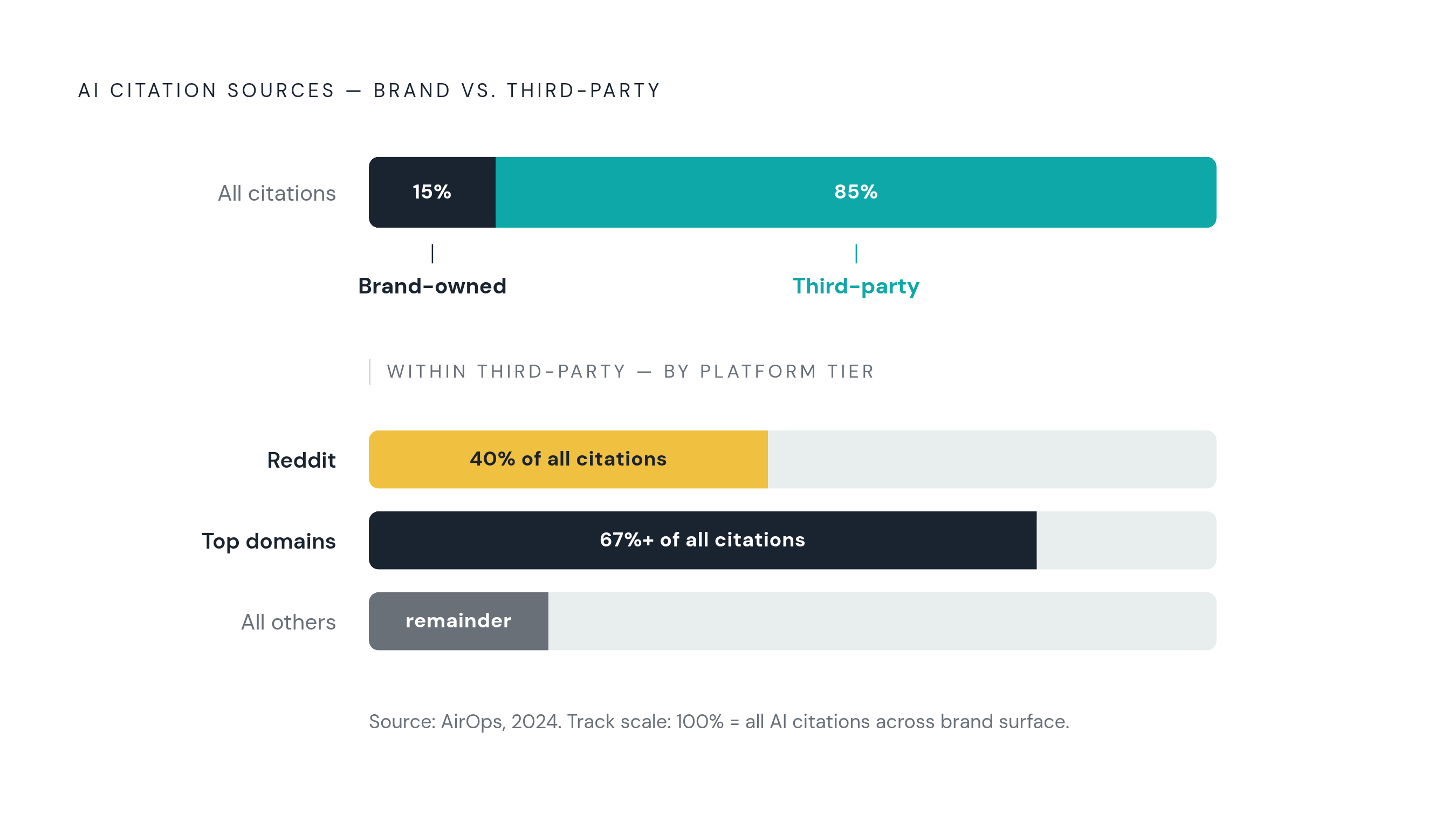
AI answer engines cite the sources that other trusted sources point to. About 85% of brand mentions in AI search come from third-party pages rather than pages the brand owns and controls, AirOps's analysis found. That single figure inverts a decade of search marketing logic: a brand's own site, no matter how well built, is a minor character in the story AI engines tell about it.
Retrieval-augmented generation is the mechanism behind this. When a user asks a question, the system pulls passages that match the query's meaning from a pool of indexed sources, then writes an answer from what it finds, attributing only the sources it judges most trustworthy. That judgment is the whole game. A page can rank well in traditional search and never appear in an AI response, while a page ranked lower can be quoted if it's cleaner, more citable, and backed by external authority. Rank and citation are two different contests, decided by two different scorekeepers. A Washington University study of tens of thousands of queries found that a meaningful share of AI-cited domains do not appear in the traditional search results for the same query, confirming that the selection pool differs from Google's own.
Independent research measures the scale of that split. Erlin's 2026 analysis of more than 500 brands found that most AI citations trace back to third-party sources, with owned websites supplying only a minority. The two systems draw from overlapping but distinct pools. A brand can win the SEO game and still lose the AEO one, or the reverse.
None of this makes owned content worthless, and later sections lay out the job it still does. The entity deciding whether a brand gets named in an AI answer is rarely the brand's own domain. It's the layer of independent sources that already surround it.
Why third-party coverage does the actual citation work
Earned press, review platforms, community forums, and industry publications form the primary channel for citations, adding far more than a citation or two on top of what a brand's own site earns. They're the primary channel. The data on this point is consistent across several independent studies, which rules out the possibility that this is a quirk of one dataset or one AI model.
Erlin's research found that Reddit discussions produce a meaningful citation lift over owned content alone, with Q&A threads responsible for a large share of Reddit's citations, and that Wikipedia and review sites like G2 and Capterra each deliver their own sizable multiplier over what an owned domain achieves by itself. Muck Rack's Generative Pulse 2025 report, built from more than a million citations across ChatGPT, Gemini, Claude, and other models, found that the large majority of links AI cites trace to earned media, meaning journalism, third-party blogs, and press releases, rather than brand-owned pages.
The format of that third-party content isn't random. MC Saatchi Performance's analysis found that nearly all third-party citations came from reviews, comparisons, and listicles, the formats built to evaluate and compare options rather than the formats built to advocate for one. That distinction matters for anyone shaping a PR or content strategy around AI visibility: an AI engine trusts a comparison piece precisely because it isn't trying to sell anything, and content that reads as advocacy is structurally at a disadvantage no matter how accurate it is.
Scale confirms the pattern. 5WPR's AI Platform Citation Source Index, built from hundreds of millions of individual citations across ChatGPT, Google AI Overviews, Perplexity, Gemini, and Claude, found that Reddit alone accounts for roughly 40% of all citations, and that a small cluster of top domains absorbs more than two-thirds of the entire AI answer pipeline. Citation power is concentrated in a narrow set of trusted intermediaries, so a content team's citations depend on breaking into that small cluster of domains.
The logic connecting these facts works as follows. When a high-authority site references a brand's product or claim, AI systems read that reference as an outside confirmation of factual credibility, and a mention in a recognized industry publication carries more weight for AEO purposes than a stack of backlinks from unknown blogs. Authority is measured in whether the source doing the linking is one the model already trusts.
Earned coverage and AI share of voice in PR
Strategic PR now carries a second responsibility beyond building reputation and generating impressions: it decides whether an AI answer engine names a brand when a buyer asks it to evaluate options. That's a structural shift in what PR work is for, and it changes what counts as success. AEO gives PR a new way to be measured, not through impressions or share of voice in the traditional sense, but through citation frequency across ChatGPT, Perplexity, Gemini, and Claude.
Format and structure carry real weight in this new measurement. Muck Rack's Generative Pulse 2025 report found that press release citations increased fivefold between July and December of 2025, with structured releases accounting for a meaningful share of all AI citations in that period. Outlet authority alone doesn't explain that jump. How a release is built, and whether it's structured in a way an AI system can extract cleanly, does.
That points to a concentration problem most PR teams haven't reckoned with yet. A large share of any brand's AI citations tends to come from a small number of media outlets, and the overlap between a brand's active outreach list and those specific citation-driving outlets is typically very low. Most PR teams are pitching outlets that build reputation without building AI visibility. The target list itself needs rebuilding around citation data rather than around traditional media rankings.
Forrester formally recognized AEO as a strategic discipline in April. That recognition carries a practical implication: PR investment in earned coverage now gets evaluated against AI citation outcomes, not just against reach and sentiment metrics.
The natural objection here deserves a direct answer. A PR team already running campaigns might reasonably think it's already earning the coverage that AI engines need. But traditional PR optimizes for audience reach and brand sentiment, while AEO-oriented PR optimizes for structured, extractable coverage placed in outlets AI engines already trust, and those two goals frequently point in different directions. A press hit that moves brand sentiment among a target demographic might sit in an outlet an AI model rarely draws from, while a comparison post on a smaller review site might get cited constantly. Reach and citation are different currencies, and a strategy built for one doesn't automatically pay out in the other.
Owned content's real job: building the entity, not chasing the citation
None of the preceding sections should be read as an argument that a brand's own website doesn't matter. Owned content rarely produces the citation directly, but it builds the entity foundation that third-party coverage then amplifies, and without that foundation, even strong earned media produces citations that are shallow and inconsistent. The website's job changed. It didn't disappear.
SEO still feeds AEO in a direct, measurable way. Erlin's analysis, citing Ahrefs data, found that the large majority of AI Overview citations come from pages that already rank in the top organic search results. Skipping SEO in favor of AEO tactics doesn't work, because ranking is what gets a page into the retrieval pool in the first place. A page an AI system never indexes or surfaces in search can't be pulled into an answer, no matter how well it's written.
Fact density is a specific, measurable lever inside owned content. Erlin's data shows that brands packing a high count of structured, verifiable facts about their products into owned pages achieve dramatically higher average AI coverage than brands whose pages carry sparse structured facts, and each additional structured attribute adds a measurable increase in coverage. That's a concrete, testable instruction: specificity on the page, not just volume of content, drives citation eligibility.
Placement on the page carries its own weight. CXL's analysis of Google AI Overview citations found that 55% of cited passages came from the first portion of the source page. An answer buried deep in a long article, however accurate, sits at a structural disadvantage next to one placed near the top where an extraction system can find it fast.
Entity clarity ties all of this together. Consistent terminology, structured data, and semantic markup help an AI system recognize a brand as a single, defined entity worth citing repeatedly across different queries, and without that consistency, third-party mentions of the brand tend to fragment rather than build on one another. The Princeton GEO study from Aggarwal and colleagues, presented at KDD in 2024, found that adding statistics, citations, and quotations each independently boosts a piece of content's visibility inside generative engines. Owned content that cites its own sources and backs claims with verifiable data has a structural advantage baked in, separate from whatever earned coverage later points back to it.
Owned content's contribution is foundational rather than direct: it gives the third-party layer something accurate and well-structured to reference. That hand-off from foundation to amplification is where the next section picks up.
The two-surface strategy: a ground site plus an earned layer
Durable AI citation depends on two content surfaces operating together rather than one surface trying to do both jobs. A canonical ground site establishes entity identity and holds original data, while a distributed layer of third-party coverage does the actual work of getting cited at scale. Treating these as one undifferentiated content effort is the mistake that leaves both surfaces underperforming.
The ground site's function is specific: it houses the structured facts, original research, and canonical definitions that third-party coverage can point back to, giving AI systems a retrievable source of record for whatever claims the brand makes. Without that record, a journalist or reviewer citing the brand has nothing precise to anchor to, and the resulting mention tends to be vague rather than authoritative.
The third-party layer is where the citation volume actually accumulates: Reddit threads, G2 and Capterra reviews, Wikipedia entries, earned press, industry listicles, and comparison pieces, the same formats MC Saatchi Performance's data shows account for nearly all third-party citations. As of October 2025, Reddit, LinkedIn, and YouTube ranked among the top sources cited by leading language models, and a brand producing accurate, useful content on those platforms directly expands what an AI system has available to draw from.
The distribution across engines isn't uniform, and treating "third-party visibility" as one target misses how differently each engine weighs its sources. ChatGPT leans heavily on Wikipedia and Reddit. Reddit's weight is highest inside AI Overviews and ChatGPT specifically, and lowest inside Claude. YouTube's weight is highest inside AI Overviews and Gemini. Perplexity weights recency above nearly everything else. Targeting the third-party layer effectively means targeting by engine and by platform, not simply chasing domain authority in the abstract.
Producing content across both surfaces at the volume this requires calls for operational infrastructure most content teams don't have by default, platforms like Letterstory, which publishes across a client's own blog and independently-hosted sites while tracking whether ChatGPT and Perplexity actually name the client, are built around exactly this gap. Multi-agent content pipelines show one way to operationalize this, using an outline stage built to satisfy AEO and GEO intent, a drafting stage that expands those outlines into full drafts, and human reviewers who gate everything before it publishes. The same underlying pipeline that produces ground-site content can be redirected toward third-party placements, which keeps both surfaces consistent in quality and terminology rather than treating them as separate workstreams run by separate teams.
Tracking whether any of this is working requires purpose-built tooling rather than a glance at rankings. Profound tracks citations at the URL level across eleven or more engines, including ChatGPT, Perplexity, Gemini, Microsoft Copilot, Claude, Grok, DeepSeek, Meta AI, Google AI Overviews, Google AI Mode, and Amazon Rufus, giving a brand a way to see which surface, and which engine, is actually generating its citations.
The freshness tax: why citation decay forces a publishing cadence
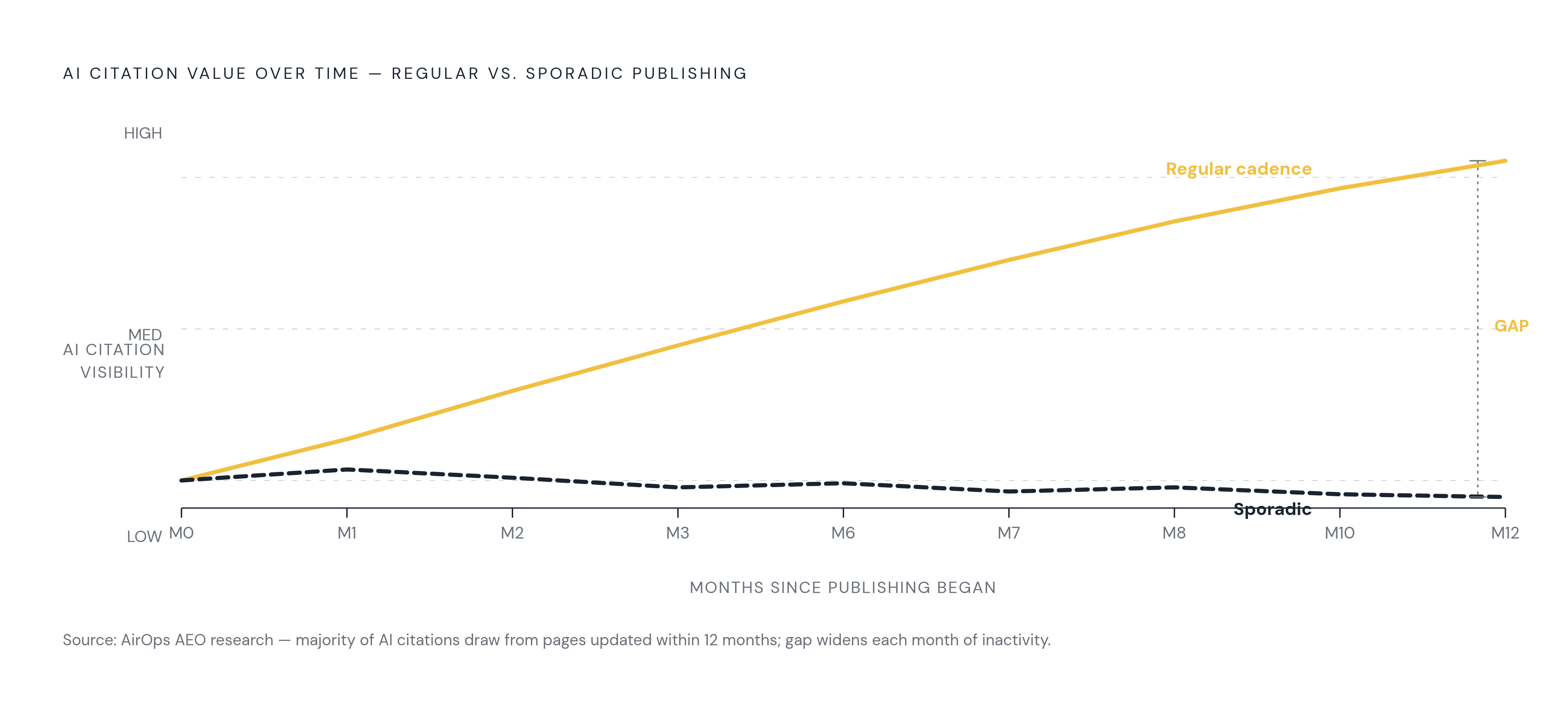
A citation earned once doesn't stay earned. AI retrieval systems favor recent content over older content that's stopped getting cited, which turns publishing cadence from a nice-to-have into a structural requirement for any brand serious about AI visibility. AirOps research found that for commercial and evaluation-stage queries, the large majority of AI citations come from pages updated within the past year, with older pages steadily losing retrieval priority to newer ones.
The category matters for how fast that decay sets in. FirstMotion's analysis of Perplexity's citation mechanics found that in fast-moving categories, content crosses an age threshold after which it enters a decay window and starts losing retrieval priority to fresher pages. Timing compounds this effect on the press side too: Muck Rack's Generative Pulse 2025 data found that journalistic content accounts for roughly half of citations on queries that require recency, and that citation volume spikes hardest in the days immediately following publication. A well-placed story that runs once and is never followed up loses its citation power fast, regardless of how strong the outlet was.
The compounding effect runs in both directions. Brands that publish and earn coverage on a regular cadence don't just hold their existing visibility, they accumulate a citation asset that widens the gap against brands publishing sporadically. Erlin's data shows that the gap in AI visibility scores between brands actively invested in AEO and brands that aren't is already substantial, and that gap widens measurably with each passing month. Delay doesn't just cost a brand the citations it missed this month. It adds to a deficit that keeps growing until the brand starts publishing on cadence itself.
Cadence alone, without a way to check whether it's working, still leaves a brand guessing. Publishing on schedule across both surfaces only pays off if there's a way to see whether the citation rate is actually moving. Measurement becomes unavoidable.
Measuring AI citation: the metrics that matter
Standard web analytics were built to track what happens after a visitor clicks a link, and that architecture makes them structurally unable to see what happens before a click, which is exactly where AI citation lives. GA4 and Google Search Console can't detect whether a brand was cited inside an AI answer that shaped a buyer's opinion before any click occurred, and that blind spot is built into how those tools work, not a setting anyone forgot to turn on. A brand can be winning or losing the AEO fight entirely inside a gap its existing dashboards were never designed to cover.
Google introduced dedicated generative AI performance reporting inside Search Console, a partial step limited to Google's own surfaces and not a substitute for cross-engine citation tracking. That's useful as far as it goes, but it only covers Google's own surfaces, and it can't substitute for tracking across the full set of engines a brand actually needs to watch.
Four metrics form the core of what a brand needs to track once it takes AEO seriously. Citation frequency measures how often the brand shows up in AI-generated answers at all. Share of voice compares those mentions against competitors across the same set of AI platforms. Citation sentiment checks whether the AI system is representing the brand accurately and favorably rather than just mentioning it. AI-referred traffic and conversions, tracked through GA4 attribution, close the loop by connecting citation activity to what happens afterward.
Engine fragmentation makes single-tool monitoring especially unreliable. MC Saatchi Performance, citing AirOps data, found that the large majority of brand mentions were unique to a single AI model. A brand can appear prominently inside ChatGPT while staying largely invisible inside Perplexity, Gemini, or Claude. Watching one engine and assuming it represents overall AI visibility misses most of the actual picture.
Brands trying to confirm whether owned content is actually getting cited, rather than simply ranked, need measurement built for that specific question. That distinction, between appearing somewhere in the index and actually being named in the answer, is the one every argument in this piece comes back to. A brand that can't see its own citation rate across engines is managing the two-surface strategy, the PR realignment, and the publishing cadence all at once, blind.
Sources
- Answer Engine Optimization (AEO): Your Complete Guide for 2026
- Answer Engine Optimization (AEO): The comprehensive guide for 2026
- Why AEO (Answer Engine Optimization) Is Critical to 2026 Marketing Planning - rygr
- AEO Meaning: What Answer Engine Optimization Is & Why It Matters in 2026
- Generative Engine Optimization: Data, Trends and Tactics for 2026 | M+C Saatchi Performance