Mapping Buyer Journey Stages to AI Query Types
AI queries behave differently at each buyer journey stage.

Buyer journeys used to funnel through a search bar. Now they start in a chat window, and the query someone types at 9 a.m. asking "what is generative engine optimization" does something structurally different than the query they type at 4 p.m. asking for pricing. Both are AI queries. Neither behaves like the other, and brands that treat them as interchangeable are leaving half the funnel unattended.
A large and growing share of B2B software buyers now start research inside a chatbot instead of Google. Forrester's 2025 Buyers' Journey Survey found 94% of B2B buyers use AI somewhere in the purchase process, and it named generative AI or conversational search as the single most meaningful information source, ahead of vendor websites. Traditional search engine volume has been projected to decline by 25% by 2026, a dramatic forecast that reflects how quickly the landscape is shifting. That projected decline is reshaping how brands think about where to invest their visibility budgets.
This is a major shift in where clicks land. It's a change in where the buyer journey actually begins. The search results page used to be the front door. AI is the front door now, and by the time a prospect lands on a company's website, a shortlist may already exist in a conversation the brand never saw and had no say in. Most brands don't even track this. That gap has less to do with apathy than with how new the whole problem still is.
Why strong SEO rankings no longer guarantee AI visibility
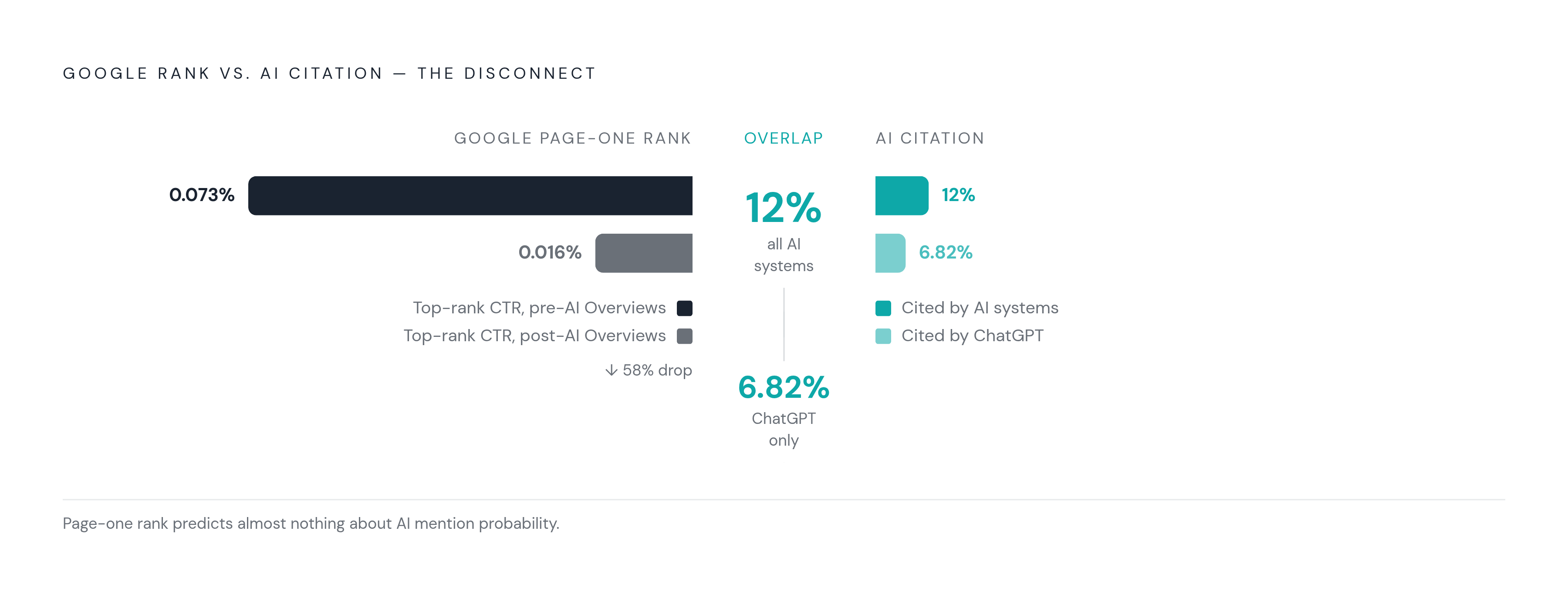
Ranking first on Google used to mean close to guaranteed traffic. That relationship is breaking down fast, and treating a page-one ranking as a proxy for AI visibility is the single most expensive mistake a content team can keep making in 2026. Ahrefs analyzed 300,000 keywords between December 2023 and December 2025 and found that AI Overviews cut click-through rate for the top-ranking page by as much as 58%, from 0.073% down to 0.016% on keywords where an Overview appeared. Seer Interactive looked at informational queries specifically and found organic CTR falling 61%, from 1.76% to 0.61%.
The ranking-to-citation relationship is even shakier than those numbers suggest. A study of 15,000 prompts using Ahrefs' Brand Radar found only 12% overlap between what AI systems cite and what shows up in Google's top ten results. That figure drops to around 6.82% for ChatGPT's fan-out queries specifically. Ranking on page one tells you almost nothing about whether an AI system will mention the brand at all.
Part of the reason is where AI systems pull their answers from in the first place. AirOps analyzed more than a billion citations and found that 85% of brand mentions in AI search come from third-party pages, not the brand's own site. A brand is far more likely to get cited through someone else's domain than through its own. Writer.com's enterprise guide on generative engine optimization frames the discipline as roughly 80% strategic (positioning, ecosystem presence, earned authority) and only 20% technical. That ratio runs close to the reverse of how most marketing teams have historically split their SEO budget, and the technical fixes that used to move rankings barely touch whether an AI system decides to name a brand at all.
A company can hold every top-three ranking it wants and still be absent, or worse, misrepresented, in the AI-generated answers buyers actually read while evaluating options. Jack Smyth coined the term "share of model," later popularized by Tom Roach, to describe this new currency: how often a brand shows up in AI-generated answers relative to competitors. Unlike a paid placement, share of model can't be bought. It's earned through content and authority signals, which raises the real question this piece is built to answer. If rankings don't determine AI presence, what does? The answer sits in matching content to the specific type of query being asked, and most brands still haven't built anything that does that matching on purpose.
The four query-intent types and their positions in the funnel
Search has always sorted into four intent types: informational (learning something), navigational (finding a specific site or brand), commercial investigation (comparing options), and transactional (taking action). What's changed is how directly each type now maps onto a buyer journey stage. Informational sits at awareness. Commercial investigation sits at consideration. Transactional sits at decision. Navigational, once a late-stage habit of typing a brand name straight into the address bar, now works as brand validation, often the final check before a purchase.
A workable framework needs two labels per prompt, not one. The first captures type: informational, comparative, instructional, brand-specific, or transactional. The second captures stage: awareness, consideration, or decision. Skip the double-tagging and the taxonomy turns into something that looks organized on a slide but tells a content team nothing about what to build next.
Real prompts complicate this fast. A query like "best project management tool for remote teams under 50 people with Jira integration" is informational, comparative, and transactional all at once, compressed into a single sentence. Prompts keep getting longer, more specific, and more intent-dense, as users increasingly phrase detailed, multi-condition questions rather than short keyword strings. That compression matters because LLMs cite only a handful of domains per response, a much narrower set than Google's ten blue links. Fewer slots means sharper competition for each query type, not softer, and the format a brand serves up has to match what the AI is actually looking for at that moment.
Awareness-stage queries: where category education happens and AI dominates
Informational queries were the original home of AI Overviews, and they still make up the dominant share of AI-triggered results. Early data confirmed informational queries as the dominant use case for AI Overviews, making up the clear majority of Overview-triggered results. This is the terrain of "what is generative engine optimization," "how do buyers use AI during a purchase," and "what's a CRM." Broad, category-level, no vendor named yet.
The formats that win here are explainer articles, "what is" guides, FAQ pages, definitional content, and structured how-to pieces. The Princeton GEO study (Aggarwal et al., presented at KDD 2024) found that adding statistics to content lifted AI visibility by as much as 40%, and adding citations or direct quotations produced similarly meaningful lifts in AI visibility. That effect appears strongest right here, at the informational layer, where authority signals do the heavy lifting in deciding which sources get synthesized into an answer.
E-E-A-T signals, meaning transparent author bios, citations to reputable sources, content that gets updated rather than left to rot, matter disproportionately at this stage because AI systems use exactly those signals to decide who to trust. A brand that never appears in category-level answers never enters the buyer's mental shortlist. The funnel doesn't start late for that brand. It doesn't start at all, and no amount of consideration-stage content fixes a hole that opens this early.
Consideration-stage queries: comparison content as the highest-value B2B battleground
Commercial investigation queries include "best [category] for [use case]," "[Brand X] vs [Brand Y]," "alternatives to [product]," "top CRM for small business." These are shortlist-building queries, and AI systems now answer them constantly. AI Overviews appear in more than 18% of commercial queries, a sharp climb from where that figure sat previously. Narrow it further to "best [product]" style shopping queries, and Overview presence in commercial and shopping queries has climbed sharply over that same period.
This is the highest-stakes battleground in B2B content, and it's the stage most brands underinvest in relative to how much revenue moves through it. The formats that win are listicles, "best of" roundups, side-by-side comparison tables, honest review pages, and alternatives pages: structured content an AI system can lift wholesale and repackage into a ranked answer. Prompts like "best GEO software for enterprises" or "how does Tool A compare to Tool B" produce, structurally, a shortlist. A brand absent from comparison content is absent from that shortlist, no matter how strong its awareness-stage presence is.
Profound's Conversation Explorer tool maps real user prompts and shows which consideration-stage queries carry the highest pipeline potential, a distinct measure from search volume alone. Volume and value aren't the same thing, and treating them as interchangeable wastes production budget on queries that never convert. Agencies running multiple client accounts feel this gap most acutely: strong informational content on a client's blog does nothing to compensate for a missing comparison page, and there's no workaround for that absence except building the page.
Decision-stage queries: where instructional and transactional content closes deals
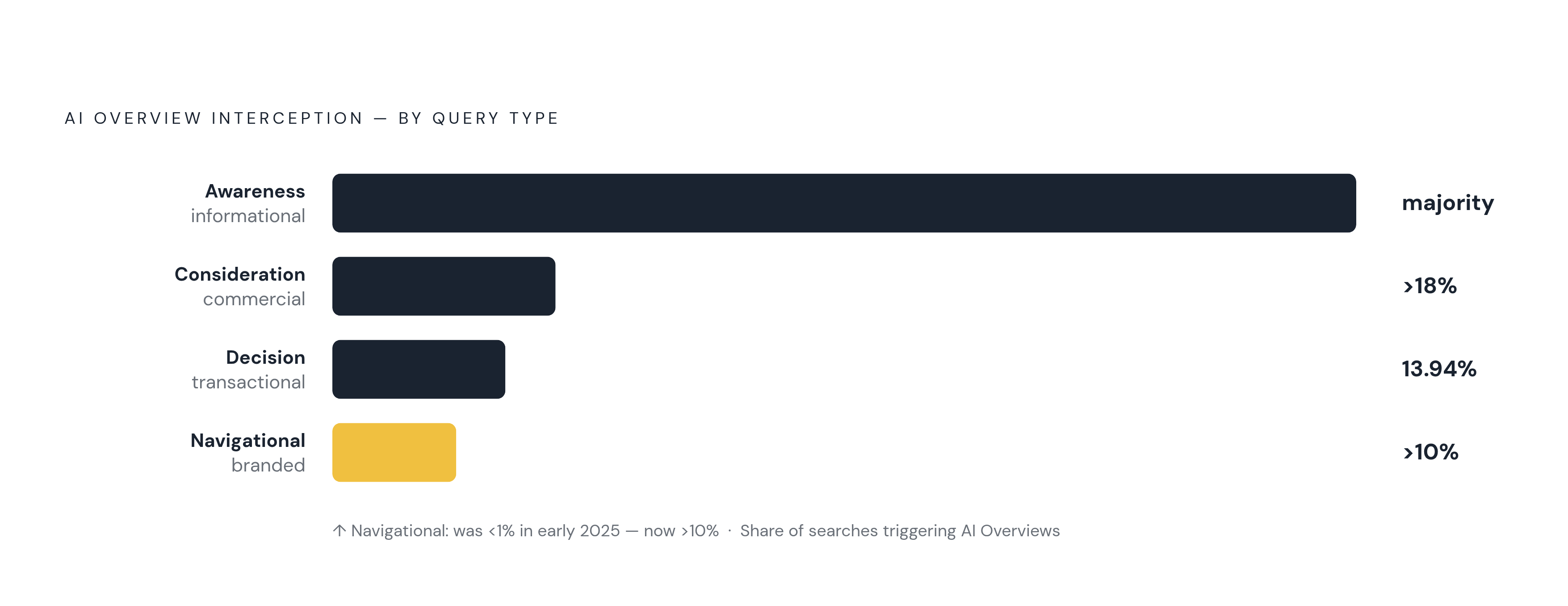
AI presence at the bottom of the funnel used to be close to nonexistent. That has changed: Overviews now appear on 13.94% of transactional queries. Even navigational and branded searches, long assumed to be immune to AI interception since the buyer already knows what they're looking for, now trigger Overviews on more than 10% of queries, up from under 1% in early 2025.
Decision-stage prompts split into a few recognizable types: pricing questions, demo or trial requests, brand-specific validation ("is Profound reliable," "Profound pricing and demo options"), and instructional prompts like "how do I set up this tool." Research on referral behavior shows AI systems hand off to a website mainly when they can't resolve the query on their own, and those unresolved cases skew heavily toward this exact decision-stage territory: vendor evaluation, pricing checks, next steps. That pattern explains why AI-referred visitors convert at a meaningfully higher rate than traditional organic search visitors. They arrive further along, having already done the comparison work in conversation.
Brand-specific prompts function as hygiene, not growth, and treating them as a growth lever wastes effort that comparison content would use better. Getting them right confirms the choice to a buyer who's already nearly all the way there, but these queries don't expand the buyer pool, so they shouldn't absorb the bulk of a content budget. Instructional content, meaning setup guides, use-case walkthroughs, integration documentation, carries lower volume but higher leverage: it's how a buyer validates a decision they've nearly made. When an AI system intercepts a branded search, the goal shifts from winning the top link to making sure the AI tells an accurate, compelling story about the product. Structured data and genuine customer sentiment need to line up so a machine can parse them correctly. Agentic AI, meaning AI systems that don't just answer questions but take actions like comparing vendors or booking a demo on the buyer's behalf, is already emerging as the next layer of this problem. Decision-stage AI presence is turning into a prerequisite for being considered by an automated shortlisting process at all, not a nice-to-have.
Building a prompt map that connects query types to content gaps
Start with real language. Sales calls, customer interviews, support tickets, and social listening (Reddit specifically gets named by Profound as a rich source) surface the actual words buyers use, and those words almost never match the tidy keyword lists a marketing team would invent on its own.
Tag each prompt twice: once for intent type (informational, comparative, instructional, brand-specific, transactional), once for funnel stage (awareness, consideration, decision). "What is generative engine optimization?" it tags as awareness. "Best GEO software for enterprises" tags as consideration. "Profound pricing and demo options" tags as decision.
Then audit existing content against that map. For each prompt cluster, does a piece of content exist in the format an AI system would actually extract for that query type? Gaps in the map become gaps in visibility, and once the map exists, those gaps appear as clearly as a missing brick in a wall. A tool like Profound's Conversation Explorer, drawing on hundreds of millions of real prompts refreshed weekly, can estimate LLM search volume per cluster so prioritization runs on pipeline potential rather than raw query count. A high-volume informational gap and a high-conversion comparison gap aren't the same priority, even when they look similar on a spreadsheet.
For agencies running multi-brand portfolios, this process has to run per client, but patterns across clients tend to reveal category-level gaps, the kind that shape both production priorities and the story told in client reporting. A platform like Thrad gives agency account teams an analytics layer to run this mapping across an entire portfolio at once, flagging which brands have real consideration-stage coverage and which are simply missing from AI-generated shortlists, then turning that evidence into something a client can actually see in a report.
Content formats that AI systems extract at each query stage
Formatting for AI extraction is a different discipline than formatting for a human skimming a page. AI systems pull specific passages from pages. Clear hierarchical HTML, deliberate heading structure, and passage-level clarity all matter more than they used to, and pages built for skimming eyes rather than parsing models are losing citations they'd otherwise earn.
The format-to-stage mapping holds up consistently. Awareness-stage content works best as "what is" guides, explainer articles, and FAQ pages, structured so each Q&A pair can stand alone as an extractable answer. Consideration-stage content works as listicles, comparison tables, "best of" roundups, alternatives pages, and review aggregations, structured so an AI system can lift a ranked list directly without reconstructing one from prose. Decision-stage content works as instructional walkthroughs, pricing pages with clean structured data, case studies with specific measurable outcomes, and genuine customer reviews.
The Princeton KDD 2024 findings apply directly here too: statistics lift visibility by up to 40%, citations and quotations by up to 41%, and that lift works best when it's embedded at the passage level rather than buried once in an introduction. User-generated content, meaning reviews and community Q&A threads, supplies the fresh, conversational language that gives LLMs the confidence to recommend a product by name, and that effect runs strongest at consideration and decision.
None of this replaces off-site presence. Given that 85% of brand mentions in AI search trace back to third-party pages, earning coverage in trade press, analyst reports, and industry publications matters as much as anything published on a company's own domain. One well-built piece of original research can echo across all three funnel stages at once: cited as a category authority at awareness, referenced inside a comparison at consideration, and pulled up as a proof point at decision.
Measuring AI visibility across the funnel, not just at the top
Organic rankings, traffic totals, and click-through rate no longer capture what's actually happening, and a team still reporting on those three alone is measuring a funnel that's already moved. A brand can watch its organic CTR decline while its share of model climbs at the exact same time, and both facts can be true simultaneously. Measuring only the first gives a badly incomplete picture. That's the mistake most content teams are still making heading into 2026.
Share of model, how often a brand turns up in AI-generated answers relative to competitors, is doing the work share of voice used to do. It can't be bought like a paid placement. It has to be earned, one citation at a time, through content built for the specific query types buyers are actually asking. What to track shifts by stage: citation rate on broad category questions at awareness, presence inside AI-generated comparison responses at consideration, and the accuracy and sentiment of how a brand gets described on branded or transactional queries at decision.
Gartner's 2026 Market Guide for Answer Engine Visibility Tools calls for new approaches to measuring visibility, including presence in AI-generated answers, citations, and conversational interfaces, and it signals how seriously the enterprise measurement conversation around AI search has matured. With AI referral traffic converting at a meaningfully higher rate than traditional organic search, brands still measuring success by rankings alone are optimizing for a metric that already stopped predicting the outcome that matters.


