Content Delivery Infrastructure for High-Frequency AI Crawler Access
AI crawlers need infrastructure designed for their access patterns, not human browsing.

With AI crawlers requesting content so often, AI visibility depends on how that content is delivered. Pages must remain consistently retrievable, current, and readable by training and real-time AI systems alike. That requires more than bandwidth or a general cache policy. Content teams and infrastructure owners need to treat origin offload, crawler permissions, publishing cadence, and citation measurement as parts of the same system.
Why AI crawlers create a different kind of infrastructure problem than search bots ever did
Human browsing concentrates requests around popular pages, while AI crawlers reach into long tails of content that people visit less often. That difference changes how much protection a cache provides to the server that holds the original content. A page frequently requested by people is well suited to repeated delivery from cache. A rarely visited page requested by a crawler is more likely to require a trip to origin.
Traditional search indexing crawls a page once and then ranks it repeatedly, separating retrieval from much of the page’s subsequent use. Retrieval-based AI systems may instead revisit pages frequently, refresh embeddings, or query content in real time. Those activities create a different pattern of origin pressure, even when the underlying pages have not changed. Fastly reports that AI workloads interact with origin infrastructure more than six times as often as human users. This is a structural gap in origin offload, rather than a cosmetic difference between classes of bot.
Consequently, additional bandwidth does not by itself address the problem. Infrastructure that serves human traffic well can still leave origin exposed to the way AI crawlers request content.
The scale AI crawlers already operate at, and why it keeps growing
Cloudflare processes AI crawler requests at a scale measured in tens of billions each day across its network. Fastly reports that AI requests grew much faster than human traffic during January–May 2026. Together, the volume and growth make crawler behavior a present capacity concern. Infrastructure built for the earlier mix of human and automated demand now faces a changing workload.
The composition of that workload matters because a crawl does not necessarily represent a person waiting for an answer. Training crawls account for the majority of AI bot requests, while real-time retrieval fetches triggered by an actual user represent a small fraction. Most of the infrastructure load is therefore not tied to an immediate user query. Heavy crawler demand represents access to content, with uncertain immediate opportunities for audience attention, visits or conversions.
This distinction also explains why human traffic alone is an incomplete guide to infrastructure needs. A site can get more automated requests even when people browse it no more than before. As AI requests grow faster, their poor origin offload becomes more consequential. Capacity planning must account for how much of that demand reaches origin independently of human audience growth.
How caching behavior breaks down when AI bots are the caller
Caching works best when requests repeatedly converge on content already available in cache. Human browsing often supplies that pattern because people cluster around a relatively small set of popular pages. AI crawlers request long tails of pages that people rarely visit, often in non-sequential bursts. Those requests often miss the cache, so origin has to serve the content. A caching strategy that performs well for people can therefore provide much weaker protection against crawler load.
A strong general cache-hit ratio can obscure weaker offload for AI requests. The distinction matters because origin bears the work that the cache does not absorb. Where AI traffic concentrates on poorly cached content, its infrastructure burden can be disproportionate to its share of requests.
For that reason, content teams and infrastructure owners need to check cache-key design, TTL settings, and bot-specific caching rules. These are the controls relevant to how content is reused and how long cached versions remain available. They are not interchangeable with a general increase in delivery capacity. Nor can caching policy be judged only by how much work it removes from origin. It must also preserve the freshness that retrieval systems need, creating a trade-off between efficient reuse and timely access to updates.
Robots.txt, bot policies, and the access-control decisions that now carry real visibility consequences
Caching policy assumes that a crawler is permitted to retrieve the page in the first place. Access policy sets that permission, with effects that now go beyond protecting infrastructure. Allowing an AI crawler can make content available to a specific platform’s answers, while blocking it can make that content unavailable. A decision intended to limit training access may also affect retrieval when the crawler serves more than one purpose. Bot classification is therefore part of the visibility decision.
Cloudflare deprecated its managed robots.txt service on September 15, 2026 and replaced it with Bot Preference Sync. Millions of domains had used managed robots.txt services to signal that they did not want their content used for AI training. That preference concerns the permitted use of content, but operators must also consider how their delivery settings handle the bots involved. A stated preference and the practical ability to retrieve a page are distinct but related questions.
Cloudflare’s default settings also began blocking “mixed-use” crawlers from pages carrying ads as of September 15, 2026, unless the site owner adjusts settings. These crawlers combine search, AI agent, and training functions, so blocking them can have consequences beyond excluding a training crawl. Sites that have not reviewed their CDN configuration may therefore be blocking crawlers they intended to allow. An audit must check that the CDN settings match the access policy the site wants. The site must choose which uses and platforms to support and make the visibility consequences explicit.
Content freshness as an infrastructure requirement, not just an editorial preference
Once access is permitted, the next question is which version of the content the crawler receives. Recently updated content receives meaningfully more AI citations than stale content, making freshness relevant to delivery and editorial scheduling. Publishing an update is only part of that requirement. The updated page must also become available when a system returns to retrieve it. Otherwise, editorial activity and crawler-visible content diverge.
Platform behavior gives this distinction practical importance. ChatGPT’s base model uses training data with a knowledge cutoff, so what was on the web before the cutoff matters in a different way from what is available now. Its search-grounded mode, however, is also sensitive to real-time retrieval. A current page serves a different role from an earlier version already represented in training data.
A publishing cadence, supported by updated timestamps, structured data, and sitemap priority, gives freshness a clearer operational basis than passive re-crawl alone. These signals influence re-crawl frequency and citation preference, but their usefulness depends on the content being delivered. Long cache TTL settings can keep crawlers from seeing updates they would otherwise encounter on a re-crawl. Infrastructure teams and content teams therefore need to make TTL policy fit their publishing cadence. The aim is to make the publishing schedule and the delivery schedule agree, rather than allowing a cache policy to conceal editorial work.
Structural content signals that determine whether a crawler can extract and cite what it finds
A current page can still fail the next requirement if the crawler cannot extract its content. Technical access does not establish that the answer is readable or easy to locate. Pages that load their substantive content dynamically can leave AI crawlers reading mostly empty templates. This can happen with pricing pages, feature comparisons, and gated content that appears after scroll. CDN performance cannot compensate for a delivery format that withholds the substance from the crawler.
Structure matters for a related reason, since an accessible page may bury the answer within content that is difficult to parse. Longer pages with substantive content receive more citations on some platforms, notably ChatGPT. But on Google AI Overviews, the largest AI citation surface, the correlation between how long a page is and how often it gets cited is near zero. Length is therefore not a general substitute for clear organization.
Structured signals also require careful interpretation. FAQ schema, comparison tables, and schema.org markup correlate with pages that receive AI citations, but controlled testing found no measurable causal lift from adding them. That distinction prevents a supporting signal from being presented as a guaranteed citation tactic. Their absence can compound other structural gaps, yet their presence alone does not prove that a page will be used. Rendering and organization belong in the infrastructure discussion because they govern both what a crawler can actually read and how a person sees the page.
How platform-sourcing differences change the infrastructure strategy for owned versus third-party content
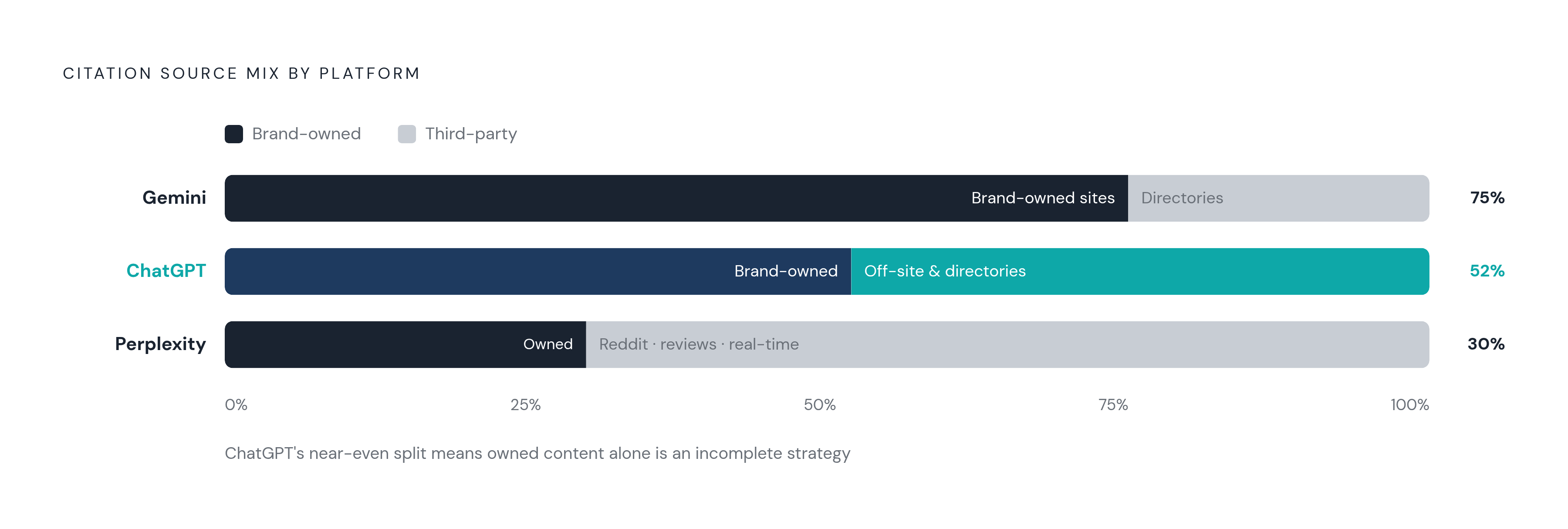
The same delivery requirements extend beyond a brand’s own website because AI platforms draw from different source networks. An owned site can be accessible, fresh, and parsable while still covering only part of the content a platform prefers. Infrastructure strategy therefore has a distribution dimension. It concerns both the canonical source a brand controls and the third-party sources through which that brand is represented. The balance depends on the target platform.
Gemini draws heavily from brand-owned websites, making owned canonical sources a priority for its visibility. ChatGPT relies more on internet consensus, with third-party directories and off-site sources accounting for roughly half of its citations, nearly equal to its brand-owned citations. Owned content alone consequently leaves a substantial part of ChatGPT’s sourcing pattern uncovered. Perplexity emphasizes community content, especially Reddit, and real-time sources, with review platforms playing a secondary role. Its inline citations also make referral traffic from that visibility trackable.
Controlled research found that earned-media distribution gave AI search visibility a much larger median lift than owned content alone. Teams therefore need content pipelines that publish on a cadence to their own properties and to the third-party platforms their target engines draw from. Those pipelines also need to keep off-site content up to date.
Measuring whether the infrastructure is actually working — AI citation as a first-class metric
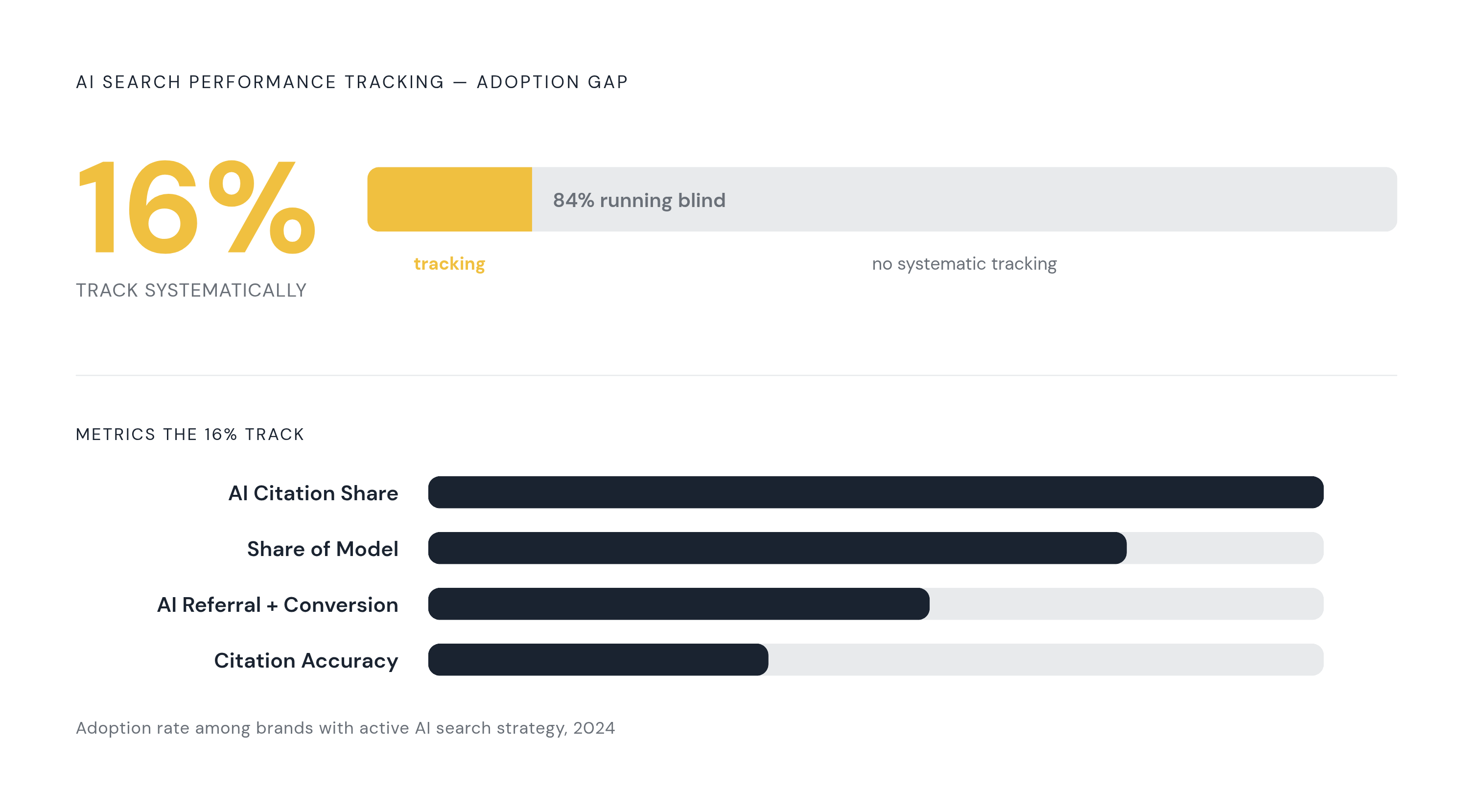
That wider source network makes measurement essential to evaluating infrastructure choices. Publishing regularly, improving parsability, and changing caching policy help content get cited, but they do not show whether it was cited. Only 16% of brands track AI search performance in a systematic way, so much of this work goes on without evidence of its results. Without that evidence, teams cannot tell whether their delivery and distribution choices are producing the intended visibility.
Cross-engine citation overlap is low, so a strong result on one platform can conceal absence on another. Tracking therefore needs to span ChatGPT, Claude, Gemini, Perplexity, and Google AI Overviews at minimum. This is not simply broader reporting for its own sake. Each engine provides evidence about a different part of the sourcing strategy.
The core measures address distinct outcomes. AI citation share records how often the brand appears in responses to target prompts. Share of Model measures how often the brand is mentioned compared with its competitors across the same prompt set. AI referral traffic with conversion tracking connects visibility to visits and subsequent outcomes, while citation accuracy establishes whether responses describe the brand correctly. Together, these measures make citation a first-class performance metric rather than an assumed benefit of successful crawling.
Citation results show whether fresh, parsable content and sustained distribution are returning a visibility signal, and they can indicate when a platform’s sourcing logic has changed. Consistent retrieval is the prerequisite. Measured, accurate citation is the evidence that the system is serving its intended role.