Automated Blog Posts From Developer Events and Merged Pull Requests
Automated drafts from code changes let teams explain features before they fade from relevance.
Automated blog posts from developer events and merged pull requests can close the gap between shipping code and explaining it. The effective model is a pipeline that turns attributable technical signals into reviewed content, distributes that content where AI answer engines can find it, and measures whether it earns citations.
The scale of the PR merge signal that teams are ignoring
Each merged PR is a structured, timestamped technical event with an attributable author. It already holds the basic inputs for an explanation, including a diff, a commit message, linked issues, a timestamp, and often the engineer’s account of intent. Those inputs record both the change and the context in which it was made.
Across repositories, this work keeps adding to the pool of source material. Yet most developer marketing teams are not turning that stream into human-readable content. The work is recorded inside the repository, while its explanation outside the repository remains intermittent.
Why the gap between code shipping and human-readable explanation accumulates into debt
Documentation debt begins with a sequencing problem. The engineer who understands a change is also under pressure to ship the next one. A content team may have time to write but lack the context or access it needs to explain the work on its own. Neither team has to neglect its responsibilities for a gap to form.
A content team member has to reverse-engineer intent from a shipped feature, often weeks after the decision was made. By then, the engineer’s working memory of the tradeoffs has faded, and the original discussion is buried in a closed thread. The facts may still exist, but reconstructing their significance requires another round of interpretation.
A blog post, changelog entry, or tutorial may appear after the feature’s moment of maximum relevance, when developers are searching for it and AI crawlers are indexing fresh material. What the brand says in public lags behind what its product can do, so an answer engine has fewer up-to-date statements to use when explaining the product.
What agentic repository workflows can do at the moment a PR merges
The Microsoft Aspire team provides a production example of how to close this handoff. When a product PR merges, its pr-docs-check workflow drafts a documentation PR in the separate aspire.dev repo. It assigns the original feature’s subject-matter expert as reviewer and posts a link back to the source PR. The pipeline has achieved a consistently high merge rate across the PRs tracked. Its output is a reviewable proposal.
GitHub calls the broader pattern “Continuous AI”. It brings AI into the SDLC in a way comparable to how CI/CD normalized automated builds and tests, while augmenting deterministic pipelines. These workflows run on existing GitHub infrastructure rather than requiring a separate platform for repository automation.
The Aspire example matters because the task is narrow. The agent reads the diff, scans linked issues, decides whether documentation is needed, and drafts within established voice and component conventions. A PR-to-content workflow can use the same pattern to assess whether a change warrants publishable coverage and prepare it for review. Triggering that work at merge time preserves the connection between the explanation and its source. The mechanism compresses the handoff while leaving the final judgment with a human.
Why human review is not optional in a PR-driven content pipeline
The production pattern automates preparation while leaving editorial responsibility with humans. GitHub Agentic Workflows reinforce that boundary through read-only permissions by default. Write operations, including creating a PR or posting a comment, need explicit approval through a safe-output mechanism. That security boundary sets what the workflow may do, while editorial review checks what the content should say. Both matter, but permission to create a draft is not permission to publish its claims.
The Aspire team kept the feature’s subject-matter expert as reviewer. The engineer’s role shifted from author to verifier. A draft can describe the diff correctly while misrepresenting why the change mattered, which problem it solved, or what a developer should do differently.
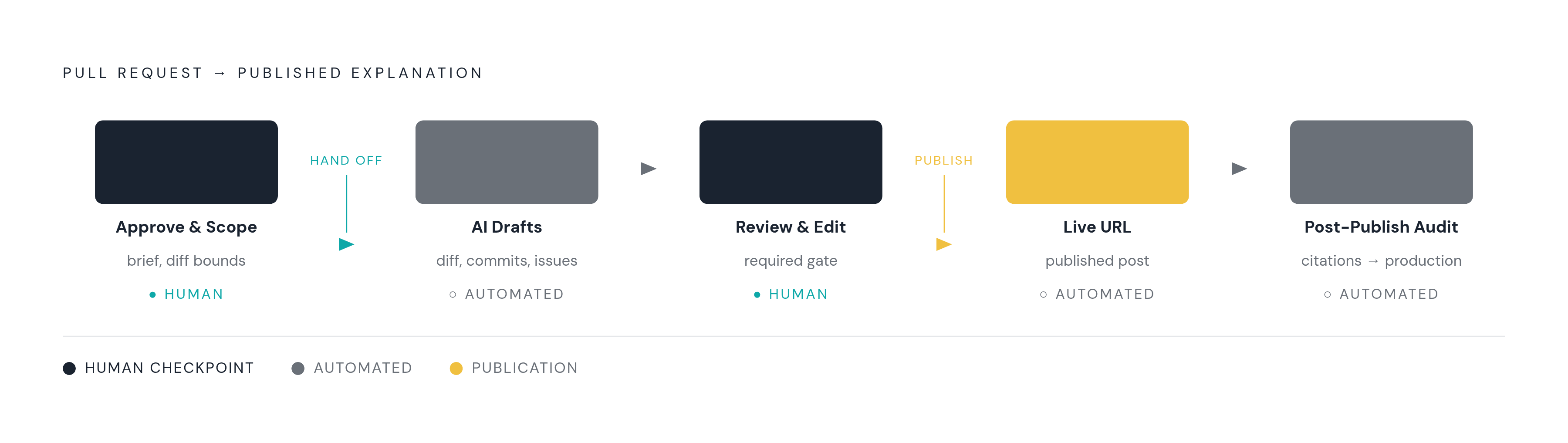
For a developer audience, that mismatch can damage credibility because readers can inspect the underlying change. The staged pipeline therefore starts with a human approving the trigger or brief and its scope, then uses AI to draft the content, with a required pre-publish review and a post-publish audit. The agent can identify a candidate for coverage, but publication at a live URL requires human approval of the content and how it will appear. Review is part of the production architecture.
What PR-driven content produces that AI answer engines specifically look for
Once reviewed, PR-driven content has properties that make it useful for grounding AI answers. It can carry specific version numbers, named engineers, dated events, and verifiable diffs. These details express subject-relation-object triplets that a language model can extract when constructing an answer. Rather than merely announcing that a product has improved, the content identifies what changed, who shipped it, and which behavior is different.
This is the connection to generative engine optimization, or GEO. Traditional SEO aims to get a link ranked, while GEO uses structured content and brand authority to get a brand into a synthesized answer. GEO also aims to shape how answers show and describe a brand beyond a named citation, while answer engine optimization has the narrower goal of being the named, cited answer. For a PR-driven pipeline, the published explanation needs to give the engine evidence it can use in that answer. The merge event provides the raw facts, and editorial work makes their relationship clear.
A grounding page needs extractable statements that do not contradict one another. A vague post announcing a feature gives an engine less evidence to use than an explanation that names the PR, version, engineer, and behavior change. Schema markup can reflect those visible facts, but it cannot substitute for them. The decisive work remains in the visible HTML text. A steady flow of attributable technical explanations gives answer engines more relevant material to draw on, without making citation automatic.
How developer events extend the same pipeline logic beyond the repository
Merged PRs are the highest-frequency signal, but the pattern extends to conference appearances, open-source releases, contributor milestones, and maintainer roundups. Each can supply an attributable event, a date, and technical context. The source is different, but the editorial task is similar. The workflow must identify what happened, extract the relevant context, and turn it into a reviewed explanation. This broadens the pipeline beyond changes recorded in a code repository.
The event calendar makes that cadence concrete. All Things Open 2026 takes place October 19–20, 2026, in Raleigh, North Carolina, with sessions on agentic AI and generative UI from Google contributors including Andrew Brogdon, Mark Techson, and Marc Dougherty. PyTorch Conference North America 2026 follows on October 20–21, 2026, in San Jose, California, including Google Cloud’s Bill Jia speaking on “Workload Fungibility in the Age of Agents”. AGNTCon + MCPCon North America 2026 takes place October 22–23, 2026, in San Jose, California, with keynotes by Google’s Sarah Drasner and Google DeepMind’s Chi Wang. KubeCon + CloudNativeCon North America 2026 follows November 9–12, 2026, in Salt Lake City, Utah, with Google engineer sessions across Kubernetes SIGs, etcd, containerd, and agent sandboxes.
A watcher agent can respond when a relevant talk is announced or a session recording is published. The sequence remains event detection, context extraction, drafting, human review, and publication. The event supplies the trigger. It also introduces another route to distribution, because event coverage can fit third-party editorial surfaces as well as a brand’s own site.
Distribution across owned and third-party surfaces and what it changes about citation probability
Technical quality is necessary, but placement changes how a claim can be used. Content published on a brand’s own domain remains identifiable as a self-claim. Third-party editorial mentions carry different weight as evidence when they appear on domains that AI engines trust in a given vertical. Publishing only on the owned site therefore captures part of the available citation surface. The distribution problem is not solved merely because a sound explanation has a live URL.
The owned layer still has a distinct role. It supplies retrievable, contradiction-free grounding pages that establish what the product is, which versions exist, and which engineers built particular features. Those pages give models facts they can pull out and check against other mentions. PR-driven content is well suited to that role because its claims can stay anchored to a specific change.
The third-party layer complements that foundation through editorial placements, contributed posts, and coverage in trusted vertical publications. It is harder to control, but it is also harder to dismiss as a self-published claim. The distribution task is to identify the publications that function as seed-domain authorities for the relevant vertical and establish a consistent technical narrative there. A one-time placement does not provide the same cadence as a continuing flow of grounded explanations. Together, the owned and third-party layers link detailed product facts to outside evidence, giving engines more grounds to cite them than either layer alone.
Measuring whether the pipeline is producing AI citations, not just content
A pipeline can publish more content without getting the brand into more AI answers. Without a feedback loop, teams cannot see which published content earns citations.
Share of Model, or SoM, is the number of times a brand is mentioned divided by the total number of brand mentions across AI answers in a tracked query set. The prompt cluster defines the audience and questions for which that visibility rate has meaning. AI engines also differ in how they cite sources. A result from one engine cannot stand in for the others. Structured prompt tracking across ChatGPT, Perplexity, Claude, and Gemini can return brand visibility, competitor share, and source attribution.
Microsoft’s Bing AI Performance Dashboard has been public since February 2026 and provides first-party data on citations and grounding queries. Microsoft notes that it shows only a sample of actual citation activity. It therefore shows directly how Bing-surface content is used, but it gives only part of the picture of AI visibility. SoM, source attribution, and first-party citation data answer related but distinct questions about mentions, evidence, and use.
The final step is to feed those findings back into production. If version release notes, contributor spotlights, or architecture decision records keep earning citations while another category does not, the pipeline can produce more of what works. This makes the case for measuring AI visibility and making every capability reachable by an agent through an API. An agentic publishing system needs access to its evaluation as well as its production steps. The pipeline becomes defensible when it is instrumented like the code it documents, with evidence determining what it produces next.