Llms.txt Implementation and Its Effect on AI Answer Engines
The file doesn't boost AI citations, but it's essential infrastructure for agent-driven discovery.
Llms.txt implementation has no measurable effect on AI answer-engine citations, but it serves a different purpose as infrastructure for the agentic web. Brands should add the file to help agents find and use the content they need, then measure agent behavior apart from the signals that earn citations in AI-generated answers.
Why llms.txt became a GEO talking point despite doing almost nothing for AI citations
The appeal of an “AI sitemap” was straightforward. HTML can surround useful content with navigation, JavaScript, ads, and tracking pixels that take up context-window space. A clean Markdown index offers a more direct path to high-signal material. It complements robots.txt rather than replacing it, guiding systems that already have permission to access the site.
That proposition arrived as AI answer engines were becoming a primary discovery surface, so GEO practitioners treated it as a potential visibility lever. Yet that interpretation joined two questions that require different evidence. A file can be easy for an AI agent to read without being read by the crawlers that supply answer engines. Server traffic exposes that gap, because the bots relevant to citations barely request the file.
What the crawler traffic actually shows about llms.txt and AI answer engines
Llms.txt has no measurable effect on AI answer-engine citations. Limy’s 2026 analysis examined a very large sample of LLM bot traffic events across a 90-day window and found only a negligible handful of requests to /llms.txt. The traffic covered GPTBot, ClaudeBot, PerplexityBot, OAI-SearchBot, and Google-Extended. Requests for the file represented a statistically negligible share of that activity.
The decisive finding is not simply that llms.txt receives little traffic. The crawlers that drive citations overwhelmingly skip it and crawl HTML directly. A curated index cannot influence retrieval through a path those crawlers do not use. Its presence therefore does not establish that an answer engine has consumed its guidance, much less used that guidance to choose a source.
Gary Illyes said in July 2025 that Google does not support llms.txt and is not planning to support it. John Mueller compared the file to the discredited keywords meta tag. Those statements leave no basis for presenting implementation as a Google-supported visibility requirement.
The conclusion is narrow but settled. Llms.txt is not a GEO ranking factor today, and selling it as one promises an effect the data does not support. That verdict concerns answer-engine citations. Keeping the scope clear allows the implementation decision to rest on what actually consumes the file.
Why the same file still earns its place in the stack — just on a different layer
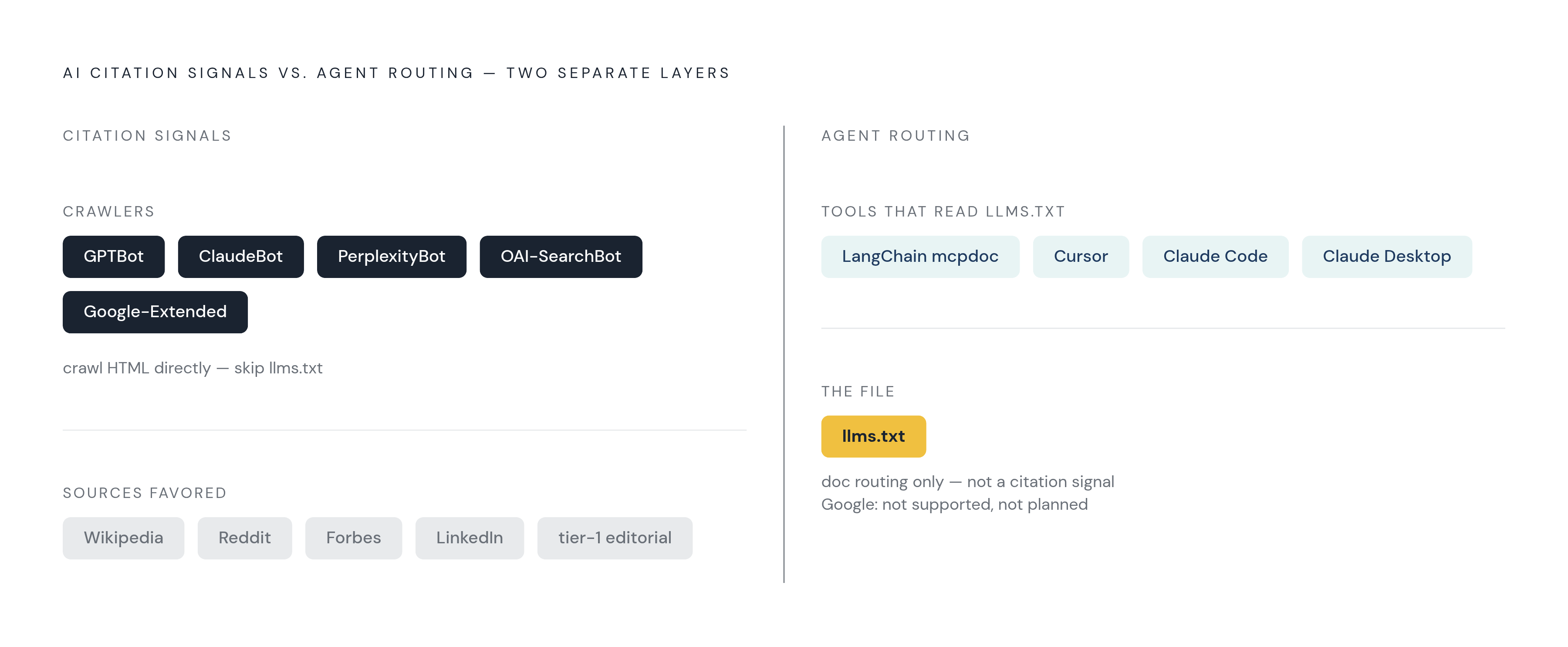
The agentic web gives llms.txt a concrete role outside search citations. AI agents act on behalf of users, fetch context, choose tools, and complete tasks. In that setting, an index can route an agent toward the documentation or product information needed for an interaction. The relevant outcome is successful access to useful context.
Limy calls this Business-to-Agent, or B2A, and positions llms.txt as its first widely adopted standard. The underlying distinction is between a website that a person can navigate and a surface that an agent can route on. GEO concerns visibility in AI answers, while B2A concerns how agents find and use a brand’s resources. Treating these as separate jobs changes both the content supplied and the evidence used to judge it.
LangChain’s mcpdoc provides a specific example of that routing role. The open-source MCP server exposes llms.txt files to host applications including Cursor, Windsurf, Claude Code, and Claude Desktop. Its fetch_docs tool lets users read URLs listed in a provided llms.txt file. Here, the index participates directly in the interaction by identifying material the tool can fetch.
Documentation platforms have made that use practical at scale. Mintlify rolled out llms.txt support across all the documentation sites it hosts in November 2024, giving thousands of sites, including Anthropic and Cursor, the file overnight. Fern, GitBook, Vercel Docs, and Supabase Docs also support it. Yoast and Rank Math support the file through opt-in features, which sites must turn on to use.
The efficiency argument also belongs at this layer. Companies serving Markdown instead of HTML have reported substantial context-window reductions, translating into faster, cheaper, and more accurate agent behavior and a material cost difference at agentic scale. For documentation-heavy brands, the file earns its place by making relevant content easier for agents to consume.
What actually drives AI answer-engine citations — and where llms.txt fits in that picture
AI answer-engine citations depend on off-site breadth and on-site signal quality. Platforms appear to seek agreement across independent sources before confidently citing a brand. When Reddit discussions, industry publications, and review sites agree in their product coverage, they give platforms more reason for confidence than an optimized owned domain alone. The strategic task is therefore to build credible presence beyond the website as well as useful content within it.
Brand mentions correlate more strongly with AI citation probability than backlinks do. That distinction shifts attention from the link graph associated with traditional SEO toward earned presence in third-party content. A mention and a backlink are not interchangeable evidence, even when they appear on the same page.
Gemini leans more heavily on brand-owned websites than rival AI engines do, particularly for local and commercial queries. Brands that target Gemini should therefore put more weight on the quality of their owned domain. This changes where the content program places its emphasis, with external coverage remaining relevant.
ChatGPT relies on a narrower pool of authoritative sources, including Wikipedia, Reddit, and editorial publications such as Forbes and Business Insider. Distribution through credible third-party coverage consequently matters more there than relying on the owned domain alone. Perplexity emphasizes Reddit, community content, tier-1 editorial sources, and LinkedIn.
Those platform distinctions are not fixed allocations. ChatGPT’s Reddit citations fell sharply over six weeks in late summer 2025, while Forbes doubled in the same window. Citation strategy must therefore adapt to changes in source selection rather than assume that a currently prominent source will retain its weight. Tracking the mix matters because a shift in citations can reflect both platform behavior and a change in the brand’s content.
Llms.txt does not alter any of these authority signals. For docs-heavy and developer-tool sites, it reduces friction when agents need to surface content that already has those signals. That makes it a useful component of a broader AEO program, but not a substitute for earning coverage or publishing strong source material.
How to implement llms.txt without the most common failures
The central implementation failure is treating llms.txt as a second sitemap. Hundreds of unsorted links reproduce the discovery burden that a curated index is supposed to remove. The recommended target is 10 to 20 high-signal links, organized by section.
Begin with one H1 containing the site or product name, followed by a blockquote that summarizes what the company does in one line. Use H2 sections to group links, and write each entry as a Markdown list item with the page name, a colon, and a short description. The description should explain what the page contains and who it serves.
Choose section labels that name the content agents need. For a B2B SaaS or developer-tool site, suitable groupings include product features, documentation, API reference, pricing, and a genuinely useful blog selection. A blog archive dump defeats the same curation principle as an oversized index. The brief’s SaaS example uses About, Features, Resources, and Pricing, with five or fewer links in each section and a one-line description for each link.
Put lower-priority links in an H2 section named “Optional”. That label allows agents to skip the material when context is tight without losing the main path through the site. For documentation-heavy sites where agents frequently need full page content, the companion file llms-full.txt serves a different need. It embeds the linked pages’ actual content so an agent can ingest it in a single fetch, rather than use the index only to locate destinations.
Publish plain Markdown encoded as UTF-8, serve it as text/plain or text/markdown, and return an HTTP 200 response. Use absolute HTTPS URLs throughout the file so each destination is fully specified.
Access rules remain separate from curation. A crawler blocked by robots.txt will not access llms.txt, so the index does not override restrictions placed elsewhere. For a static site, place the file at the root. For a Flask or Django site, serve it from the static folder or configure a dedicated route, and use the file audit in Chrome Lighthouse 13.3, released May 7, 2026, to verify deployment. Deploying llms.txt is low-effort infrastructure work.
What to measure — and why "did citations go up?" is the wrong question for llms.txt
Citation changes after deployment do not establish an llms.txt effect. The file is not in the causal chain for answer-engine citations, so measuring it against citation rates returns noise. A rise can lead a team to credit the wrong intervention, while a flat result can lead it to dismiss useful agent infrastructure.
The appropriate measurement frame follows agent behavior. It asks whether developer-tool agents resolve to the documentation, whether MCP-connected tools fetch llms.txt and pull its linked pages, and whether agent-referred traffic converts. These outcomes correspond to the role the file actually performs. They distinguish an index that supports useful interactions from a file that merely exists at the expected location.
AI answer-engine visibility needs its own set of measures. Share of Model, or SoM, measures brand mentions divided by the total number of AI answers in a tracked prompt set. A brand visibility score represents how often the brand appears in responses to a target query cluster.
A mention makes the brand visible in a response, while a citation links to content as a source and can generate referral traffic. Only a minority of brand mentions in ChatGPT include clickable citation links that appear in analytics. Referral data therefore cannot stand in for the full measure of brand visibility.
Tools that measure answer-engine visibility run structured prompt sets against several LLMs and return visibility scores, competitor share, and source attribution. That measurement layer should track which platforms cite the brand, which source types they use, and how those patterns shift as the content program develops. Llms.txt belongs in the same broader AEO program as cheap agentic infrastructure for docs-heavy and developer-tool sites, but its assessment belongs with agent behavior. The boundary between routing agents and earning citations determines where a brand invests and which evidence can show that the investment works.