Conversational Query Patterns in Enterprise B2B AI Search
Enterprise buyers now ask AI chatbots full questions instead of typing keywords into Google.

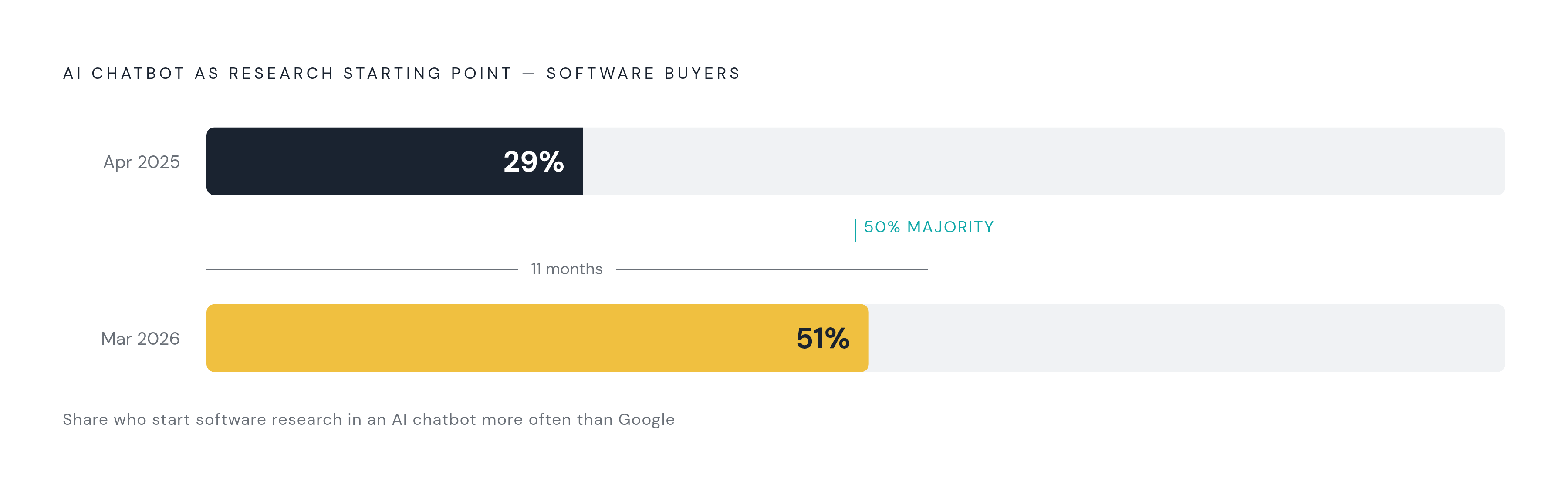
Enterprise B2B buyers no longer type three words into a search bar and scroll through ten blue links. They ask full questions, in full sentences, often across several turns in the same chat session, and they do it before a sales rep ever hears their name. G2's research found the share of software buyers who start research in an AI chatbot more often than Google jumped from 29% in April 2025 to 51% by March 2026, a coin flip becoming a majority in under a year. What matters most for brands is that the queries themselves changed shape. It's that the queries themselves changed shape, and most companies are still writing for the query shape that's disappearing.
Generational adoption data closes off the easy objection that this is a Gen Z quirk: adoption spans every generation, with younger cohorts leading and older buyers following at a meaningful lag. This is a workforce-wide shift in how people gather information before they spend money.
What a conversational query looks like, and why the structure is different from keyword search
A keyword query is a fragment: "enterprise CRM pricing." A conversational query is a full sentence, sometimes several, asked inside a back-and-forth session with a system like ChatGPT, Claude, or Perplexity. VisibilityStack's glossary defines conversational search as query-based interaction using natural language, where users ask complete questions and carry on multi-turn dialogue instead of typing keyword strings. That sounds obvious once stated, but the mechanics that change how a query gets interpreted and answered are what separate this from search-as-usual.
Three things happen here that never happened with keyword search. First, the system has to work out intent, so "what should I use to replace my spreadsheet-based forecasting" has to be understood as a software category question. Second, context carries across turns. A follow-up question builds on what came before, so the session accumulates meaning the way an actual conversation does, instead of resetting with each new search box entry. Third, and most consequential for marketers, the system hands back a constructed answer instead of a ranked list of links. There's no SERP. The buyer sees a paragraph, sometimes with citations, and that paragraph is stitched together across many sources at once.
A few things conversational search is not. It isn't a synonym for voice search: plenty of it happens in text, typed into a chat window during a lunch break. Keyword density, the old habit of stuffing a phrase into a page enough times to signal relevance, doesn't work here either. What works instead is writing complete, direct, question-answering prose. And these systems aren't limited to simple lookups; they handle layered, multi-part B2B questions, the kind that used to require a call with a solutions engineer just to untangle.
A brand built to rank in Google and a brand built to get cited inside a synthesized AI answer are running two different content programs. Different structure, different research process, different definition of what "winning" even looks like.
Enterprise B2B buyers' query sequencing across the buying journey
Forrester's survey found buyers use AI tools for three distinct jobs: researching product information (54%), comparing vendors head-to-head (55%), and building an internal business case before contacting a vendor at all (47%). Those three numbers map onto three stages of intent, and each stage carries its own query grammar.
Early on, buyers ask orientation questions: what is this category, how does it differ from that one, which kind of solution actually solves this problem. They don't know what they don't know yet, and AI search compresses a learning curve that previously required substantial independent research across multiple sources. Whichever brand appears inside these orientation answers gets a head start on category framing before the buyer even realizes they're becoming a buyer.
Then comes evaluation: which tools integrate with our stack, what's the real difference between these three platforms, which one actually fits the use case. This is where the shift bites hardest, because AI tools now do work that used to belong to a sales rep: summarizing documentation, comparing features, surfacing gaps between competitors. At this stage the AI's answer functions as the shortlist itself.
Last comes validation: what ROI do companies typically see, is there independent research backing this claim, has anyone published real numbers. TrustRadius found that 90% of buyers who ran into Google AI Overviews clicked through to the cited source to check what they'd just read. That number turns citations into measurable traffic, not an abstract visibility metric someone reports on a slide.
Research into B2B buying behavior consistently finds that a majority of the buying journey wraps up before the buyer ever contacts a vendor. Most of the sequence above happens with zero vendor involvement, and it happens on top of buying committees running many stakeholders deep on complex purchases, each one often running a separate, uncoordinated AI session on the same decision.
Role-specific query patterns: how different buying committee members phrase the same purchase decision differently
Eleven to fourteen people, one purchase decision, and each person shows up to AI search with a different vocabulary and a different definition of success. That's the practical weight behind the buying-committee-size figure above. It's a warning that visibility gets earned separately, role by role.
Procurement and sourcing professionals write constraint-heavy prompts: find a supplier for X, with Y limitation, in Z geography. A growing share of that traffic never reaches a human decision-maker first. It runs through eProcurement AI agents, and Mirakl's research notes those agents need structured product data just to surface a vendor as an option.
Technical evaluators, usually people in IT, ask about integration complexity, security posture, and how a new tool plays with the existing stack. These questions demand sourced, specific technical detail. A marketing page full of adjectives does nothing for this reader, human or machine, and the machine notices faster.
Marketing and business line leaders ask about ROI benchmarks, reporting capability, and what peer companies have actually experienced, weighting third-party proof heavily when they judge an answer credible. Finance and the CFO's office ask about total cost of ownership, contract flexibility, and business-case benchmarks. Buyers using AI to build an internal business case before contacting a vendor sit disproportionately in this seat.
AI visibility is role-segmented whether a brand plans for it or not. Content answering the marketing leader's question may not appear in the procurement agent's output, because the query, the vocabulary, and the underlying data requirement are different animals. The eProcurement layer raises the stakes further: an AI agent, unlike a human buyer, doesn't pause to call and ask a clarifying question when a spec sheet is incomplete. It just moves to the next supplier. Incomplete data is disqualification, silent and automatic, and nobody at the vendor even finds out it happened. It's disqualification, silent and automatic, and nobody at the vendor even finds out it happened.
The 7-word threshold: where conversational query length opens AI Overview surfaces to B2B brands
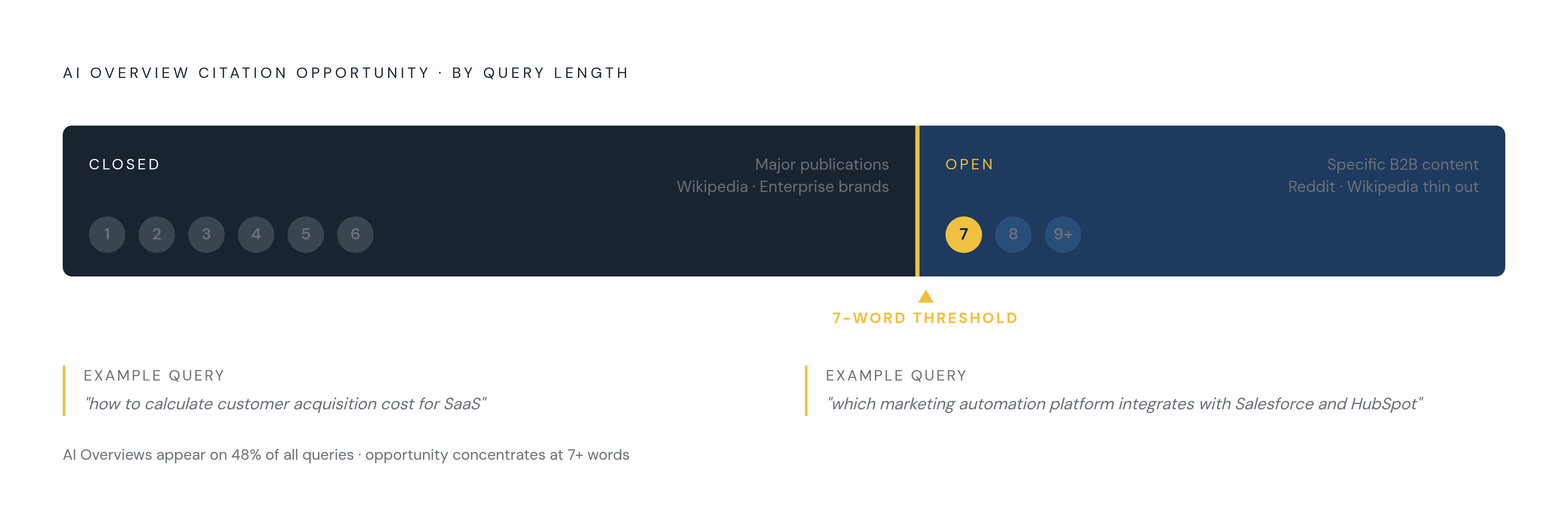
Averi's data shows AI Overviews now appear on 48% of queries, but they don't spread evenly across query types. They lean hard toward long-tail, specific phrasing over short head terms, and Averi's research puts a number on where that shift becomes usable: seven words. Queries at seven words or longer are where AI Overviews open up meaningfully, where Reddit and Wikipedia stop crowding out everything else, and where a mid-market or specialist B2B brand actually gets a shot at showing up. That threshold is the floor any serious generative engine optimization strategy has to build from.
Short head terms, one to three words, belong to whoever already owns the internet's attention: major publications, huge reference sites, established enterprise brands. Competing there is close to a waste of budget for most companies, the equivalent of bidding against a major beverage brand for the word "drink."" But something like "how to calculate customer acquisition cost for SaaS" or "which marketing automation platform integrates with Salesforce and HubSpot" opens a door that head terms keep shut. Google's own language backs this directly: the company describes users asking "longer and more specific questions, as well as follow-up questions to dig even deeper." That's a platform describing its own users, not an analyst guessing at behavior from outside.
Analysis of enterprise content requirements spells out what this means for anyone still writing generic material. If a query can be answered by summarizing what any competent consultant already knows, the AI answers it directly and never sends a click anywhere; there's no reason to cite a source when the model already has enough to close the loop on its own. The opening sits on the other side of that same coin. At seven-plus words, Reddit's dominance thins out, and big publications tend to write broadly rather than deeply, leaving room for specific, operationally detailed B2B content to get picked up, provided it's built to be pulled apart and extracted rather than just read start to finish.
Why generic content is losing ground in AI-synthesized answers
More content was never the fix. Better content is, and the two got confused constantly under old SEO logic, where publishing volume bought rankings even when the writing said nothing new. Large language models keep getting better at summarizing whatever's already public, so a generic post repeating category consensus becomes trivial to replicate, and gives the model zero reason to cite it over a hundred nearly identical competitors saying the same thing in different words.
Savictech's 2026 analysis of Google's March 2026 core update points to "Information Gain" as the metric that mattered most, and it rewards two kinds of content specifically. First, hands-on expertise a model can't fabricate: real implementation timelines, actual cost figures from completed projects, patterns that become visible only after watching many engagements play out. Second, content that adds something the web didn't already know, rather than repackaging it.
Structure carries as much weight as substance. Systems that retrieve information in real time, Perplexity and Google AI Overviews among them, weight the opening of a page heavily, so the first couple hundred words need to answer the core question directly instead of building up to it with throat-clearing. Guidance on AI search optimization treats clear H2 and H3 structure, FAQ schema, and consistent terminology as prerequisites for a model to parse a page correctly at all, not stylistic flourishes to get to later. Demonstrated expertise and content freshness are widely cited as factors that influence AI Overview inclusion.
There's also a citation path a brand doesn't fully control. Review platforms like G2, Capterra, and Trustpilot, along with Reddit threads and YouTube transcripts, carry heavy weight in how AI systems answer "best X for Y" questions. Part of any brand's AI visibility, then, depends on how it shows up in places it never wrote a word for and can't edit.
Ahrefs found that AI Overviews cut click-through rates for top-ranking Google content by 58%, up from 34.5% the year before. Brands that get cited still capture traffic, and it arrives at high intent. Brands that get summarized away get nothing back. There's no longer a middle outcome.
How AI traffic from conversational queries converts differently from traditional organic search
A visitor arriving from an AI citation has already read a synthesized answer built from multiple sources before ever landing on the site. That head start is visible in the conversion numbers. Get-ryze.ai's research on AI visibility measurement adds a sharper figure: AI-influenced sessions convert at two to three times the rate of cold organic sessions, because the buyer isn't starting cold. They're arriving with a model's worth of pre-digested context already loaded before they click anything.
G2's research reveals something sharper still. Among buyers surveyed, 33% purchased from a vendor they had never heard of before, discovered entirely through an AI search answer. That's a brand getting created, from the buyer's perspective, inside an AI platform the company never previously touched or even knew was in play. That's a brand getting created, from the buyer's perspective, inside an AI platform the company never previously touched or even knew was in play.
Adobe's analysis flags the gap this opens for measurement. Standard analytics track what happens on a website, but they're blind to the orientation and evaluation stages happening earlier, inside AI platforms an organization doesn't own and can't instrument. A company can watch website traffic climb with no idea whether that lift traces back to a citation in a chatbot's answer three weeks prior. Fixing that means building attribution models that track AI mentions and citation quality upstream of the website session, not bolting one more metric onto the existing analytics stack and hoping it happens to catch something it was never built to see.
GEO and AEO in practice for B2B brands managing conversational query presence
Two acronyms took hold in 2026, close enough in meaning that most agencies now use them interchangeably. Generative Engine Optimization, or GEO, means structuring content and brand presence so systems like ChatGPT, Perplexity, Google AI Overviews, and Claude cite and recommend a brand inside their answers. Answer Engine Optimization, AEO, started out focused on voice search specifically, but since most voice queries now route through the same generative systems, AEO has largely folded into GEO as a practical matter, and the distinction matters less each quarter.
Llmpulse.ai's 2026 GEO guide offers a clean way to hold the three disciplines apart: SEO ranks a brand, AEO selects it, GEO gets it cited and recommended. A mature strategy runs all three at once, though the money is visibly shifting. GEO is projected to claim around 40% of enterprise SEO budgets by 2027, a reallocation that would have sounded aggressive two years ago and now reads as almost conservative.
Answer Engine Optimization guidance breaks the discipline into four pillars that have moved from theory into daily execution. Prompt strategy comes first: mapping the 15 to 25 core buyer prompts that define a category and staging them across the funnel, since a brand with no map of these prompts has no baseline for what "visible" even means. Technical structure comes next: the clear headings, consistent terminology, and explicit definitions that make a page interpretable to a model. Citation and authority strategy follows: understanding which third-party sources, review sites, analyst write-ups, Reddit threads, and user-generated content actually shape how AI systems answer questions in a given category. Ongoing monitoring closes the loop, because AI outputs shift as models update and competitors publish, and a visibility baseline measured once and filed away is stale by the time anyone opens the file again.
Sources
- 50 Real Queries Triggering AI Overviews in B2B SaaS This Quarter
- Top 5 AI Trends in B2B Reshaping Commerce in 2026 – Mirakl
- AI Search Behavior and Brand Visibility in Customer Journeys
- VisibilityStack
- Google's 8 Rules for AI Search Success 2026 — Enterprise B2B Content Strategy | SAVIC
- startsomeshift.com
- llmpulse.ai
- Answer Engine Optimization in 2026: What B2B Brands Must Do to Stay Visible in AI Search