Competitive Query Analysis for AEO Gap Discovery
AI citations now matter more than search rankings as buyers form decisions inside chatbots.
Similarweb's clickstream data shows more than two-thirds of Google searches now end with no click. Buyers ask AI engines the question instead, get an answer inside the chat window, and move on with a shortlist already half-formed before any brand's website enters the picture. That shift changes what "competitive analysis" even means: the fight is no longer over rankings, but over which brand gets named when the model answers. It's over which brand gets named when the model answers.
Ahrefs' analysis of 300,000 keywords, comparing December 2023 to December 2025, shows that where Google's AI Overviews show up, the top-ranking page's click-through rate falls from 7.3% to 1.6%. Ahrefs puts the real reduction at 58% when adjusted against a baseline click-through rate absent AI Overviews. Gartner had predicted a 25% drop in traditional search volume by 2026. Writer.com's guide states that prediction has already played out, ahead of schedule.
Buyers form silent shortlists inside AI conversations, well before they land on a vendor's site. By the time they arrive, if they arrive, the decision may already be settled. A brand absent from AI answers is absent from early-stage consideration, and no amount of on-site polish fixes that after the fact.
What AEO competitive analysis measures, and why it differs from SEO competitive analysis
AEO competitor analysis compares how often a brand gets named or cited inside AI-generated answers against how often rival brands get named for the same buyer questions. That sounds close to SEO competitor analysis, but the mechanics run almost backwards. SEO ranks a brand's own pages against competitors' pages. AEO measures whether an AI model cites the brand at all when answering a buyer's question, regardless of whose page it pulls the answer from.
SEO was mostly a first-party contest. A brand controlled its own site, optimized its own pages, and climbed its own rankings. AEO, sometimes called GEO (generative engine optimization), runs mostly through third parties: AirOps analysis found roughly 85% of AI references originate from third-party platforms rather than brand-owned domains. That single fact reorders the whole discipline, and most teams still haven't caught up to it. Polishing an owned page still matters, but it isn't where the battle happens anymore. Treating it as the main lever is the first mistake, and it's the one most teams make.
The brands that show up in AI answers are often not the brands that rank on page one of Google. AI search competitors and organic search competitors can be two entirely different lists, so any gap analysis has to start from what the AI engines actually say, not from assumptions carried over from traditional rankings.
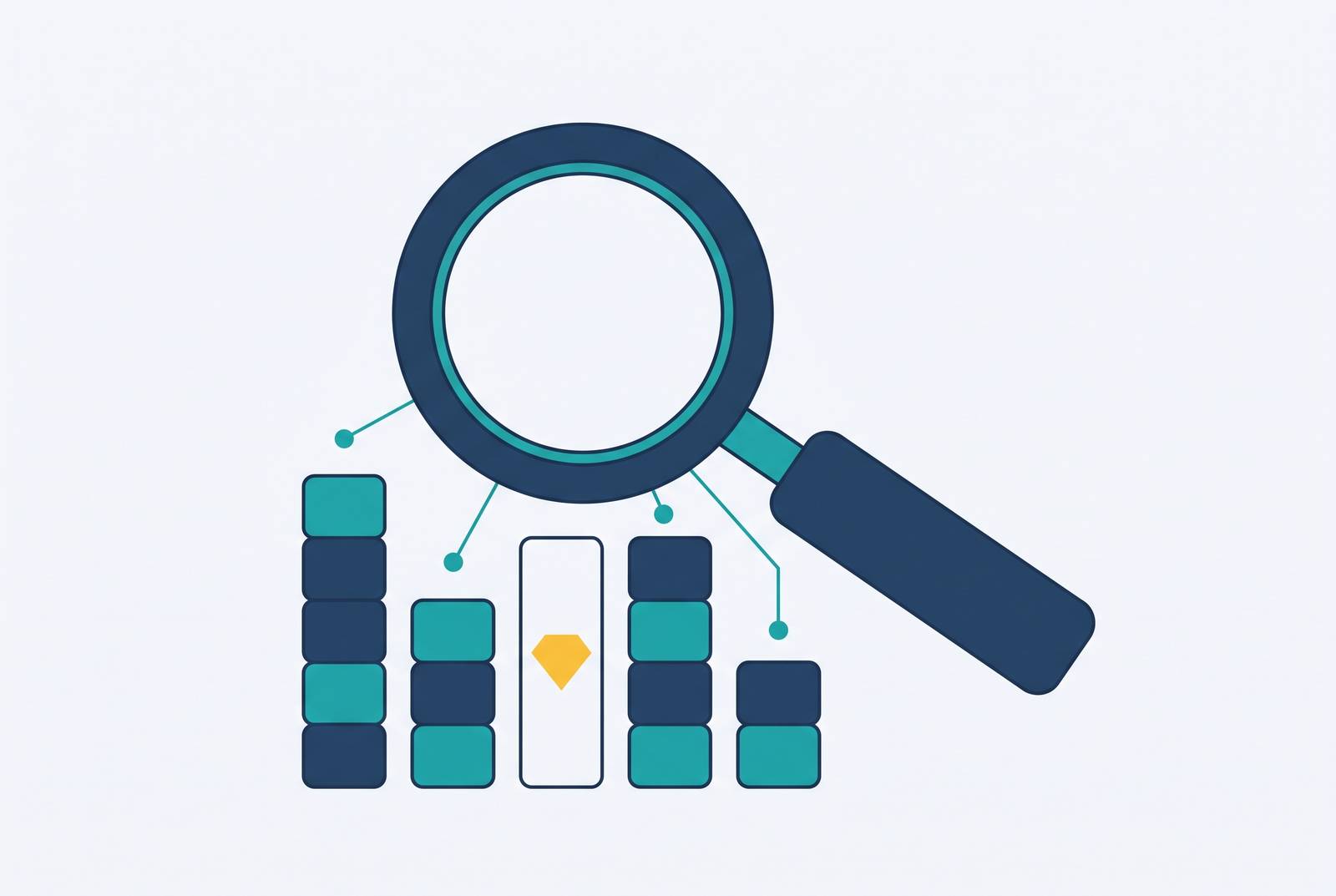
Three kinds of gaps tend to appear once that analysis runs. Query gaps are questions where a competitor gets cited and a given brand simply doesn't show up. Surface gaps are engine-specific: one platform favors a competitor heavily while another treats both brands about the same. Format gaps appear when competitors keep earning citations through a content type, a comparison table or an original data study, that the brand in question never publishes.
The metric tying all three together is Share of Model, or SoM: the percentage of AI-generated responses, across a defined set of prompts, that mention a given brand. Writer.com's guide credits Jack Smyth and Tom Roach with coining the term. Unlike paid share of voice, SoM can't be bought. ChatGPT's sponsored cards are labeled as such and don't touch the underlying model's response, so getting into the actual answer has to be earned through citation-worthy content and third-party authority.
McKinsey found only 16% of brands systematically track their AI search performance today. That gap between what executives say matters and what teams actually measure is the opening sitting in front of anyone willing to run the analysis properly.
Building the query set: selecting and categorizing the prompts that reveal competitive gaps
Running the prompts first reveals who shows up. Don't guess who the competitors are and go looking for confirmation afterward. AI-cited competitors can differ sharply from organic ones, so discovery has to come before assumption, not the other way around.
Three categories of prompts cover most of the buyer journey. Category questions, things like "what's the best tool for X," are at awareness and consideration. Comparison questions, "how does A stack up against B," mark active evaluation. Alternative questions, "what are the alternatives to C," sit closest to the purchase decision, since that's where shortlists actually lock in. That third category pays off the most directly in gap analysis, because it's the exact moment a competitor can shut a brand out of consideration.
Prompt design matters more than it did in the keyword era. Specific, intent-loaded questions outperform broad terms, and the length gap proves it: the average ChatGPT prompt runs 23 words, versus 3.37 words for a traditional search query, per HubSpot's reporting (citing The Growth Memo for the traditional search figure). That extra length carries intent, and intent is what makes an AI answer purchase-proximate in a way a keyword fragment never was. Pew's research backs this up from another angle: AI Overviews appear on 53% of searches with ten or more words, and on 60% of searches that open with a question word. Long, question-shaped prompts are the right unit to build a query set around, not short keyword fragments.
The set should also include prompts built to surface third-party content specifically: review-site queries, "according to [publication]" phrasing, industry-specific comparisons. That's a direct response to the 85% figure above. If most citations come from third parties, some prompts need to go fishing for exactly that kind of source.
Run each prompt three to five times per engine, in a logged-out session, and record the citation rate rather than a single pass-or-fail outcome. AI answers shift enough that one run proves nothing. Coverage needs to span ChatGPT, Perplexity, Google's AI Overviews and AI Mode, and Gemini, because these engines don't converge on the same sources. Only 11% of domains get cited consistently by both ChatGPT and Perplexity for the same queries, which makes cross-platform coverage a requirement.
Running the benchmark: how to count, log, and score citations across AI surfaces
Two things get tracked here, and mixing them together throws off every downstream number. A citation is a case where a source URL actually surfaces in the response. A mention is a case where the brand name shows up in the generated text with no link attached. Both count, but treating them as one thing overstates presence in some cases and understates it in others.
Log each prompt run with a consistent structure: the engine and date, the exact prompt text, every brand named in the response, every source cited, where in the response the brand appears (early versus buried near the end), and how the brand gets framed, recommended outright, mentioned neutrally, or set up as a lesser alternative.
Calculate Share of Model per brand by dividing the number of responses that include it by the total number of prompt runs, expressed as a percentage per engine and again in aggregate. Rough visibility benchmarks in circulation suggest below 20% signals underrepresentation and above 40% signals real competitive outperformance.
Position on the page matters almost as much as whether a citation happens. CXL's analysis of Google's AI Overview citations found 55% came from the first 30% of the source page. Other research into broader LLM citation behavior points in a similar direction. A page can be technically "cited" and still be losing the format war if the answer sits buried at the bottom, unread by whatever process pulled it in.
Google Search Console rolled out generative AI performance reports starting June 3, 2026, reaching global availability by August 31, 2026. These reports surface impressions, pages, countries, devices, and dates for AI Overviews and AI Mode combined, without breaking the two features apart, and carry no click, CTR, or query-level data. Useful for owned-site visibility. Not a substitute for the manual benchmark described above.
One caveat sits at the center of all of this: citation presence doesn't hold still. AirOps research found only 30% of brands stay visible from one AI answer to the next, and just 20% remain visible across five consecutive runs of the same prompt. A single benchmark snapshot is a starting point and nothing more. Repeated sampling across sessions and over time is the only method that produces a trustworthy read; treating a one-off audit as a finished picture means measuring the wrong thing.
Reading the gap map: what citation patterns reveal about content and authority weaknesses
Once the logging is done, three gap types tend to separate out clearly. Query gaps, prompts where a competitor gets cited every time and a brand never appears, carry the highest priority because the signal is the most direct: something specific in the competitor's content is winning that exact question. Surface gaps occur when a competitor dominates on one engine, Perplexity, say, while both brands run roughly even on Google's AI Overviews. That points to a difference in which sources each engine prefers. Format gaps appear when competitors keep earning citations from how-to guides, comparison tables, or original research, while a brand's own content sits almost entirely in formats those engines rarely pull from.
Because 85% of brand mentions in AI search originate from third-party sources, a query gap usually comes down to why the review sites, trade publications, and community forums keep referencing a competitor instead of the brand in question, and whose page reads better rarely enters into it. That calls for a different kind of work than a content audit alone can fix.
Writer.com's July 2026 guide frames GEO as roughly 80% strategic (positioning, ecosystem presence, brand authority) and only 20% technical. A gap map built entirely from owned-site content audits will misdiagnose the cause most of the time, because it stares at the 20% slice while the real driver sits elsewhere. This is the mistake most teams make first, and it costs months.
Research into AI citation behavior consistently finds that the overlap between top Google search results and AI-cited sources has narrowed sharply. Strength in traditional SEO tells almost nothing about strength in AI citation anymore. The two need separate audits, run separately, because a competitor's SEO dominance and its AEO dominance may not even trace back to the same pages.
Sentiment matters as much as presence. A brand named as the "more expensive option," or held up as a cautionary example, is technically a mention, and it's a liability dressed up as visibility. The logging structure has to capture framing, beyond whether the name showed up somewhere in the response.
Certain content signals correlate directly with getting cited: statistics-heavy pages, content that quotes and cites outside sources, guides that open with the direct answer rather than building up to it. Research into GEO content signals has found that statistics-heavy pages and content that quotes outside sources can measurably boost AI visibility, a concrete lever for improving it. That's a concrete lever."
Translating gap findings into a sequenced content plan
Sequencing should follow one intersection: how close a query sits to a purchase decision, and how wide the competitive gap is at that query. Comparison and alternative queries go first, full stop, because that's where vendor selection actually happens and where the gap analysis usually finds the sharpest lock-in.
A handful of content moves close citation gaps faster than others, based on what's actually driving AI citation behavior. Pages that answer the question directly within the first 30% of the content tend to get pulled more often, matching the CXL and SparkToro findings above. The Princeton study cited earlier found that content built around a proprietary statistic or original research, something not replicated word-for-word on ten other sites, moves visibility measurably. Distributing content across third-party platforms, rather than publishing only on the owned domain, matters given how much citation volume runs through third parties. Structured "A versus B" or "alternatives to C" pieces address the exact prompts where the gap analysis found competitor lock-in.
Sometimes the real finding from the gap map is a coverage problem. If review platforms, trade publications, and community forums keep citing a competitor and ignoring a brand, the fix runs through earned coverage: contributed articles, analyst relationships, PR placements in the outlets AI engines already trust. That's content strategy now.
Sequencing by engine matters too. If Perplexity shows the widest gap, prioritize the source types Perplexity tends to favor. If the gap sits mainly in Google's AI Overviews, owned-site structure and direct-answer formatting carry more weight.
The payoff for closing the highest-intent gaps first appears in conversion data. Research into AI search behavior suggests visitors arriving from AI search tend to convert at higher rates than typical organic search visitors. HubSpot separately reported lead conversion from AEO running three times higher than other channels. Solve the queries sitting closest to the purchase decision first, because closing them closes the most valuable gap on the map, not the easiest one.
None of this is a one-time build. FirstMotion's analysis of Perplexity's citation behavior found that content older than roughly 90 days starts losing retrieval priority to newer pages, at least on topics that shift or trend. The plan needs a refresh cadence built in from the start, beyond a production calendar for new pages.
The operational challenge of running this process across multiple clients at scale
The math gets heavy fast. Running 25 prompts across four AI engines, sampled three to five times each, produces somewhere between 200 and 400 query runs per client each month. Multiplying that across a portfolio of 20 clients produces a number too large for a spreadsheet or a couple of analysts to handle by hand, no matter how organized the process is.
Most AEO tools on the market were built for a single in-house brand team, not an agency managing many. They charge per domain, cap the number of workspaces, and still require someone to manually assemble the findings into something a client can actually read before a report goes out. That fragmentation is the central operational bottleneck agencies run into in 2026, and buying another single-brand tool doesn't fix it.
The fragmentation runs deeper than tooling. Many organizations still run separate vendors for SEO, content production, technical implementation, and AI visibility, each one reporting its own numbers and optimizing its own narrow slice. Cross-brand and cross-function optimization becomes structurally hard when four vendors are each looking at a different dashboard and none of them talk to each other.
An agency platform built for this reality needs a few specific things: one workspace for monitoring every client at once, portfolio-level analytics that roll SoM data up across the whole client base while still allowing drill-down into any single account, client-ready reporting that connects citation data directly to recommended content actions without a manual assembly step, and billing and access structures flexible enough to fit however the agency actually bills, whether per-client or centralized.
The skills gap sits on top of the tooling gap. 70% of marketers say AI visibility ranks as a top-priority topic for their CMO or CEO right now, but agency account teams often can't yet speak credibly about AEO methodology when a client asks a direct question about it. Selling this service means the team running it has to understand the gap-discovery process end to end, not hand over a PDF generated by someone else's software.
Thrad is built specifically for this operating reality: one workspace for agency portfolio management, cumulative analytics across every client, granular per-client access controls, flexible billing structures, bespoke weekly reports and per-client data exports, and a dedicated enablement process that trains account teams to talk about AI visibility with real fluency. The aim is turning the agency into a trusted authority on the subject.
Sustaining the advantage once competitive gaps start closing
Citation volatility is structural. It's structural. AI models rebalance answers to favor diversity, freshness, and broad coverage, and they rebuild each response from scratch rather than caching a fixed answer. A brand cited heavily in one week's worth of answers can vanish from the same query the next week with no change made to its content.
Given that, a one-time competitive check is close to worthless on its own. Continuous measurement is the baseline requirement for any of this to mean anything. It's the baseline requirement for any of this to mean anything.
Run a monthly re-benchmarking cadence at minimum: the same prompt set, rerun on schedule, logging every shift in which competitor gets cited where, and flagging newly opened gaps as older competitor content ages out or new entrants show up in the answers.
Formats shift too, on their own timeline. An engine's citation preferences move: a format that earned citations reliably in one quarter can get displaced by a different preferred format a couple of quarters later. Treat the gap map as something alive, checked and revised on a schedule, never as a diagnosis filed away and forgotten.
A real first-mover advantage sits inside all this volatility, and it deserves to be treated seriously rather than as a footnote. Early wins tend to be narrow: a handful of high-intent queries where one competitor had locked up every citation until someone built the right page and broke the pattern. Citation patterns across the AI ecosystem are still forming, not settled. A handful of well-targeted pages can move the needle faster right now than they will once the market matures and those patterns harden into habit.
Sustained visibility compounds on itself. Brands that hold citation presence across a query set over time tend to become the engine's default answer, and that default status reinforces the same third-party coverage, analyst recognition, and community mentions that earned the citation to begin with. The goal is a position an AI engine keeps returning to without being asked twice, built while the patterns are still soft enough to move. That window is open now. It won't stay open indefinitely.


