Optimizing Existing Blog Content for AI Answer Inclusion
Refresh your archive with verifiable data to win AI answer citations.

AI-referred sessions climbed 527% year-over-year in the first five months of 2025, according to Previsible's 2025 AI Traffic Report. That's not a slow drift in how people find content, it's a structural break, and most teams are responding to it the wrong way. The instinct is to write more. The correct move is to stop writing new posts and fix the archive instead, because a blog built for keyword coverage across hundreds of posts has almost nothing structured to survive the way AI engines actually select sources.
Gartner projects traditional search volume will drop 25% by 2026, and the queries themselves have changed shape: a ChatGPT prompt averages 60 words versus 3.4 words for a typical Google search, per Similarweb's 2025 GenAI Landscape report. People aren't scanning ten blue links anymore. They're asking specific, evaluative questions and expecting a specific, evaluative answer back, and large language models cite only a handful of domains per response on average, a far narrower gate than Google's page-one format. Getting through that gate is a problem beyond content quality. It's an architecture problem, and it needs to be treated as one.
What AI engines are actually doing when they select a source
Retrieval and ranking are two separate stages, and treating them as one is where most GEO effort gets wasted. An AI engine first pulls a broad set of candidate sources, then runs a reranking model, such as the one Go Fish Digital identified inside ChatGPT ("ret-rr-skysight-v3"), that reorders those candidates by trust and authority before anything gets synthesized into an answer. Showing up in the retrieval set means nothing if the reranker doesn't trust the source enough to use it.
Some of these systems use retrieval-augmented generation, pulling from the live web in real time instead of relying only on what a model learned during training. On platforms built this way, a page updated this morning competes on equal footing with a page that's ranked well for years. That alone should change how a team thinks about its archive.
Consensus decides more than any single page's polish does. Research from Profound shows AI platforms scan for agreement across independent sources before citing a brand with any confidence. A brand mentioned consistently across Reddit threads, review sites, and trade publications, in addition to its own domain, gets cited. A brand that only talks about itself, on its own site, does not, and no amount of on-page polish fixes that gap.
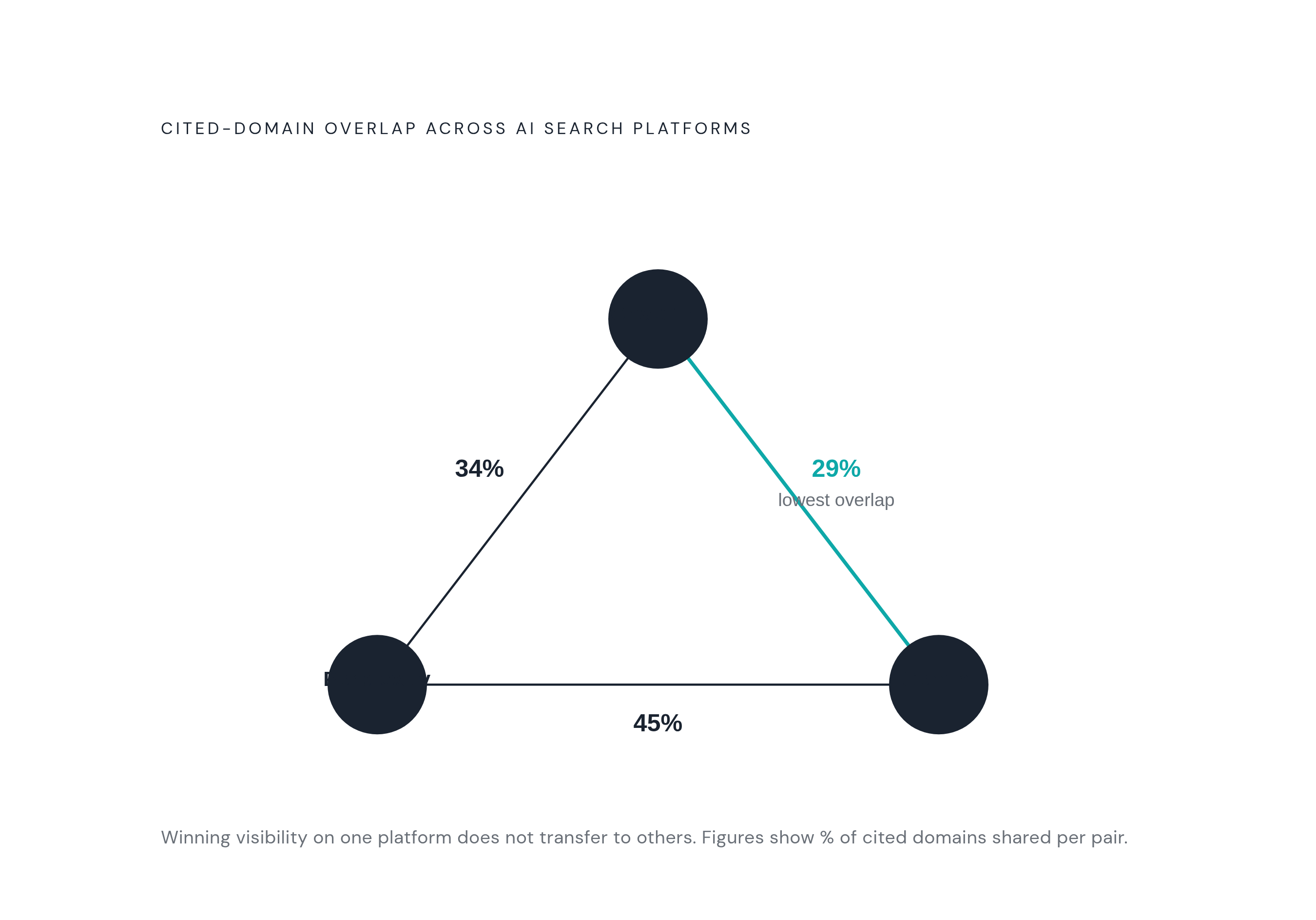
Each platform weighs these signals differently, and the differences are wide enough to matter. Perplexity leans hard on recency and citation density inside the content itself: 46.7% of its top sources come from Reddit, with a strong preference for material published within the last 90 days. Google AI Overviews leans on existing organic performance and the E-E-A-T signals search has rewarded for years. ChatGPT's SearchGPT favors domain authority paired with answer-first structure, and Wikipedia alone accounts for 47.9% of its top cited sources on factual questions. Overlap between platforms is thinner than most teams assume: ChatGPT and Perplexity share a cited domain only 34% of the time, Perplexity and Gemini 45%, and Gemini and ChatGPT 29%. Winning a citation on one engine doesn't transfer to the next.
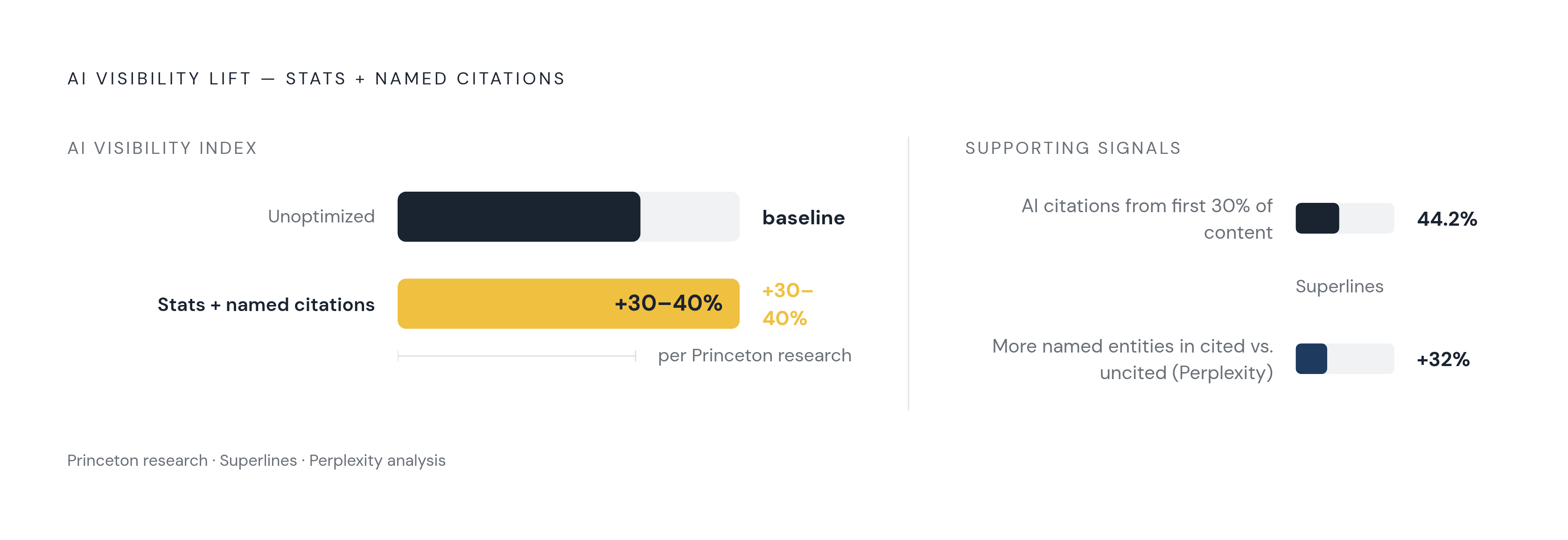
One finding anchors the rest of this argument. Content with verifiable statistics and named citations achieves 30 to 40% higher AI visibility than unoptimized content, per research out of Princeton. That's the single most tested lever in this practice, and it settles a debate that shouldn't still be open: this was never about stuffing in keywords. It's about giving the reranker something it can verify.
Why the existing archive is the right place to start, not new content
Half of the content cited in AI answers is less than 13 weeks old, per Frase's GEO guide. Read that as an argument for constant publishing and it leads you astray. Read it correctly and it's an argument for updating what's already live: a refreshed post with a new "Last Updated" date competes on the same recency terms as something written yesterday, but it arrives with domain authority and inbound links a brand-new post doesn't have.
Content decay is the term worth sitting with. A 2026 AI content audit framework frames the real work ahead as identifying posts that have quietly lost citation potential as their information aged out, not producing fresh material to pile on top of them. And weak posts don't sit neutrally in the archive doing nothing. Practitioner analysis suggests that sites mixing high-quality and low-quality content tend to get passed over entirely, because AI systems can't cleanly separate the trustworthy pages from the rest. Consolidating or removing the weak posts can lift citation rates on the good ones without a single new article getting written.
NerdWallet makes the commercial case plainly: the company saw 35% revenue growth despite a 20% drop in site traffic, because its content and brand expertise kept reaching users through snippets and AI channels even as fewer people clicked through. That's the priority order worth committing to: fix the archive first, and let content expansion wait.
How to triage the archive: deciding which posts to keep, rewrite, or remove
Every post falls into one of four buckets, a model confirmed across multiple practitioner frameworks. Posts scoring 7 or above across quality dimensions get kept, with a light optimization pass every three to six months: refreshed dates, updated stats, new internal links, sharper E-E-A-T signals. Posts in the middle get rewritten, and that's the bulk of the structural work covered next. Posts below the threshold get deleted or consolidated into a stronger piece, not patched. Spending a rewrite cycle on a post that belongs in the bottom tier is wasted labor, full stop.
Citation gap analysis belongs in this audit too: checking where AI engines currently cite competitors on questions a brand should own itself, then flagging those topics as high-upside rewrite targets.
None of this matters if the content can't be crawled in the first place, and this is the step teams skip most often. Robots.txt has to allow GPTBot, ClaudeBot, PerplexityBot, and Google-Extended. Crawlers need the full article text, not a teaser paragraph behind a "read more" link. Paywalls and aggressive pop-up interstitials block AI systems just as effectively as they annoy a human reader, and a team that skips this check has made every other optimization invisible.
Conductor's 2024 SEO report found that 67% of marketers have no visibility into how AI systems reference their content. That's exactly why measurement gets built into the audit itself, not bolted on afterward. What comes out the other end is a prioritized queue of posts ready for structural rework, which is where the real editorial labor starts.
The structural changes that make a post extractable
Every H2 section needs to open with its answer, not build toward one. This is BLUF, bottom line up front: the first sentence under any heading should stand alone as a citation without needing the paragraph above it for context. Superlines' analysis of AI citation patterns found that 44.2% of citations come from the first 30% of a piece of content. Front-loading the answer isn't a style preference, it's a direct response to where these systems pull from.
Each relevant section should open with a direct-answer block, a complete, self-contained answer running 40 to 60 words, since that's the format AI engines lift most reliably. At the top of the post, a short TL;DR gives the whole piece a clean, quotable version of itself an engine can attribute without digging.
Headings carry more weight than most editorial teams give them credit for. They should mirror how someone would actually phrase a question out loud, not the internal shorthand a content calendar runs on. Paired with the section's opening sentence, each heading should function as a standalone question-and-answer unit.
Density matters too, and it varies by platform. Cited content on Perplexity contains 32% more explicit concepts, named entities, defined terms, and specific claims than content that goes uncited. That's the same lever the Princeton-led KDD study measured: retrofitting old sections with real numbers and named sources can lift AI visibility by close to 40%. Structure has to be machine-readable on top of that. FAQ blocks, numbered steps, comparison tables with clear column headers, these give an AI engine a container it can lift cleanly instead of a wall of prose it has to interpret first. That gap matters more by the month, as agentic tools like OpenAI's Operator, launched in January 2025, push search toward completing tasks rather than just answering questions.
Keeping the post current enough to survive recency filters
Google AI Overviews and other retrieval systems weight recent content heavily on time-sensitive queries. A visible "Last Updated" date, current-year statistics, and fresh examples all beat an evergreen post that hasn't been touched in years, particularly on any topic that moves fast.
Perplexity searches the live web in real time, and a well-optimized update can show up in citations within hours or days of going live. Most businesses see improved citation rates within weeks of an optimization pass.
The edits themselves are unglamorous but specific. Swap outdated statistics for the most current figures available and update the year attribution. Add a visible last-updated date with a short note on what changed. Replace stale case examples with current-year ones, and add structured metadata like timestamps and revision histories so a crawler can detect recency without guessing at it.
Recency is the one lever here that never finishes. Cornerstone posts need a standing review schedule, not a single pass marked complete and shelved. For agencies running this across client accounts, that maintenance cadence is a core part of the strategy. It's a deliverable with its own line item.
Building the off-page authority signals that on-page edits alone cannot create
On-page rewrites only solve half the problem, and treating them as the whole solution is the most common mistake in this practice. Research found that roughly 85% of brand mentions inside AI search results come from third-party pages, not from anything the brand publishes itself. Omnibound's GEO statistics put the earned-media share of AI citations at 82%. Digital PR, contributed articles, and forum presence aren't a layer added on top of GEO. They're one of its primary inputs, arguably the primary one.
Consensus is the operating mechanism behind all of it. A brand needs consistent, aligned mentions across Reddit discussions, YouTube content, trade publications, and review sites like G2, all saying roughly the same thing about what the brand does and who it serves. Inconsistent positioning across those sources actively suppresses the confidence score an AI engine applies before it's willing to cite the brand at all.
Zero-click search grew from 56% to 69% in a single year following the rollout of AI Overviews, per Similarweb's July 2025 data. Most brand exposure now happens without anyone visiting the owned site, which makes third-party consistency more important than it used to be, not less. E-E-A-T signals on owned content, transparent author bios, clear sourcing, regular updates, reinforce what third-party mentions establish, but they don't replace them. On-page work is necessary. It is not, on its own, sufficient.
What AI visibility actually looks like as a business outcome
Getting cited in an AI answer is a conversion event now, even when no click ever happens. A user absorbs a brand's statistics, positioning, and messaging directly from the answer, according to Frase's GEO guide, and that impression forms without a single site visit.
In B2B specifically, G2's The Answer Economy report found that 51% of B2B software buyers now start research in an AI chatbot more often than in Google, and Forrester reports that 89% of B2B buyers have folded generative AI into their self-guided research process. When AI-driven traffic does convert, it converts differently: B2B sites report these visitors are 4.4 times more valuable than traditional SEO traffic. Fewer visitors, sharper intent, a trade most teams would take if they understood it was on offer.
NerdWallet's reported outcome, 35% revenue growth alongside a 20% drop in raw traffic, remains the clearest illustration of what this looks like in practice: brand value delivered through a channel that never registers as a session in a traffic report.
The measurement gap is the defining problem heading into 2026. Available research shows 54% of teams plan GEO initiatives while only 23% actually measure them, and Conductor's 2024 report found that 67% of marketers can't see how AI systems reference their content in the first place. Clicks and rankings don't capture any of this. Teams need new KPIs instead: AI visibility rate, citation rate across platforms, share of voice inside AI-generated answers, and the sentiment attached to how a brand gets described when it is mentioned. Tracking AI crawler activity surfaces data a tool like GA4 was never built to capture, and it's often the only way to prove any of this work is doing something.
How agencies can run this process across a client portfolio without losing consistency
Each client blog needs its own audit, its own disposition triage, its own rewrite queue, its own freshness schedule, and its own citation tracking. Running all of that by hand across a full roster of accounts is where quality slips and reporting gaps open up, and it happens faster than most account teams expect.
Account teams need real fluency in AI visibility, not a checklist handed down from someone else. That fluency is becoming a condition of keeping the account, not a value-add layered on top of it, as AI search moves from curiosity to the client's central concern.
The gap between the 54% of teams planning GEO work and the 23% actually measuring it means most clients have no baseline at all right now. The agency that builds that baseline first is the one that ends up controlling the story about what's working and what isn't, and that positioning is worth more than any single tactic in this piece.
Reporting has to cover four things at minimum: AI citation share of voice broken out across ChatGPT, Perplexity, Gemini, and Google AI Overviews; sentiment trends inside AI-generated brand mentions; measurable progress against the rewrite queue that came out of the content audit; and third-party mention coverage tracked alongside the on-page work, since one without the other tells only half the story.
Sources
- What is Generative Engine Optimization (GEO)? 2026 Guide | Frase
- What is Generative Engine Optimization (GEO)? Guide for 2025
- 10-step framework for generative engine optimization [2025 guide]
- Generative Engine Optimization: The Complete 2026 Guide | Similarweb
- Generative Engine Optimization Statistics (2026): 60+ Data Points on AI Citations, Brand Visibility, and Content Performance
- How AI Chooses Trusted Sources for Answers - ZipTie.ai - AI Search Intelligence
- demandlocal.com
- cxl.com


