Long-Form Content vs Concise Answers for AI Engine Preference
AI engines cite passages, not pages, so section structure beats word count.

AI engines don't cite web pages. They cite passages: fragments of text pulled out of a page and stitched into an answer. That fact should have ended the long-form-versus-short-form debate that's dragged on for two years now, because the real question was never how long a page should be. It's whether one section of it delivers a complete answer in something like 100 to 200 words, and most teams are still optimizing for the wrong unit.
Old-school SEO logic said length signals authority. Write several thousand words on a topic and Google reads that as coverage, as depth, as a page that deserves to rank. That logic held for a decade of blue-link search. It stops holding the moment the retrieval unit stops being a ranked page and starts being an extracted chunk of one. Word count as a proxy for quality is dead, and clinging to it is costing pages their citations right now.
What the data actually shows about length and citation across different engines
Ahrefs looked at 174,048 pages and more than a million cited URLs and found the correlation between word count and the odds of getting cited in an AI Overview sits at roughly 0.04. That's functionally zero. Over half of all AI Overview citations, 53.4%, go to pages under a thousand words. The page holding the top citation slot averages around 1,270 words, while positions four through ten run slightly longer, somewhat longer. The direction cuts against the old assumption: the top slot doesn't reward the sprawling page. If anything, it leans tighter.
ChatGPT looks like the exception, at first glance. SE Ranking's study of tens of thousands of domains found pages over a few thousand words picked up substantially more ChatGPT citations than pages under 800 words. Read alone, that's a clean case for going long. But the same study buries the finding that actually explains it: pages built with 120 to 180 words between each H2 or H3 got 70% more citations than pages with thin sections under 50 words. Section size beat page size. A long page doesn't win because it's long. It wins because length, done properly, means more well-built, self-contained sections for the model to grab onto.
DEJAN's research into how Google grounds its answers backs this up from another angle. The model works with something like a 2,000-word budget per query, pulled across every source it touches, and the snippets it extracts average just 15.5 words apiece. That's not a document being read. That's a fragment being lifted, and the rest of the page might as well not exist for that query.
None of this makes length irrelevant. If every competing page on a topic runs several thousand words and a client's page sits at a few hundred, that's a weak authority signal no matter what the citation data says about passage extraction. But length doesn't drive citation directly, and treating it like it does is the mistake worth naming plainly. It's a proxy, and a shaky one at that.
How query intent determines which format earns the citation
Not every query wants the same shape of answer. That's the piece the length debate keeps skipping past, and it's where most content briefs get intent backwards.
Navigational and definitional searches want concision, full stop. Someone asking "what is a debt-to-income ratio" wants a clean definition, not three paragraphs of preamble before the definition shows up. Bury the answer under an introduction and the engine just finds a cleaner one somewhere else on the web.
FAQ-style searches reward the same instinct. Question-and-answer formatting maps directly onto how people actually search, so a model can identify the matching question, lift the answer beneath it, and move on. Short, answer-first blocks win here, and no amount of narrative writing makes up for the structural disadvantage of burying the answer in prose.
Local and transactional intent works the same way: someone wants a price, a comparison, a straight recommendation, and long narrative prose gets in the way of that rather than helping it.
Complex, decision-heavy queries flip the script. A buyer comparing enterprise software platforms, or working through a multi-step technical process, has several sub-questions bundled into one search. That's where a long-form page earns its length, not because the whole page gets cited at once, but because each section becomes its own separately citable passage. Depth here means covering every sub-question a serious researcher would ask next, not padding the prose.
So the rule is blunt: if the honest answer fits in a few hundred words, stretching it to several times that length doesn't help. It just buries the passage the engine came for under filler. If the topic has real, remaining sub-questions, those questions earn more sections. Nothing else does. Any brief padding for a word count target is working against the retrieval mechanism, not with it.
The answer island: what a citable passage actually looks like structurally
Call it an answer island: a self-contained block, typically 100 to 200 words, that fully resolves one specific question without asking the reader to dig up context from three paragraphs above it. SE Ranking's data puts the sweet spot at roughly 120 to 180 words per H2 or H3, which lines up almost exactly with the length of a well-built AI Overview snippet.
A handful of structural traits show up again and again in passages that get extracted. They open with the answer, not a warm-up sentence. One idea per section, and the heading names that idea plainly enough for a model to match it straight to the query. The passage stands alone: a reader landing on just this one block, nothing above or below it, still walks away with a full answer. Paragraphs stay short. Bullet points or numbered steps show up only where there's a genuine sequence to enumerate, not as decoration.
What kills extractability is just as clear. Burying the answer three paragraphs deep kills it. So does writing a section that only makes sense if the reader already read the section before it, or a heading that names a topic ("Pricing Considerations") instead of answering a question ("How Much Does X Cost"). Generic filler sentences dilute the one specific claim the model was hunting for, and that dilution is often the real reason a well-researched page gets skipped in favor of a thinner, cleaner competitor.
Speakable schema markup reinforces this at the code level. It flags the specific section of a page best suited for extraction, giving platforms a direct signal about which passage answers the target query.
The hybrid architecture that serves both AI retrieval and human depth
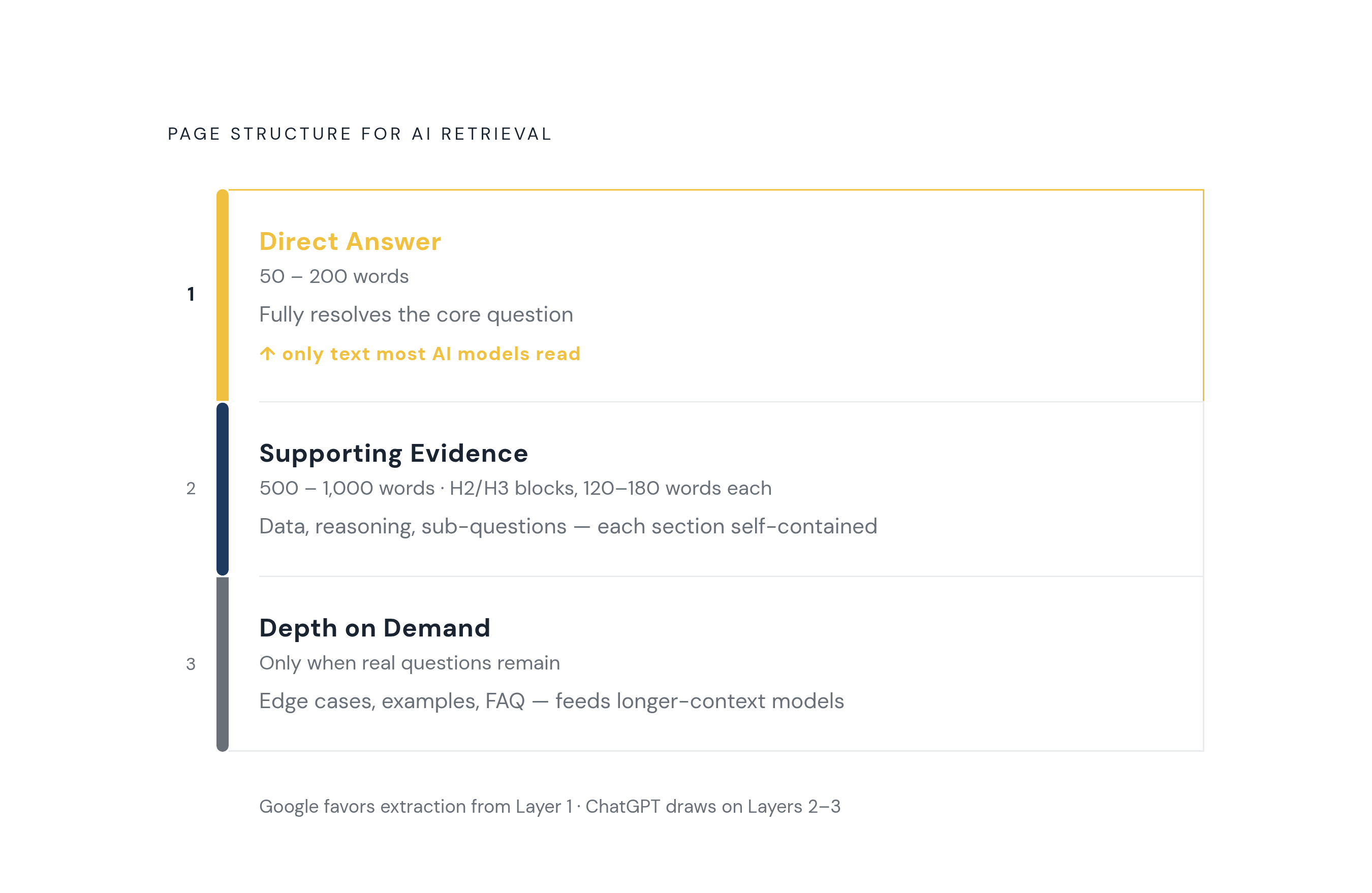
Forget "write short" or "write long." Build long-form content with short-form extraction points embedded inside it: long where the topic demands it, structured in short, self-contained blocks throughout, with no section allowed to depend on the one before it.
Picture three layers stacked on top of each other. Layer one is the direct answer, somewhere between 50 and 200 words, sitting right at the top of the page and fully resolving the core question before anything else happens. This is the block Google's extraction tends to favor. Write it as though it's the only text an AI model will ever read, because often it is exactly that.
Layer two is supporting evidence, roughly 500 to 1,000 words: the data, the reasoning, the sub-questions a serious reader raises right after getting the initial answer. Every H2 or H3 in this layer gets held to that same 120 to 180 word band, each one self-contained, each one quotable on its own.
Layer three is depth on demand: edge cases, worked examples, an FAQ block. This layer shows up only when the topic has actually earned it, when real remaining questions exist, never because a word count target says the page needs another 500 words. This layer feeds ChatGPT's appetite for longer, denser pages, and it's also the layer a human buyer works through while validating a serious purchase decision before committing.
A simple definition page stops after layer one. A how-to guide usually stops after layer two. A comparison page or a pillar page runs all three, because comparison intent genuinely spans definitional, procedural, and edge-case questions at once. Length becomes an output of how complex the topic actually is, not a target an editor sets before a word gets written.
Rough targets, grounded in the citation data above: a simple how-to sits around 600 to 1,000 words with clear numbered steps. A complex how-to guide runs several hundred to a few thousand words, covering steps, edge cases, and FAQ. A service page stays lean, 400 to 800 words, answering objections directly instead of dancing around them. A comparison or pillar page runs the full three-layer structure, with each search intent served by its own self-contained section.
The average AI Overview citation, per Ahrefs, lands around 1,282 words. That number isn't a target, and treating it like one misses the point. It's a byproduct: pages that length tend to have accumulated at least one well-built, extractable passage somewhere inside them. Chase the passage, and the length takes care of itself.
Why AI citation matters commercially: the stakes that make this structural work worth doing
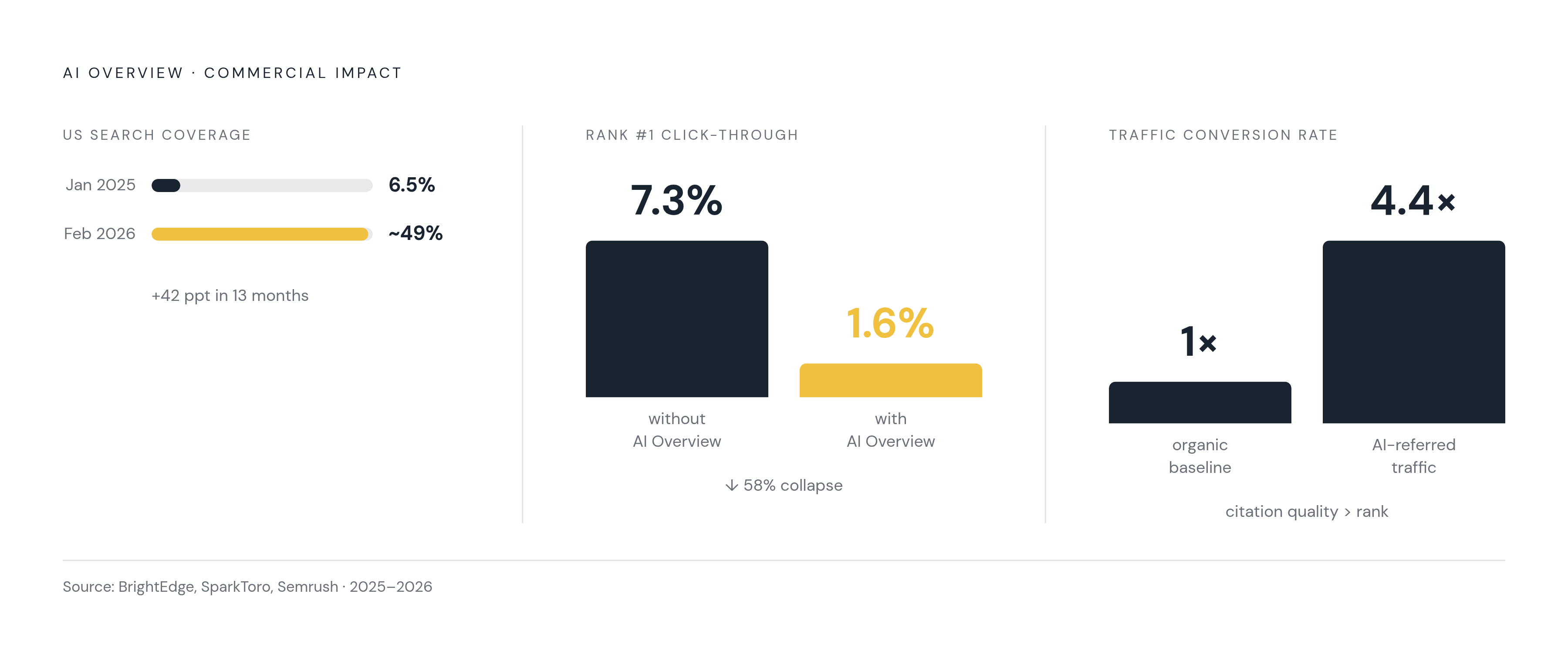
AI Overviews now show up on somewhere around 48 to 50% of all US Google searches, per BrightEdge and Generative Parser data reported in February 2026. That's up from 6.49% in January 2025, roughly an eightfold jump in a little over a year, and it means the passage-versus-page argument isn't theoretical anymore. It's the default search experience for half the country.
Ahrefs' review of 300,000 keywords found that where an AI Overview appears, click-through for the page ranking first can drop by up to 58%, from 7.3% down to 1.6%. Rank one and get almost nothing is now the normal outcome on a huge share of queries, not a fluke. The overlap between top-10 Google rankings and AI Overview citations makes the same point from a different angle: it fell from around 75% in mid-2025 to somewhere between 17% and 38% by early 2026. Ranking well no longer guarantees a seat in the answer, and any strategy still chasing rank one as the finish line is optimizing for a prize that's shrinking underneath it.
Getting cited flips the outcome. Brands that land inside an AI Overview see organic click-through rise 35% and paid click-through rise 91% compared to brands that don't get cited, and AI-referred traffic converts 4.4 times better than standard organic traffic. Some high-traffic content brands lost an estimated 70 to 80% of their organic traffic between late 2024 and mid-2025, a concrete case of what happens when a content strategy doesn't adapt fast enough. A Series A fintech startup running a structured GEO program moved the other direction, growing AI visibility from 2.4% to 12.9% in 92 days, with 20% of its demo requests reportedly influenced by AI search along the way. Same underlying mechanism, opposite outcome, depending on whether the content got built for extraction or just built for ranking.
How agencies apply passage-level content architecture across a client portfolio
Auditing one brand's content for passage-level structure is manageable. Doing it across twenty or thirty clients at once, on an ongoing basis, is a different problem, and it's the one agencies are running into right now, mostly without the tooling to match.
The operational work is short to describe but demanding to run. Audit each client's existing pages for extractable passage quality and self-containment, not word count. Map each client's target queries to intent type (definitional, FAQ, comparison, complex how-to) and prescribe the layer architecture that fits. Track which client pages get cited in AI Overviews, ChatGPT, and Perplexity, since citation patterns shift every time an engine changes how it retrieves and ranks passages. Then report it back in language clients can act on: presence inside AI-generated answers on the queries that actually drive revenue, not raw ranking positions that no longer tell the whole story.
The gap that trips agencies up isn't technical. It's about people. An account manager who can't explain why passage-level structure matters can't sell the strategy, and can't defend the spend to a client when results take a few months to surface. Training account teams to speak fluently about GEO and AEO mechanics is a baseline requirement for agency credibility now, not a nice-to-have layered on top of the real work.
Thrad for Agencies is built around this operating model directly: one workspace to manage AI visibility across an entire client roster, with cumulative analytics that roll performance up across every client, per-client exports built for client reporting, and an enablement process aimed at getting account teams fluent in AI visibility conversations. Billing flexes centralized or per-client, matching whatever commercial structure an agency already runs, instead of forcing every agency into the same arrangement.
The wider agency landscape, with AI-native shops like Monks, NoGood, Siege Media, and Avenue Z among the names pushing this shift, is moving toward exactly this kind of operation. Firms that bake passage-level architecture into their standard offering, and that can show AI citation performance in a client report rather than just a ranking chart, are positioning themselves as the credible authority in this space. Everyone else is just passing through a login, still reporting rank-one wins on queries where rank one barely gets clicked at all.
Structure is the starting point. Applying it consistently across a portfolio, tracking whether it's working, and giving account teams the language to explain why it matters: that's the harder problem, and it's the one that separates an agency running this well from one just repeating the term "GEO" in a pitch deck.


