Internal Linking Architecture for AI Crawl Prioritization
Link structure now determines whether AI systems cite your content or leave it invisible.

Ranking used to mean traffic. Now a page can sit at the top of Google, get quoted inside an AI answer, and never see a single click. Internal linking architecture, the structural choices a site makes about click depth, hub-and-spoke clustering, and anchor text, has become the mechanism that decides whether a page gets pulled into that answer or left behind in the index, unseen and unused.
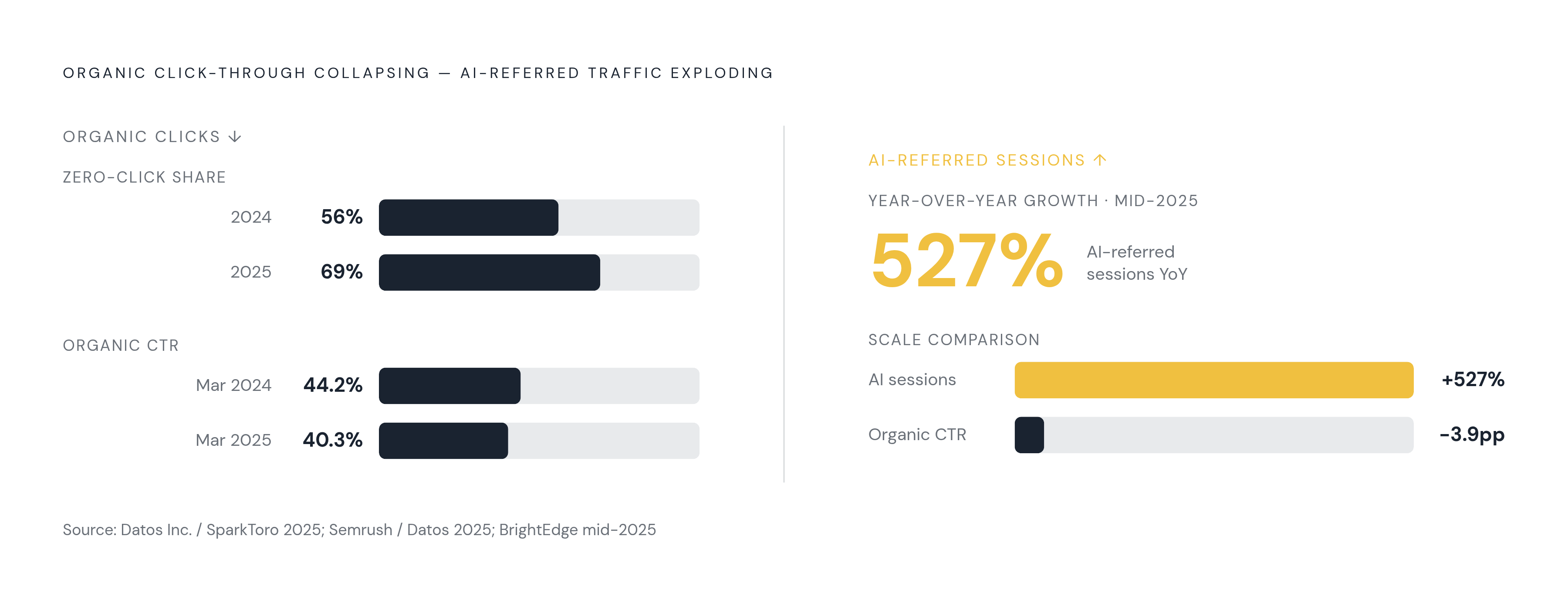
The numbers explain why this matters now. Zero-click searches climbed from 56% in 2024 to roughly 69% in 2025, meaning most searches now end without a visit to any site at all. By March 2025, only 40.3% of Google searchers clicked an organic result, down from 44.2% a year earlier. At the same time, AI-referred sessions to websites grew 527% year over year through mid-2025, and ChatGPT alone now handles over 2.5 billion queries a day. Traffic is shrinking on one side of the ledger and growing fast on the other. Internal linking now has to do two jobs at once: guide a person toward a purchase or a signup, and tell a machine how a site's ideas connect to each other. AI systems don't browse a site the way a person does. They pull out fragments of it, and what gets pulled is shaped entirely by the structural signals already built into the pages long before anyone types a prompt.
The two families of AI crawler your robots.txt must treat differently
Not every AI bot hitting a server does the same job, and treating them as one undifferentiated mass is the single most common mistake in this space.
Training crawlers, GPTBot and ClaudeBot among them, feed the datasets used to build future model versions. They crawl in bulk, without urgency, and they respect robots.txt strictly. Block them, and a site's content simply never becomes part of what the next generation of models learns from.
Real-time search crawlers are a different animal. OAI-SearchBot, PerplexityBot, and Claude-SearchBot index continuously to power live AI search results, while a separate set, Perplexity-User and Claude-User among them, fetch pages on demand when an actual person asks a question. Block these, and visibility in ChatGPT Search or Perplexity results drops sharply, though blocking these crawlers can reduce the depth of a site's visibility in those results.
GPTBot and OAI-SearchBot are not the same directive. Blocking one in robots.txt does nothing to stop the other, and plenty of sites find this out only after visibility disappears. On many enterprise domains in 2026, AI crawler traffic represents a growing share of total bot traffic, and that share keeps climbing. AI search visits have grown substantially year over year, a trend documented across multiple industry trackers. A brand with a misconfigured robots.txt file is quietly opting out of a channel expanding at that pace, usually without realizing it.
Before writing a single new directive, pull the user agents actually showing up in server logs. Figure out which crawlers are present and which family each one belongs to. A blanket block, applied through robots.txt or a Cloudflare rule set, takes five minutes to write and months to notice the damage from.
Once a crawler can reach a site, the next question is what it finds once it gets there, and how much weight it assigns to what it finds.
How click depth determines whether a page enters AI retrieval or disappears into indexed-but-invisible inventory
Click depth is the number of clicks needed to get from the homepage to a given URL. It sounds like a minor technical detail. Treating it that way is where most architecture reviews go wrong.
Crawl frequency drops off sharply as depth increases. A page that rarely gets crawled doesn't reflect current content, current structured data, or current authority signals, and AI retrieval systems can only work with what's been reliably fetched. Depth 1 through 3 tends to drive the overwhelming majority of impressions on a site, while depth 4 and beyond accounts for a disproportionate share of what sits indexed but functionally invisible, present in Google's index while never surfacing anywhere a person or a model would find it.
Rough depth targets hold up across most site types: homepage and category pages at 1 to 2 clicks, product and service pages at 2 to 3, blog posts and supporting content at 3 to 4 clicks maximum. A flat architecture, where every page sits within three clicks of the homepage, is one of the highest-leverage structural changes a team can make for both crawlability and AI citation readiness.
The failure pattern shows up constantly: a team publishes something genuinely well-researched, buries it five clicks deep in the navigation, and then wonders why nothing ever cites it. The content isn't the problem. The path to it is.
Diagnosing this doesn't take guesswork. Crawl the site, export URLs by depth, cross-reference that list against Search Console impressions. The gap between depth and performance is the to-do list.
One trap catches teams that otherwise get this right: AI crawlers don't run JavaScript the way Google does. A dropdown menu or hamburger navigation rendered client-side is often invisible to most AI crawlers entirely. Check that navigation shows up in view-source, not just in the rendered page a browser displays.
Fixing depth is necessary. It isn't enough on its own, because the links creating those shallow paths still have to carry the right signals to matter.
The three link properties that AI retrieval models actually use to assess authority and topic relevance
Traditional SEO treats internal links mainly as a way to pass authority and help pages get indexed. Generative engine optimization asks more of them: they also have to signal topical clusters and entity relationships that AI models read as evidence of expertise.
Link position is the one most templates get backwards, and it comes first. Contextual, in-body links carry more weight with AI retrieval models than anything sitting in a nav bar, sidebar, or footer, because they sit closest to the actual passages these systems process and cite. AI systems retrieve and surface specific passages, not entire pages, so a link embedded close to the relevant content is better positioned to associate with the concepts being cited than one parked in a global menu. A short, direct answer near the top of a page, close to its links, tends to get pulled forward more easily, since content appearing early in a page is typically among the first text a crawler processes.
Anchor text specificity comes second. "Click here" and "learn more" tell a model nothing about what's on the other end, and sites still ship them by the hundreds. An anchor like "AI crawlability scoring framework" or "PerplexityBot JavaScript rendering capabilities" names the concept outright. Good anchor text should make sense even stripped of its surrounding sentence: it should set an expectation and name both the entity and the intent, something closer to "compare X vs Y pricing" or "DMARC setup guide." Used consistently across a cluster of related pages, that kind of anchor text helps a model recognize a site as a coherent, authoritative source on a specific subject rather than a scattered pile of loosely related posts.
Link convergence is the third property, and the one teams underuse the most. When several pages all link to the same resource using descriptive, topically relevant anchor text, AI models read that convergence as a strong signal that the destination page is the authority on the subject. A cluster of related pages consistently pointing back to one pillar is exactly what makes that pillar the most likely candidate to get cited. A workable baseline runs 5 to 10 internal links per 2,000 words, with longer pillar content supporting more, and the real test for any single link is whether it's genuinely useful to a reader standing at that spot in the text. In practice, 3 to 10 contextual internal links per long-form page, weighted toward the pillar and its closest cluster pages, tends to hold up.
One failure mode deserves naming directly: when the bulk of internal links point at a small handful of pages, everything else on the site starves for the authority signal it needs. A healthy site spreads links wide, not narrow, and most sites still get this backwards by piling links onto whatever page already ranks well.
These three properties compound when they're organized on purpose, and the structure that organizes them best is hub-and-spoke.
How hub-and-spoke clustering concentrates topical authority in the pages AI systems retrieve and cite
The model itself is simple. One pillar page covers a broad topic and links out to a set of detailed cluster pages, which link back to the pillar and sideways to each other where relevant.
A blog category is not a cluster, and confusing the two costs sites real visibility. A category is a filter applied to a list of posts, built for a person scrolling through a navigation menu. A cluster is a hub-and-spoke structure with one canonical pillar URL, deliberate internal linking, and a defined scope, built to concentrate authority signals for a machine reading the site's structure.
A strong pillar page covers definitions, why the topic matters, the key concepts, a practical overview, and the strategic framework, without going deep on every subtopic. That depth belongs to the cluster pages underneath it. Pillar pages typically run 3,000 to 5,000 words, and each one should carry somewhere between 15 and 30 internal links, with supporting posts linking up to the pillar, across to related spokes, and down into more specific subtopics.
The reason this matters to AI systems specifically comes down to how they process a question. ChatGPT, Perplexity, Gemini, and Google's AI Overviews break a single query into multiple retrieval sub-queries, typically generating multiple fan-out variations per prompt, then look for sources that address the topic consistently across all of them. A well-linked cluster signals exactly that consistency. AI search engines increasingly judge sources at the brand level rather than scoring one page in isolation, so depth spread across a cluster earns repeated citation in a way a single strong page rarely does on its own.
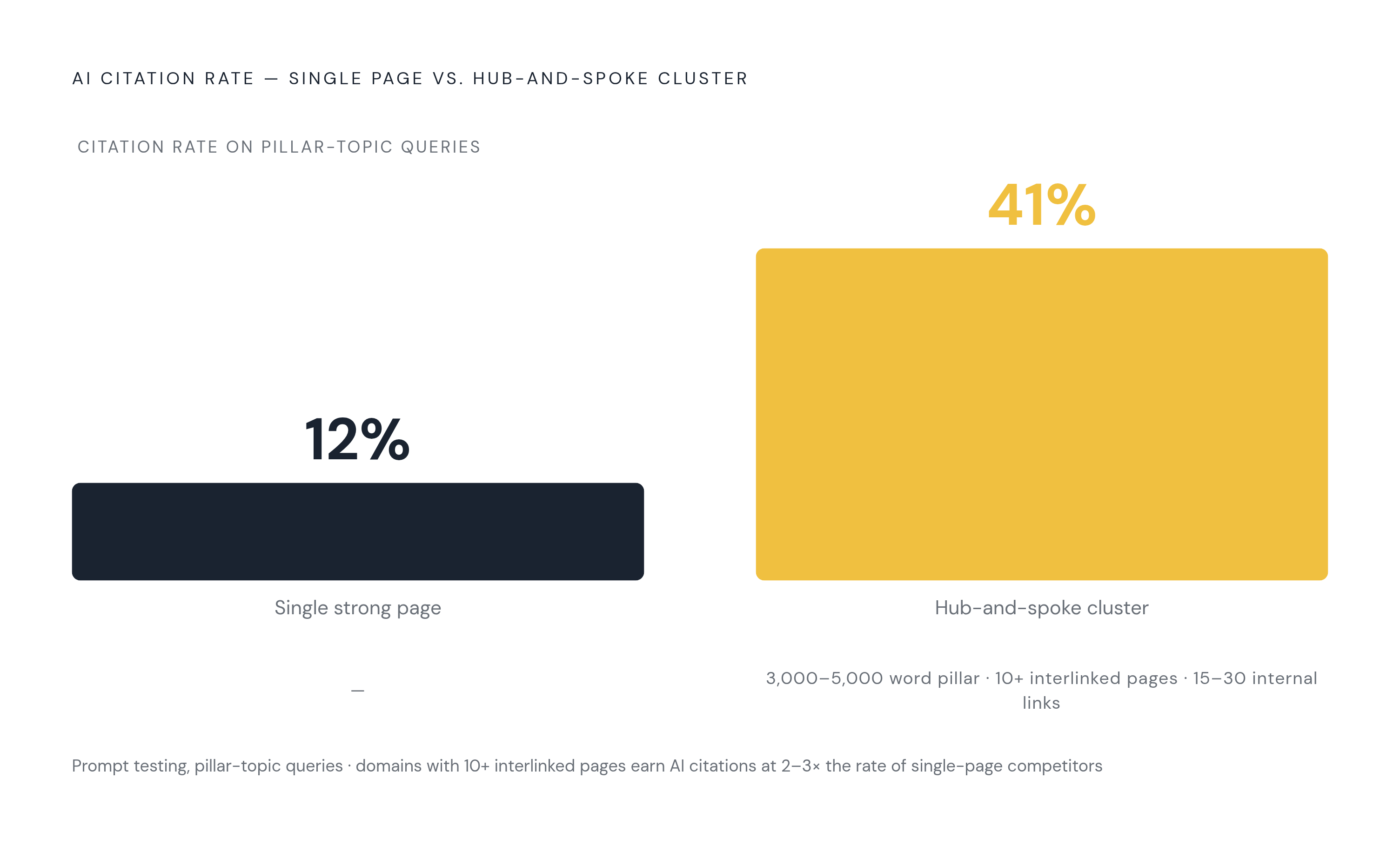
Per research published by Passion Fruit, domains with 10 or more interlinked pages on a topic cluster earn AI citations at 2 to 3 times the rate of single-page competitors. Prompt testing across multiple platforms found hub-and-spoke internal linking pushing AI citation rates from around 12% to 41% on pillar-topic queries, a gap large enough that it's hard to explain away as noise.
A double bind is worth naming directly. A brand with strong entity signals but thin topical coverage gets recognized by AI engines but rarely cited, because there's nothing substantial enough to quote. A brand with strong topical depth but weak entity signals produces genuinely citable content that gets stripped of attribution once the answer gets synthesized. Both halves have to hold at once, or the work on one side gets wasted.
Author entity signals reinforce all of this over time. A consistent byline from a small set of named experts builds an expertise signal that a rotating cast of contributors never does, because the message to an AI system is specific: this person, on this topic, has produced a large body of in-depth work.
Knowing the right structure is one problem. Auditing what already exists on a live site, and changing it without breaking what's already working, is a separate and harder one.
Pre-deployment evaluation of internal link changes using graph-based analysis
Link changes redistribute authority across a site and alter its semantic coherence in ways that are genuinely hard to isolate once they've gone live. Evaluating them after deployment is noisy, because the changes interact with content updates, external links, crawler behavior, and ranking-system updates, all happening at once.
Research from WebKnoGraph (arXiv:2606.06106, published June 2026 by researchers at the Technical University of Munich and Ss. Cyril and Methodius University) built an open-source framework for testing internal linking strategies before they ship. The study used a production crawl of Kalicube.com from the second quarter of 2025, roughly 2,000 English pages, with 1,841 incorporated into the final site graph after URL normalization and parsing. The method models a site as a directed graph, represents each page with an embedding, scores candidate links using GraphSAGE, and evaluates proposed changes by placing the site inside larger host environments to see how it behaves.
The finding worth sitting with: automatic link selection generally produced stronger authority redistribution, what the paper calls Authority Yield, but at a real cost to semantic coherence. Expert-assisted selection preserved coherence better, and when experts specifically targeted low-authority pages, it hit the highest Authority Yield of any method tested. Neither automation nor human judgment alone won outright, and pretending one does is the mistake to avoid. In practice, generate candidate link changes at scale, score them jointly across authority gain, volatility, the balance of gains against losses, and semantic coherence, and only then hand the results to an editor for a final call before anything goes live.
Most teams don't have a graph neural network pipeline sitting around, and don't need one to apply the same logic at a smaller scale: audit the highest-value URLs first, model the proposed change, and check whether the new anchor text actually fits the surrounding content before publishing anything.
The March 2026 Google Core Update reinforced the importance of structural quality from a different angle entirely, continuing a broader shift toward rewarding depth and coherence over keyword targeting alone. Internal linking architecture is one of the clearest signals of that coherence a site can produce.
With an evaluation framework in place, the remaining piece is making sure crawlers actually reach the priority pages often enough to keep them current.
Eliminating crawl waste so AI systems fetch priority pages more frequently
Crawl budget is finite. Every URL sitting in the fetch queue that doesn't need to be there is displacing a re-crawl of a page that does.
Budget usually drains in predictable places: faceted navigation throwing off large numbers of near-identical parameter URLs, dev or staging paths that were never blocked, thin paginated archives nobody reads past page two, and duplicate content that was never properly canonicalized. None of this tends to be intentional. It piles up quietly over years of site changes, and a crawler has no way to tell deliberate architecture apart from leftover technical debt.
The fix is unglamorous but effective. Use robots.txt to block what genuinely doesn't need crawling, submit XML sitemaps that surface only canonical, indexable URLs, and consolidate duplicates with proper canonical tags. The goal is a shorter, cleaner fetch queue where the pages that matter get crawled and refreshed often enough that AI retrieval indexes reflect what's actually on the page right now, not a stale version from months back.
Orphaned pages, ones with no internal links pointing to them at all, get crawled less often and risk falling out of AI retrieval systems entirely. Auditing for orphans regularly is a core task, part of the same crawl budget discipline as blocking junk URLs. Hub pages and breadcrumbs do complementary work here: hub pages compress depth and concentrate authority where it belongs, while breadcrumbs create a second, stable linking layer that reinforces the site's hierarchy across every template without requiring an editor to manually link every single page.
With the architecture sound and the waste cleared out, the last question is whether any of it actually shows up where it's supposed to.
Measuring AI citation readiness across a portfolio of clients or brands
Most teams can report rankings and traffic without much trouble. Very few have instrumented AI citation coverage as something they track at all, and that gap is exactly what makes it hard to prove the value of architecture work to anyone holding the budget.
A few things are worth tracking directly. AIO citation presence tracks which target queries return an AI-generated answer, and which of those answers actually cite the pages in question. Depth distribution comes from a crawl export segmented by depth, cross-referenced against Search Console impressions, since the gap between depth and visibility is the priority list for architecture work going forward. Orphan count, pages with zero internal links pointing to them, belongs on the dashboard as a standing metric rather than a one-off audit, since orphaned pages keep reappearing as sites grow and templates change.
Sources
- Depth, Dead Ends, and Link Overload: The Architecture Traps that Hide Good Content
- WebKnoGraph: GNN-Powered Internal Linking
- Robots.txt for AI Crawlers: GPTBot, PerplexityBot & GEO Audit | Pixis
- AI Crawlers and Access Control: Managing Bot Access for Training, Retrieval, and Search | Visively
- robots.txt for AI Crawlers in 2026: Training Bots vs Retrieval Bots
- AI Crawler List 2026: Every AI Bot, User Agent, and How to Verify Them
- quattr.com
- discoveredlabs.com


