Editorial Calendar Best Practices for B2B Content Teams
Separate your content strategy for Google search and AI answers—they require different planning.

A modern B2B editorial calendar has two jobs, earning visibility in traditional search and in AI answers. Winning one no longer guarantees winning the other. Teams need separate content tracks, clear review gates, and shared measurement that shows whether each piece is doing the job it was planned to do.
Why the two-visibility problem exists and what it costs planning teams
A piece can get fewer Google clicks and more AI citations in the same quarter. Another page might never rank in Google yet appear regularly as a source in ChatGPT. Traffic alone cannot explain that pattern. If a team reads every decline in clicks as a decline in visibility, it can overlook work that is gaining a different kind of reach.
That distinction matters more as B2B buyers turn to generative AI while deciding what to buy. AI answers are an early-stage discovery channel. Planning needs to cover more than which keywords might bring visitors to a website. It also includes which buyer questions the brand should help answer, and whether its content makes those answers easy to extract. Those are related jobs, but they are not interchangeable.
Most editorial calendars do not make that distinction visible. Their columns record a keyword, search volume, publish date, and funnel stage, while saying nothing about how readily an AI engine can extract the answer. A team can fill its schedule with commercially relevant search content without deliberately planning any work that establishes the brand’s identity or explains its relationships to a subject. The cost is systematic underinvestment in one discovery channel, even when the calendar looks full and the publishing process appears orderly.
What a dual-surface calendar actually needs to track that a standard one does not
The standard fields still have a job. Primary keyword, search volume, content type, funnel stage, owner, publish date, and status remain necessary for planning Google-focused work. A content track flag should identify whether a piece is primarily built for Google organic or AI citation. The editor can use that choice to judge the piece’s brief.
An answer extractability check should then record whether the piece gives a direct answer in its first two or three sentences, before the supporting detail. Placement is part of the design. Content that buries its conclusion is structurally disadvantaged for AI citation, even when the explanation itself is strong. An entity coverage field addresses a different concern, recording whether the piece consistently names and links to the brand’s entity record across its website, LinkedIn, directories, and Wikidata. Drift between those sources weakens the clarity of the brand’s identity.
The calendar also needs to expose responsibility and results. An AI-source flag should show whether AI tooling helped with the draft and which human review stage it needs. An AI citation KPI link should connect the entry to a measurable visibility outcome. Neither field is simply administrative. Together, they make it possible to see how a piece must be reviewed before publication and how its intended performance will be assessed afterward.
CMI’s 2026 B2B report found that spending on AI tools is rising fast. That makes these fields a practical need. As teams expand AI-assisted production, a schedule that records only output cannot show whether the necessary governance and measurement are in place. The fields encode decisions that would otherwise remain scattered through briefs, conversations, and assumptions.
Two content tracks that belong in every B2B calendar as explicitly separate slots
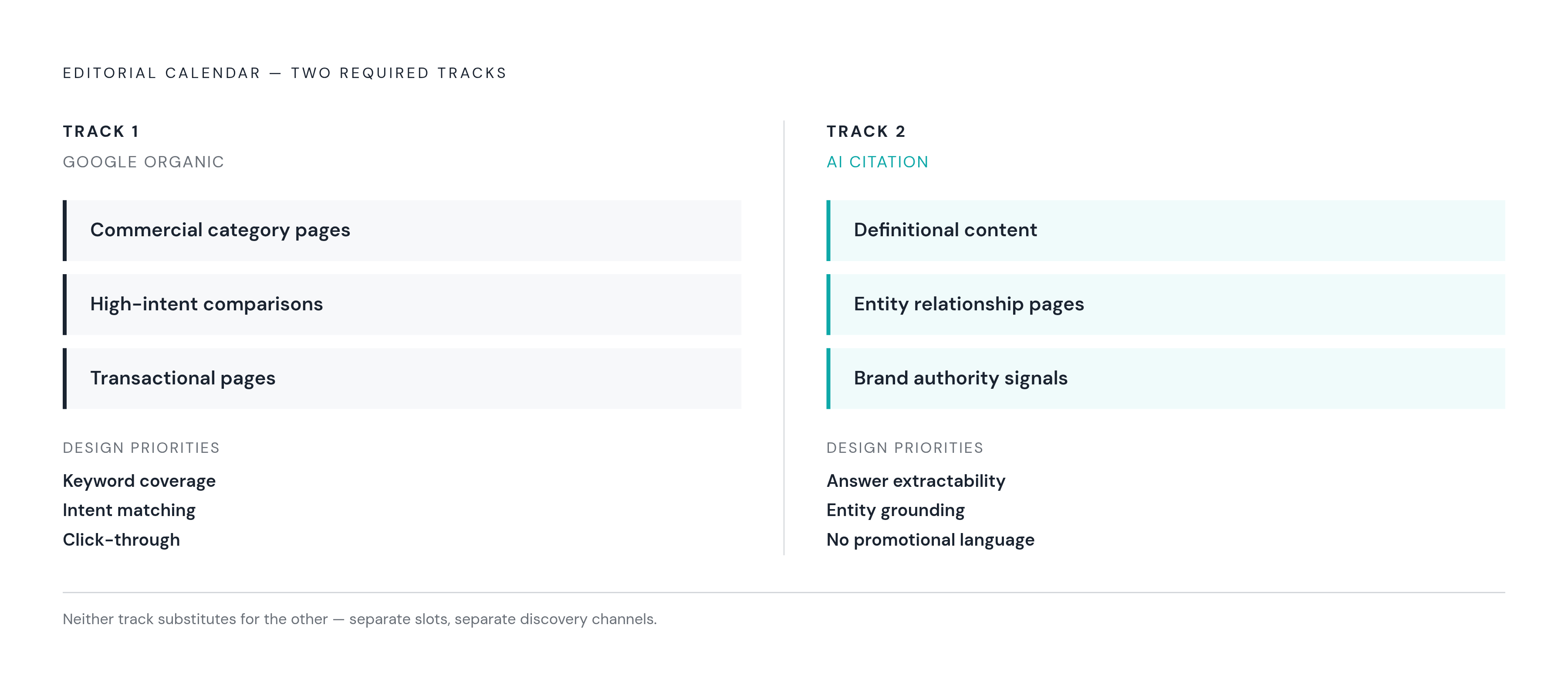
The Google-organic track should have commercial category pages, high-intent comparisons, and transactional pages. Its design centers on keyword coverage, intent matching, and click-through. These pieces serve buyers looking into a category, weighing options, or moving toward a purchase. Comparisons belong here when they answer that need factually and on the merits. Their place in the calendar follows from the buyer’s intent.
The AI-citation track has a different central task. Definitional content, entity relationship pages, and brand authority signals help AI models understand who a brand is and what it is known for. Precision takes priority over promotional language here. The design principles are deliberately strict, with no adjectives, one fact per sentence, and visible timestamps labeled Created, Updated, and Verified. A page intended to establish facts should make those facts easy to separate from each other and from the surrounding explanation.
Entity grounding also changes the planning horizon. Without a Wikidata entry, a brand is missing a key structured signal that entity recognition systems across major LLMs use, so it is less likely to be cited. Identification comes before a model can reliably cite a brand. Entity grounding through Wikidata typically takes 6–12 weeks to produce measurable citation signals, so this work belongs in the calendar’s 90-day roadmap. It cannot be treated as a last-minute addition to publication week.
Capacity is the reasonable objection to separate tracks. But separate does not mean equal in volume. A small number of well-structured AI-citation pieces can do significant grounding work when they are planned. The calendar should also have room for off-site editorial work, such as digital PR, contributed articles, and community seeding. Its value needs a different reading for AI citation, where an unlinked mention on a highly authoritative site can be more valuable than a link on a low-quality blog.
How cadence logic and topic scoring change when both surfaces are in scope
Treating the calendar as a ranked demand backlog keeps an available publishing slot from becoming the main reason to commission something. To get a simple starting score, add business value and ranking feasibility, then subtract effort. Topics that fall below the team’s threshold should be set aside until they meet it. For Google-organic work, that judgment should consider traffic potential, ranking feasibility, conversion potential, click potential, and effort to create.
The AI-citation track needs more signals because search demand alone cannot show how a piece will help it earn citations. Answer extractability asks whether a piece can be lifted cleanly into an answer. Entity coverage asks whether it strengthens or establishes recognition of the brand. Authority source potential considers whether a Tier 1 or Tier 2 publication or directory is likely to pick it up. These signals give grounding work a fair place in prioritization without pretending that it serves the same immediate goal as a transactional page.
Topic discovery should reflect that wider frame. CRM notes, customer calls, and feedback from the sales team can reveal buyer questions in words that keyword volume data misses. A question need not have an obvious search-volume opportunity to be useful in an AI answer. The team should still weigh its business value and how much work it will take to produce. The change is that keyword demand no longer gets to stand in for every kind of buyer need.
One well-researched piece per week outperforms three thin ones for both SEO and AI citation, because AI models favor authoritative, factually dense content over volume. A quarterly sprint gives teams room to review, prune, and re-prioritize without revising the calendar daily. It also fits the weeks required for structured data changes and Wikidata entries to propagate. Sequencing the two tracks within that window helps prevent immediate search opportunities from continually displacing slower entity-grounding work.
Where human review must sit in an AI-assisted production workflow
AI-led, human-checked tasks include transcription cleanup, tagging, formatting, and first-pass repurposing. Research synthesis, briefs, outlines, drafts, and optimization belong in an AI-assisted, human-owned category. Strategy, interviews, proprietary insight, legal or reputation-sensitive claims, and final sign-off remain human-led.
Within that structure, the outline is the most efficient point for editorial intervention. Before the system commits resources to generating thousands of words, a human editor should decide whether the proposed piece is worth pursuing. The editor can check whether the outline meets the buyer need the piece is meant to serve and fits its assigned content track.
Fact claims need to be pulled out and checked, and an originality check against SERP competitors should test whether the piece adds anything to what is already in the results. Structure validation and an entity coverage check address the page’s organization and consistency. Human expertise should add specific examples, edge cases, or a contrarian perspective where appropriate, followed by an E-E-A-T audit. A fluent draft is not evidence that these checks have happened.
Every AI-generated draft should remain reviewable and reversible before publication. Automation must leave room for an editor to say no. The calendar should show both the AI-source flag and the assigned review stage for every entry, even when that information is already in the production tool or has been passed along in an informal handoff. This makes the review obligation visible at the point where work is planned and tracked. Teams can work fast and do good work when the pipeline makes clear where a human must step in to make a judgment.
How to measure AI citation alongside traditional search performance in the same dashboard
The shared dashboard should keep tracking traditional search performance and show AI visibility as a separate channel. Google rankings and traffic cannot show all the results of a dual-surface plan. Nor can one AI platform stand for the rest. The overlap between domains cited by ChatGPT and those cited by Perplexity is narrow, so a result from one engine gives an incomplete picture of where the content is appearing.
Measurement also needs to separate mentions from citations. A mention names the brand in an answer, while a citation links to its content as a source. Both are useful, but they describe different outcomes. ChatGPT mentions brands significantly more often than it links to them. Citation-only tracking undercounts brand presence. Mention-only tracking creates the opposite problem by overstating the content’s authority as a source.
Five core metrics should make that distinction usable. Mention rate and citation frequency track brand presence and source use, while answer-share records what portion of relevant queries surface the brand in the answer. Sentiment and accuracy rate show how the brand is represented. Those measures should be tracked over time through a fixed prompt panel comparing ChatGPT, Perplexity, Google AI Overviews, Gemini, and Copilot.
Referral traffic is an easy place to start before spending on dedicated AI visibility tooling. GA4 can segment sessions using referral source filters where session source contains “perplexity.ai”, “chatgpt.com”, or “claude.ai”. That view shows visits. It therefore complements the prompt panel rather than replacing mention and citation measurement, and belongs beside traditional search results in the same dashboard.
The useful endpoint is a decision about the next revision. If a piece performs well in Google but earns zero AI citations, the team should inspect its answer extractability and entity coverage. The calendar’s track flag and KPI link give that diagnosis a place to go. A direct answer may need to move closer to the start, or entity information that differs across sources may need to be fixed.