Open Source Release Announcements That Drive Community Growth
Verifiable specifics and clear contribution paths convert technical quality into community momentum.
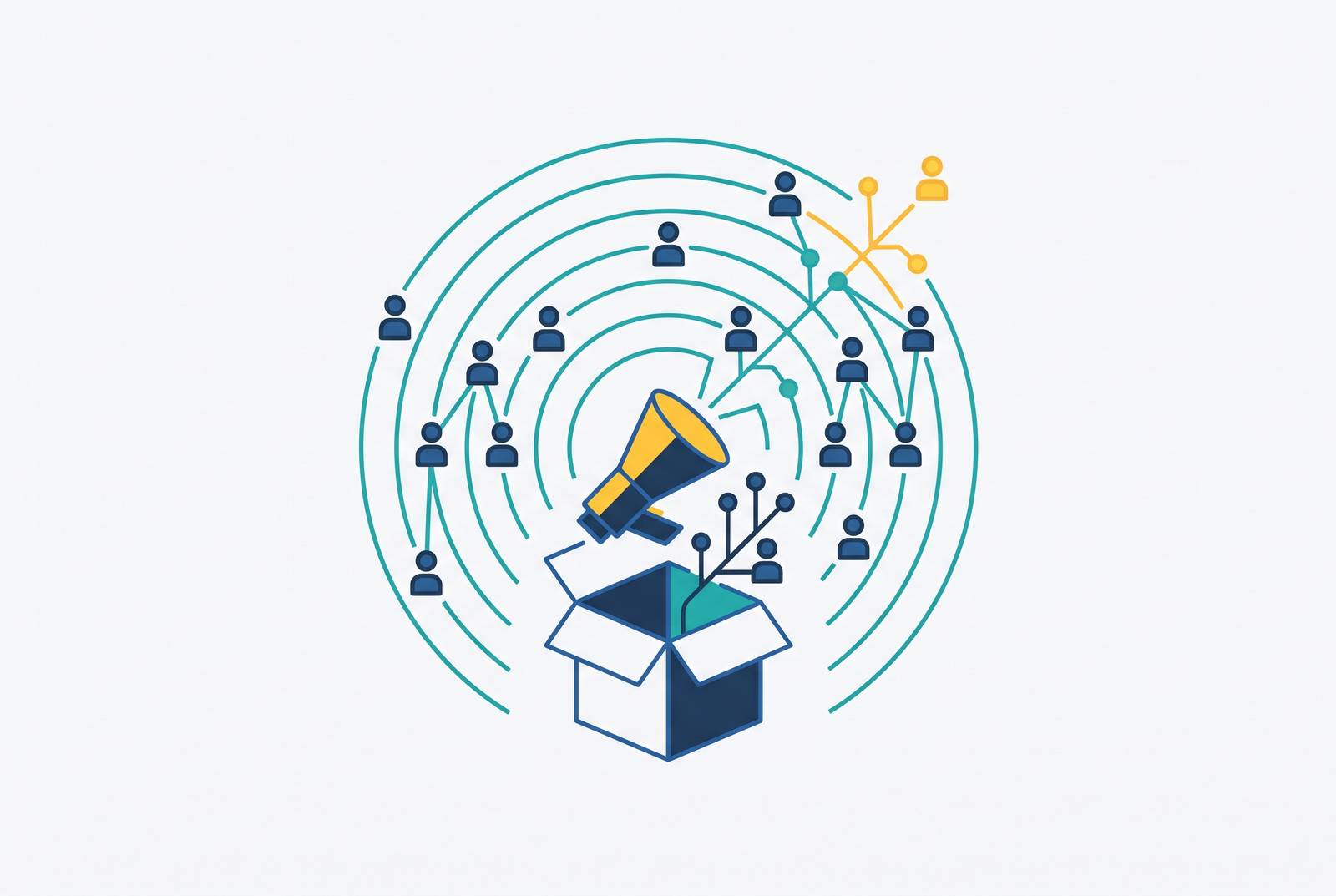
An open source release announcement can drive community growth, but only if it does more than report what shipped. It must give developers reasons to trust the work, show contributors where they can help, and offer something worth passing on. Those are distinct jobs, and the strongest announcements treat each as a design goal.
Why release announcements have become a different problem than they were five years ago
There are so many projects in the open source ecosystem that even those with good code get very different amounts of attention. Hugging Face’s Spring 2026 report describes a model ecosystem in which a tiny fraction of models account for roughly half of all downloads. An announcement competes not just for a passing look but for a place in the ecosystem from which downstream adoption can grow.
At the same time, the route to that first look is changing. AI answer engines increasingly put tools in front of developers who have not visited a project’s site or searched for its name. A citation can become a place on a shortlist. A project absent from the sources behind an answer may never enter the developer’s comparison, however good its implementation is. Release communication therefore has to work beyond the audience already waiting for the next version.
The three things a release announcement must do at once, and why most do only one
Most release announcements are built around technical credibility because that is the job closest to the engineering work. A changelog lists what changed, performance claims explain what improved, and architecture decisions show why the project was built that way. All of that belongs in the announcement. But it answers only one of a new reader’s questions, namely whether the project is serious. It does not necessarily explain where that reader could contribute or why a colleague should hear about the release.
Those other jobs often have no one clearly in charge of them. Guidance on how to contribute becomes documentation debt, left for a README or CONTRIBUTING file with no clear path to it from the announcement. Sharing is treated as luck, something that happens if the release is exciting enough.
OpenClaw and the Qwen model family illustrate what becomes possible when a release is legible beyond its technical claims. OpenClaw gave contributors a way to understand where their additions could fit. Qwen’s community built the vast majority of its derivatives on the Hugging Face Hub. Neither case makes technical quality incidental. Instead, each gives reason to examine how a release turns that quality into something other people can understand, extend, and discuss.
What signals technical credibility to a developer reading a release announcement for the first time
Technical depth is not the same as technical credibility. Even after reading a dense explanation, the reader may have no way to tell whether a claim holds. The stronger signal is verifiable specificity, with a named workload, stated conditions, and an artifact the reader can inspect. “Significantly faster” asks for trust without giving much back. A performance claim tied to a benchmark and its test suite gives the developer a basis for deciding whether it applies to their work.
Google’s August 2026 announcement of formal verification for the Common Expression Language offers a concrete example. Rather than relying on a broad claim of greater security, the announcement shows the verifier catching a logic flaw and provides a video of a REPL demonstration. It also presents exact counterexamples from separate validity and invariant checks, then explains the mathematical guarantee. The reader gets something specific to examine.
An announcement that names the rough edges helps developers decide whether the release fits their work before they run into its limits. Security deserves the same explicit treatment. OpenSSF’s February 2025 release of the Open Source Project Security Baseline and its joint initiative with Linux Foundation Europe to help projects get ready for global cybersecurity legislation show that maintainers are more widely expected to speak openly about security. That makes silence about security harder to read as reassurance.
How to build a contributor on-ramp into the announcement itself, not the documentation that follows it
A developer can believe a release is good and still have no idea how to help. A general invitation to “get involved” leaves that person to discover what the project needs, whether their skills fit, and where to begin. Most readers will not reach a CONTRIBUTING.md to resolve those questions. The opportunity can pass at that point. The announcement has earned interest but left the next step hidden.
Contribution needs its own clearly labeled place inside the announcement. That space should name the kinds of help needed now, such as a bug to fix, a feature with a good-first-issue tag, or a documentation gap, with a direct link to each. Specificity lowers the reader’s burden of interpretation. Detailed instructions can remain in the documentation, while the announcement provides an entrance with enough context to make following the link a purposeful choice.
OpenClaw shows why that entrance must be conceptual as well as procedural. Its original announcement explained what “skills” meant and how they plugged into the agent architecture, giving contributors a clear mental model for extending the project. The community-built ClawHub plugin marketplace emerged from that opening. Without the model, a contribution link would have offered a destination without explaining what could be built there.
Engineering the shareable moment rather than hoping it happens
A release becomes shareable when a reader has a reason to repeat something about it. That reason need not be a slogan. It can be a concrete result that travels in a sentence, such as a verifier catching a logic flaw and producing the exact counterexample. The CEL demonstration offers that kind of compact evidence. “Major improvements to policy authoring” gives a colleague much less reason to look because it names a category of change without showing what became possible.
The announcement should give a non-author something to pass on without reconstructing the whole argument. A useful demonstration preserves both the result and the reason to believe it as it moves between readers.
Yet a transferable claim still needs places to travel. The practical implication is to distribute the release beyond the project’s site, including developer forums, third-party editorial roundups, YouTube walkthroughs, and relevant Reddit threads. Off-site sources account for a large share of AI citations, so publication on the project domain alone restricts discovery. Seeding those surfaces at launch rather than weeks later also takes advantage of the preference for recently updated content, when the release is freshest.
Why AI citation coverage is now part of what a release announcement must earn
When a developer asks an AI assistant which framework fits a task, the response draws on sources the engine has encountered. Even a project with technical merit faces a discovery problem before a persuasion problem when it is absent from that pool. The announcement must earn representation in the material from which recommendations are formed.
That requirement changes how community communication is valued. Brand mentions correlate more strongly with AI visibility than backlinks, so discussion in forums, tutorials, and comparisons is also citation infrastructure. The engines do not all favor the same sources. Claude’s citation behavior favors documentation-like content, while video is prominent for Perplexity and community discussion for ChatGPT. Gemini and Google AI Overviews further broaden the discovery landscape, making a single publishing format an incomplete approach.
For small and niche projects, the visibility gap makes early distribution especially consequential. But presence is not a permanent asset. A project that appears in one round of answers may disappear in the next as engines rebalance toward freshness and source diversity. Teams therefore need to use Share of Model tracking across engines to see whether the release earns citations, alongside their counts of stars or downloads. Those measures answer different questions, because repository attention does not establish that an assistant will surface the project when a developer asks for options.
How the content work after a release determines whether the initial spike becomes sustained growth
A release announcement can name possibilities that it has neither the space nor the purpose to teach in full. Follow-up content gives those possibilities substance. Tutorials show how the use cases work, comparison guides show how the project compares with other tools, and later posts answer questions from the community. Each also creates another surface from which an AI engine may cite the project.
This work requires maintenance as well as publication because recently updated content has an advantage over stale material in AI citations. The range of formats, including release notes, tutorials, comparison guides, Reddit posts, and YouTube scripts, has pushed teams toward agentic content pipelines. The useful model is a multi-stage process in which an agent monitors questions and content gaps, drafts a response, passes it through automated checks, and leaves review and approval to a human before publication.
Human review protects the technical trust that the announcement established. Inaccurate follow-up material can undermine that trust even when the underlying release is sound. There is also a legal dimension. The EU AI Act’s transparency rules, which apply from 2 August 2026, require disclosure when AI-generated text on matters of public interest has not been through human review or editorial control by a person or organisation that takes editorial responsibility. That makes editorial responsibility more than a workflow preference for publishing covered by those rules.
Growth depends on people going from taking an interest to using the project and contributing to it. Stars and downloads can diverge significantly. A viral release without sustained content can leave interested readers with little to build on, while Qwen’s sustained release activity helped create the conditions for its derivative ecosystem. The follow-up work is therefore not merely a way to prolong publicity. It helps people act on possibilities they first encountered in the announcement.
The objection that great technical work speaks for itself, and why the strongest open source cases actually argue the opposite
The strongest objection is that excellent projects have built large communities without treating every announcement as a distribution exercise. Home Assistant and llama.cpp give that view weight because their large ecosystems grew through technical quality and community trust without campaigns to get them seen in AI answers. Why should maintainers infer that communication engineering is essential? It makes sense to push back on advice that treats more publishing as a replacement for software that does what people need. A compelling announcement cannot make an unsuitable tool fit a developer’s needs.
But that objection does not make communication incidental. Community trust depends in part on people being able to understand what a project does and judge its claims. People can contribute when they can find work that helps the project. Qwen’s derivative ecosystem is instructive here because downstream builders needed releases they could understand, fork, and extend. That legibility is a communication and documentation achievement as well as a technical one, even when nobody calls it a growth strategy.
An announcement can give the engineering it describes evidence, an entrance for contributors, and a form that travels. Treating those tasks as afterthoughts wastes an opportunity. The craft of the release announcement is how good technical work becomes available to the community that can take it further.