Technical Content QA Tools That Integrate With CI/CD Pipelines
Automated checks catch documentation drift so it ships accurate alongside code.
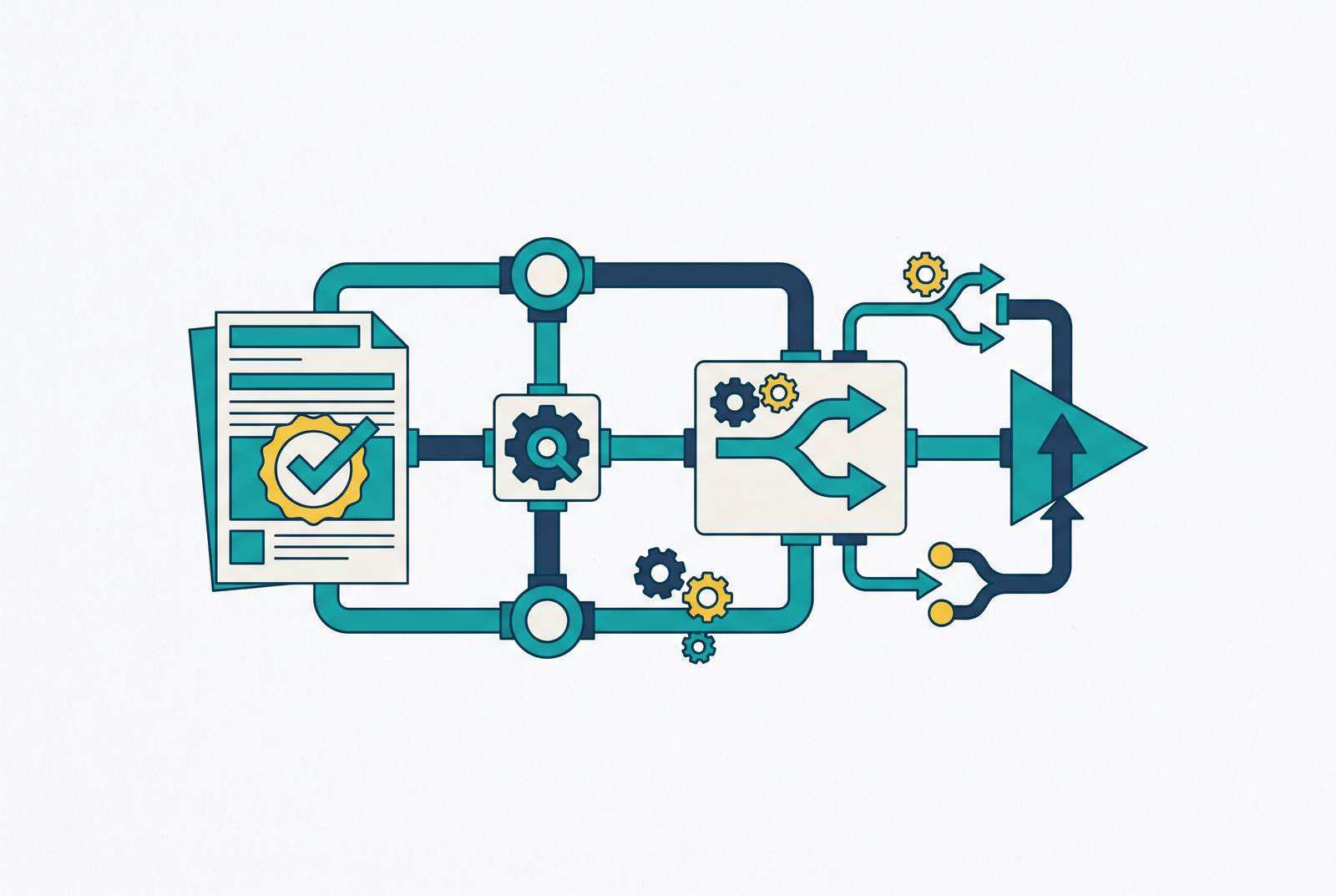
Technical content QA tools belong in CI/CD pipelines because documentation is a shippable artifact. That calls for its own toolchain, with fast checks before merge, deeper tests before release, and human review of claims that automation cannot judge. The right stack connects those gates to the pipeline a team already uses, then tracks failures through to correction.
Why documentation needs its own quality gates in a CI/CD pipeline
Most CI/CD pipelines treat documentation as commentary on the code. That leaves a structural gap in release checks. A passing application test does not establish that a documented API parameter still exists, or that a procedure matches the current UI. Both can mislead users even when the software works as intended. Without a documentation gate, there is no systematic point at which those discrepancies must be resolved.
When users follow wrong instructions into broken configurations, documentation becomes part of the failure path. Code testing can cover that path only if the instructions themselves are used as test inputs. Documentation therefore needs checks that test what it promises, even when the application turns green and is allowed to ship.
How a CI/CD pipeline is structured and where documentation fits
A pipeline separates the work of running checks from the decisions about when to run them. Executors perform the tests, while orchestrators such as GitHub Actions, GitLab CI, and Jenkins schedule them and act on results. A management layer then links those results to requirements and release readiness. Documentation belongs in all three layers. A final check for proofreading alone leaves some of that work undone.
Commit and pre-merge stages are good places for fast checks of links, style, spelling, and code-sample syntax because authors can fix problems before their changes reach the main branch. Build and integration stages test contracts and interactions. Pre-release checks can then compare documentation with the current API specification and staged UI, while checking cross-references in the built content.
The orchestrators: GitHub Actions, GitLab CI, and Jenkins as the foundation
The existing repository platform usually settles the orchestration choice. GitHub Actions keeps workflows in the repository and offers a free tier plus usage-based minutes, making it a low-friction option for GitHub teams. GitLab CI/CD provides the corresponding path for GitLab repositories, using .gitlab-ci.yml and offering free and paid tiers. Jenkins is self-hosted, with an extensive plugin ecosystem and full control over custom workflows. Its flexibility comes with more setup work.
All three can host documentation quality gates. A particular workflow needs different amounts of configuration or glue code on each platform. GitHub Actions and GitLab CI can trigger documentation checks from pull-request comments, while Jenkins supports complex multi-stage builds with conditional gates. Integrate checks before merge. A check that runs only after changes reach the main branch removes the author's opportunity to fix the content within the original review cycle.
Checks that belong in a documentation QA gate: what to run and when
What does it prove when documentation passes a gate? If it checks only spelling and links, it says little about whether readers can use the instructions successfully. Pre-merge coverage should also enforce the team's terminology, heading structure, and voice, with a project-specific spelling allowlist for product names and technical terms. Code blocks need parsing or compilation in their own language. Markup must render without errors, and the build should fail if it has dead links.
Before release, API contract comparison should flag any endpoints, parameters, or response codes in the documentation that differ from those in the current OpenAPI/Swagger specification. Browser tests can check whether the UI steps in the documentation lead to the stated outcome in a staged build. Cross-reference checks should confirm that their targets are in the current documentation build, while version-label checks compare the tags on the documentation with the release version. These slower checks test the content against what is about to ship.
Tools for content linting, link checking, and markup validation
The pre-merge layer has a mature, mostly open-source toolchain. Vale uses style packages for prose linting, which teams install separately from the Vale Package Hub and can add to with project-specific rules. For links, lychee is a fast, Rust-based CLI tool, while htmltest provides another command-line option. Both support allowlists for links intentionally behind authentication or subject to rate limiting. They return a non-zero exit code on broken links, allowing the orchestrator to fail the build.
Markup needs a separate kind of inspection. For Markdown, markdownlint enforces rules such as heading hierarchy and blank-line usage, returning a non-zero exit code on violations. A build-and-check step for Hugo, Docusaurus, or MkDocs catches rendering failures that source linting alone misses.
Codedown extracts fenced code blocks from Markdown so they can be passed to the appropriate language tool. Python snippets can go through py_compile or pytest, JavaScript samples through Node's parser, and shell scripts through shellcheck. Command-line tools use exit codes to tell the orchestrator that a check has failed, so it can act without a custom plugin.
Tools for API contract validation and procedural accuracy testing
API checks need to distinguish a valid specification from a truthful one. Spectral, an open-source tool from Stoplight, lints OpenAPI and AsyncAPI specifications against configurable rulesets. It catches malformed specifications before deeper tests begin. Dredd then reads an API description in OpenAPI or API Blueprint and makes real HTTP calls against a running service to compare documented behavior with implementation. It exits non-zero when the two diverge.
That distinction determines where each tool belongs. Spectral fits pre-merge because it can inspect the specification without waiting for a staged service. Dredd fits pre-release, when the service is available for behavioral validation. A well-formed contract can still describe behavior that the running service does not provide.
Procedural documentation needs the same connection to a running build. Playwright, built by Microsoft, drives Chromium, Firefox, and WebKit from a single API, with bindings for JavaScript/TypeScript, Python, Java, and.NET. A test can encode a documented sequence such as navigating to Settings, clicking Add User, and filling the form, then verify the described outcome in staging. The procedure becomes an executable claim about the product. If a UI change breaks that encoded flow, the test fails.
Environment setup can otherwise obscure what failed. Testcontainers provides ephemeral containers for integration-level documentation tests that depend on a running database or external service, reducing the “works on my machine” problem. For larger procedural suites, Playwright supports test sharding across parallel GitHub Actions runners. That keeps execution time low enough for pre-release use. These checks are achievable with standard open-source tooling rather than a separate, specialized testing platform.
Where AI-assisted generation fits and where human review must hold the gate
AI generation changes how a draft enters the pipeline. One documented pattern uses a pull-request comment to trigger an agent that reads merged code changes, drafts documentation, and opens a pull request for review. Release-note automation works much the same way, using changes that have been merged and a style guide that is versioned. The draft remains subject to a publishing decision.
Review depth should follow the risk of the change. Changes to formatting, links, and small bits of wording can go through automated checks with a quick look from a human. Procedural changes and new parameters need human verification of the claims and their accuracy. That review takes meaningful time because plausible wording is not evidence of correctness. AI-generated content can look orderly while containing subtle inaccuracies that automated checks were never designed to catch.
Contract and browser tests can also check some claims about how the product behaves. But those tests cover only what has been encoded. Human review still has to judge the remaining factual and semantic content, including whether the draft describes the change accurately. A reviewable, reversible workflow preserves the ability to hold any generated suggestion before it ships. That is the quality gate, regardless of who or what produced the draft.
Test management and results traceability across the documentation pipeline
A failed check needs somewhere useful to go. Without results management, documentation pipelines say whether checks pass or fail but have no set path for getting the content fixed. The management layer holds test cases, ingests CI results, links checks to requirements, and reports trends. For documentation, that connection must extend to a named editor or subject-matter expert. A file path identifies where an error appeared, but not who can resolve its underlying claim.
Patterns across runs also change the response a failure deserves. An intermittent link failure caused by rate limiting is different from a consistently broken reference. Likewise, failures accumulating over three sprints present a different risk from a stable pipeline with an isolated problem. Keeping track of flakiness and trends helps keep people from tuning out either kind of failure. Useful controls include representative questions or scenarios, expected outputs, acceptable answer boundaries, and failure classifications, all connected to a route for correction.
Measuring whether published technical content is being found and cited by AI answer engines
Can developers find the content through the AI systems they use for answers? Documentation may pass every release gate and still go uncited while another source is shown instead. ChatGPT, Claude, Gemini, and Perplexity have distinct sourcing architectures, with low citation overlap across engines. Visibility therefore needs platform-specific monitoring rather than an assumption that success in one engine transfers to the others.
Content structure affects that visibility in several ways. Consistent product descriptions across documentation, schema markup, and third-party references reduce ambiguity that can suppress citations. Fact-dense pages with timestamps and one fact per sentence are more reliably retrievable than narrative prose. References on other sites also affect what shows up because AI answers draw much of their content from third-party sources. Documentation confined to a vendor's own domain has a different discovery position from content referenced by external technical communities.
Several tools measure parts of this picture. SE Visible from SE Ranking collects real AI responses to track brands and content across ChatGPT, Perplexity, Gemini, AI Mode, and AI Overviews. GetCito tracks how brands show up across AI search engines and how those systems describe a company. Semrush AI Toolkit extends SEO measurement into citation monitoring across ChatGPT, Perplexity, Gemini, Google AI Mode, and Google AI Overviews.
Traffic provides a separate downstream signal of discovery. GA4 session source filters can separate out referrals from AI platforms for free to show when citations bring people to the site. That does not replace monitoring the answers themselves. The measurement discipline is to track visibility on a cadence tied to publishing and investigate drops as signals of change in the content, the model, or competing coverage.
Putting together a documentation QA pipeline: the practical stack decision
The stack decision starts with the orchestrator already in place, then follows the documentation format and risk profile. For Markdown, a minimum viable gate combines Vale, lychee, and markdownlint with mandatory human editorial review before merge. Those CLI tools work across GitHub Actions, GitLab CI, and Jenkins. OpenAPI-first teams add Spectral and Dredd, while documented UI procedures call for Playwright. Testcontainers supports deeper tests that need isolated service dependencies.
Internal developer documentation may use pre-merge checks and a human editorial pass, while compliance-relevant or security documentation needs the full pre-release layer and a review by a subject-matter expert. Results management connects failures to owners, and AI citation monitoring follows published content into discovery. The practical rule is one tool per job, non-zero failure exits for automated checks, and a named owner for every failure. The stack is the means of treating documentation as a shippable artifact, with the same quality discipline expected of code.